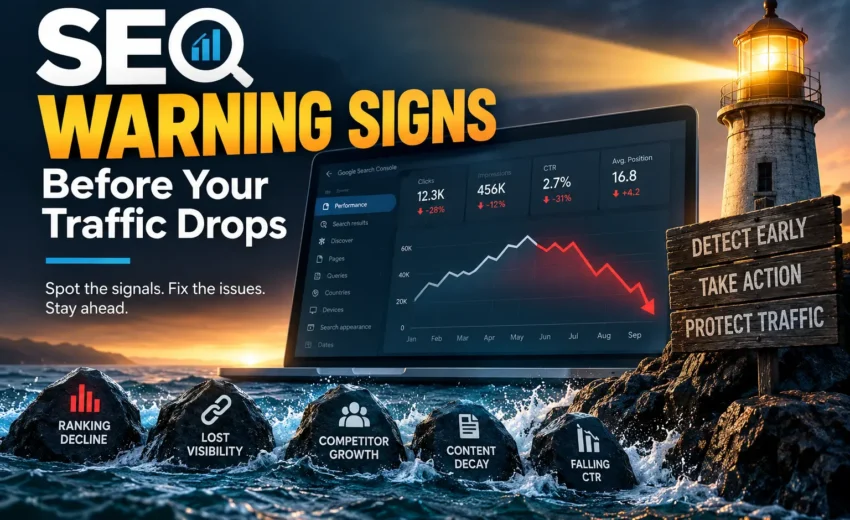
Think of organic traffic like a ship. It rarely sinks overnight. Usually, it takes on water slowly—a small leak here, a crack there. Before Google Analytics flashes a massive red arrow pointing down, these smaller issues are already present. They just aren’t obvious if you are only looking at the total number of visitors.
The biggest mistake in SEO is waiting for the graph to collapse before you start asking questions. The smarter move is to watch the currents beneath the surface.
Why "Total Traffic" is Often a Lie
Let’s cut to the chase. A rising total traffic number often masks a hidden problem.
Imagine your overall visits jump from 100,000 to 120,000. That looks like a win, right? But let’s pull back the curtain. What if your blog posts about general topics brought in an extra 35,000 visitors, while your product and service pages lost 13,000 visitors combined?
Your boss sees the 20% growth and smiles. Meanwhile, your high-intent commercial queries drop by 20%, and organic leads fall by 12%. The website is attracting a crowd, but the crowd is full of readers, not buyers.
That’s why we don’t just chase volume. We chase value. We need to look at Google Search Console to see which parts of our traffic are growing and which valuable parts are quietly falling apart.
Here are the ten specific cracks to look for before the whole ship takes on too much water.
1. Your Most Important Keywords Are Sliding
A one-day dip from position 4 to 5 is just noise. It doesn’t mean anything. But if you see a slow, steady decline—say from position 2 down to 7 over a few weeks—that is a red flag.
This is especially critical for keywords that drive sales or sign-ups. When this happens, don’t just rewrite the page immediately. Ask yourself: Did a competitor update their content? Did Google change the layout of the search results page? Is a different page on your own website now ranking for that term instead?
A ranking decline isn’t a reason to panic; it’s a reason to investigate.
2. Google is Ranking the Wrong Page
This is one of the sneakiest issues in SEO. Let’s say you have a guide about tax relief and a separate page for your tax relief services. You check your ranking report and see you are at Position 4. Great.
But click that link. Is it your service page, or is Google showing the guide? If Google prefers your informational blog post over your money-making service page, you have a problem. You are getting clicks, but from people who just want to read an article, not from people ready to buy.
If Google keeps switching back and forth between these two pages, you have an overlap. You need to decide which page is the “authority” for that topic and guide the search engine toward it through better internal links and clearer intent.
3. Impressions Are Up, But Clicks Are Stagnant
Impressions mean people are seeing your link in the search results. That sounds good, right? But if impressions are skyrocketing while clicks stay flat, your visibility isn’t actually helping you.
Usually, this means you are ranking for broader, less specific terms. For example, if you sell commercial coffee machines and suddenly start ranking for “how to clean a coffee machine,” you’ll get a ton of impressions. But you won’t get many clicks from business owners looking to buy. You are becoming visible, just not for the right reasons.
4. Your High-Intent Queries Are Vanishing
This is related to the point above. If you sort your keyword data by intent, you might notice a scary trend. Informational searches (“what is SEO”) are going up, but commercial searches (“best SEO agency” or “hire SEO consultant”) are going down.
You can report a traffic increase to your team, but your sales pipeline is drying up. Always separate your queries by business intent. If the “buying” keywords are dying, you need to act fast, regardless of how the overall traffic graph looks.
5. Your Click-Through Rate is Crumbling
Click-through rate (CTR) is the percentage of people who see your result and actually click on it. If you have 10,000 impressions and used to get 500 clicks (a 5% CTR), but now you are only getting 300 clicks (3%), something has changed.
Often, this is about your title and meta description. They might be outdated and no longer match what searchers are looking for. Or perhaps Google has added a new “People Also Ask” box or a featured snippet that gives away the answer without the user needing to click. A falling CTR tells you that your link doesn’t look as appealing as it used to.
6. Competitors Are Answering Smarter Questions
Keyword research usually focuses on volume—how many people search for a term. But that can miss the mark. A competitor might be ranking higher not because they have more keywords, but because they are answering the questions your customers are too afraid to ask.
Take an industrial flooring company. You have a page about durability and installation. Your competitor has a page that answers: “Can the warehouse remain open during installation?” and “How fast can we drive forklifts on this floor?”
They are addressing the real, practical fears of a decision-maker. You aren’t. Don’t just copy their keywords. Read their content and ask: What specific, practical concerns are they solving that I am ignoring?
7. The Search Results Page Has Evolved
Don’t just look at your ranking position. Actually go to Google and search for your most important term. Look at the whole page.
Has Google started showing more videos? Are there product carousels at the top? Is there a massive block of “People Also Ask” questions above the regular results?
If the format of the search results has changed, the way you need to compete has changed. You can’t just write a blog post if Google is now prioritizing YouTube videos for that query. The “search experience” has shifted, and your content format might need to shift with it.
8. Blog Traffic is Growing, Sales Traffic is Dying
This is the classic “busy fool” scenario. You are getting more visitors than ever, but they are all landing on your “How To” guides. Meanwhile, your pricing page, product pages, and location pages are losing ground.
You are becoming a free textbook instead of a business solution. If you see your informational content growing while commercial traffic falls, you have a strategy problem. You need to find ways to guide those readers toward your commercial pages, and you need to strengthen the authority of your sales pages.
9. Traffic is Flat, But Revenue is Dropping
This is the most deceptive signal of all. Your organic sessions look stable—maybe down just 1%. But your organic leads have crashed by 25%.
When this happens, the easiest assumption is that the landing page conversion rate is broken. But don’t change the button color just yet. Check the composition of the traffic first.
Chances are, you’ve lost high-intent traffic and gained low-intent traffic. The volume is the same, but the audience is completely different. You are getting more students and fewer buyers. Always look at the quality of the traffic before you blame the website design.
10. Your Best Content Hasn't Been Touched in Years
You wrote a fantastic guide three years ago. It ranked well for a long time. But the internet doesn’t stand still. Competitors have added newer examples, original research, better visuals, and updated statistics.
Your page hasn’t become bad; it has just become average compared to the new standard. You don’t need to rewrite everything every month. You just need to review your most important pages every year and ask: Does this still provide the level of detail and usefulness that searchers expect today?
The Bonus Signal: Lost Internal Pathways
As your website grows, your navigation and internal linking can get messy. That service page that used to have a link right on the homepage might now be buried three menus deep. New blog posts aren’t linking to it. Old articles that linked to it have been deleted.
The page is still indexed, but it has lost its “pathways.” Critical pages should be reachable within a few clicks from your homepage. If they are buried, Google assumes they are less important. Check your most vital pages and make sure they are still well-connected to the rest of your site.
A Quick Approach to Acting on These Signs
Don’t panic-react to a single dip. SEO data is noisy. But if you see three or four of these signals pointing in the same direction, it’s time to take action.
Here is a simple 15-minute routine to keep you safe:
- Open Google Search Console and look at the last 28 days compared to the previous 28 days.
- Sort your queries by the biggest drops in clicks.
- Group those queries by intent. Are you losing commercial or just informational terms?
- Manually search for those terms. Is Google showing the URL you want to rank, or a different one?
- Check Google Trends to see if the overall search demand for that topic has simply dropped for the season.
Once you have the data, choose your action: Monitor it for another week, Investigate the competitor, or Improve the content. Don’t go from “traffic is down” to “rewrite the whole website.”
Good SEO isn’t about changing things constantly. It is about making smart changes when the evidence clearly supports them.
The Bottom Line
Organic traffic is a useful metric, but it is not the whole story. You can have traffic going up while your business is going backward. You can have stable rankings while Google sends people to the wrong page.
Don’t wait for the catastrophic drop to wake you up. Watch the smaller signals. Ask better questions about your commercial visibility.
A traffic graph going up is nice. But a healthy SEO strategy isn’t about the number at the top of the chart. It’s about understanding the story behind that number—and catching the plot twists before they ruin the ending.

Alfik P S
hi
September 4, 2026