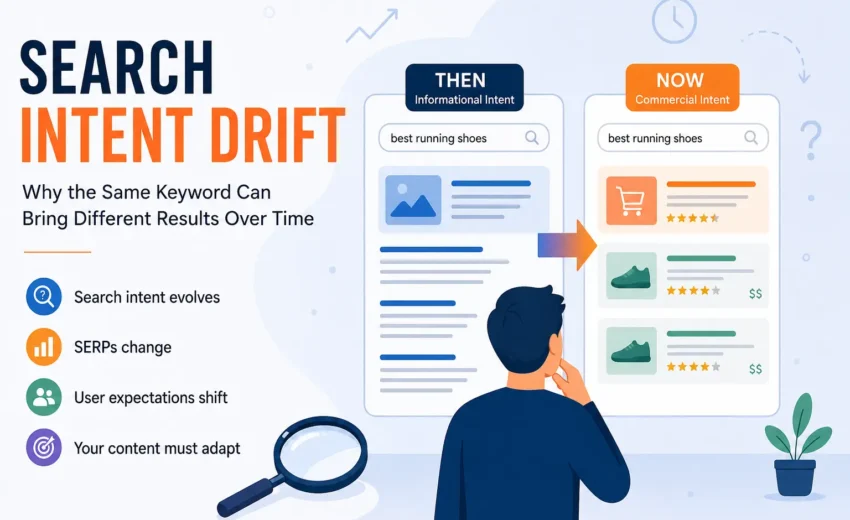
Your keyword hasn’t changed. Your content is still accurate. Traffic is falling anyway.
Most SEOs blame algorithm updates. But there’s a stealthier culprit that’s easier to miss: search intent drift.
Google’s understanding of what users want for a query can evolve dramatically—even when the keyword itself stays exactly the same. A keyword that returned informational articles two years ago might now show product pages, videos, and shopping results.
Your page hasn’t gotten worse. But it may no longer match what searchers actually need.
What Is Search Intent Drift?
Search intent is the underlying goal behind a search query. Common categories include:
- Informational — learning something
- Commercial investigation — comparing options
- Transactional — ready to purchase
- Navigational — finding a specific site
- Local — finding a nearby business
But these aren’t permanent labels. A query that once produced mostly informational articles can eventually produce guides, comparison pages, product pages, reviews, or videos.
The query hasn’t changed. The searcher’s expectation has.
That’s what makes search intent drift different from ordinary keyword research.
Why Can a Good Page Lose Rankings?
Imagine publishing an article called: “Types of Eyeglasses: Shapes, Sizes and Buying Tips”
When published, Google showed mostly informational guides. Your article performed well explaining frame shapes, lens types, sizing, and buying considerations.
A year later, search results increasingly favor ecommerce category pages, product collections, comparison pages, reviews, and pricing information.
Your article hasn’t become worse. But Google now interprets the query as having stronger shopping or commercial investigation intent.
The mismatch: Your page says “Here’s everything you should know” while the SERP says “Here are the products you should compare or buy.”
The problem isn’t content quality. It’s intent alignment.
Types of Intent Drift
1. Informational → Commercial
A query like “email marketing software” shifts from educational explanations toward software comparisons, pricing, features, reviews, and vendor pages.
Fix: Add decision-making information—comparisons, use cases, limitations, pricing context, feature differences. But don’t turn an educational article into an aggressive sales page.
2. Guide → Comparison
“Best website builder” evolves from “teach me” to “help me decide.” A traditional guide explaining how builders work may not satisfy users comparing platforms, pricing, features, and ease of use.
Fix: Restructure your page around the decision, not just the education.
3. Text → Video or Visual Content
“How to change a tire” may increasingly expect step-by-step images, diagrams, or video demonstrations. Google’s guidance confirms that high-quality, relevant images and video provide additional opportunities in Search.
Fix: Don’t abandon text—make the page useful across multiple formats.
4. General → Local
“Taxi service” becomes “taxi from Kochi Airport” or “taxi near my hotel.” Generic national articles struggle when Google shows local businesses, maps, and location-specific results.
Fix: Consider localizing content or creating location-specific resources.
How to Diagnose Intent Drift
Signal 1: Different competitors are ranking
Your page is a blog article, but new top results are product pages, service pages, category pages, or comparison pages. That’s worth investigating.
Signal 2: The SERP looks different
Search the query today and compare with what you remember. Look for:
- Featured Snippets
- People Also Ask
- Video/Image results
- Local/ Shopping results
- AI Overviews
- Discussion forums
A changed SERP doesn’t prove intent drift, but it provides evidence the search experience has evolved.
Signal 3: Clicks fall while impressions stay stable
This can indicate something about the SERP or click opportunity has changed. But don’t immediately conclude intent drift—also investigate CTR, SERP features, ranking position, competitors, and title changes.
Signal 4: Your page hasn’t changed, but its ranking environment has
Compare your unchanged page to the pages above you. That’s often where the clue is.
Start With Google Search Console
GSC is one of the best places to begin. Look at your page’s performance over a meaningful period:
Period | Impressions | Clicks | Average position |
Earlier | 20,000 | 1,100 | 4.8 |
Recent | 19,500 | 650 | 5.1 |
The numbers alone don’t confirm intent drift, but they tell you something deserves investigation.
Now examine the queries producing the decline. Maybe your page used to receive traffic from “what is SEO” but is now increasingly surfaced for “SEO Service in Kochi.” The query mix itself may reveal a changing search journey or audience need.
Then Search the Keyword Yourself
SEO tools show rankings, but when diagnosing intent, look at the actual SERP. Search the query and study the first page.
Ask yourself:
- What kind of pages dominate? Blog articles? Product pages? Comparison pages? Videos? Local businesses?
- What does the content help the searcher do? Learn? Compare? Choose? Buy?
- What information appears repeatedly?
If eight of the top ten results contain comparison tables, pricing information, and product recommendations, but your page is a 2,000-word general introduction, that’s a meaningful content-format mismatch.
Don't Just Copy the Top Results
Finding competitors rank with comparison tables doesn’t mean “add a comparison table because Google likes tables.” The real question is: Why is that table useful to the searcher?
Google’s people-first guidance emphasizes creating content that provides substantial value, original information, analysis, and a satisfying experience—not simply rewriting what already exists.
Competitor analysis should reveal the user’s current need, not give you a template to copy.
Intent Drift vs Content Decay
These concepts are connected but not the same:
- Content decay asks: Why is this page losing performance over time? Possible causes include outdated information, stronger competitors, lost links, declining demand, or technical problems.
- Search intent drift asks: Has the type of result users now expect changed?
Intent drift can be one reason behind content decay, but not every declining page has an intent problem. This distinction saves you from unnecessary rewrites.
Should You Refresh, Restructure, or Rewrite?
What Changed | Recommended Action |
Information outdated | Refresh — Update statistics, replace outdated examples, fix broken links |
Format changed (guide→comparison) | Restructure — Change from educational to decision-support format |
Intent fundamentally different | Rewrite — The page may need a completely different purpose |
Multiple pages competing | Consolidate — Merge similar content into one stronger resource |
Minor temporary fluctuation | Do nothing — Wait and reassess |
What Not to Do
❌ Stuffing more keywords — More keyword variations don’t solve an intent mismatch
❌ Copying competitors — Understand the user’s need, don’t reproduce another website
❌ Adding sections just to make the article longer — Google says there’s no preferred word count
❌ Creating pages for every tiny query variation — More pages don’t automatically mean better coverage
❌ Assuming every ranking drop is intent drift — Check technical problems, demand, competitors, and other explanations first
A 10-Minute Intent Drift Audit
- Open GSC — Check clicks, impressions, CTR, average position, queries
- Identify declining queries — Don’t assume the entire page has the same problem
- Search those queries — Look at today’s SERP
- Identify the dominant intent — What is the searcher trying to accomplish now?
- Identify the dominant page type — Guides? Products? Comparisons? Videos?
- Compare your page — Look for gaps in purpose, format, audience, information, usefulness
- Check Google Trends — Determine whether demand itself has changed
- Check competitors — Look at pages that recently moved above yours
- Decide the smallest effective action — Refresh → Restructure → Rewrite → Consolidate → Leave alone
- Monitor the result — Don’t repeatedly change the page without allowing time to understand the effect
Final Takeaway
Your keyword can stay the same while its search intent changes. That’s why a page can lose rankings even when it still looks perfectly good.
When traffic falls, don’t immediately rewrite the article or blame an algorithm update. First investigate.
Look at Google Search Console to understand what changed. Use Google Trends to check whether demand changed. Search the keyword and study the current SERP. Compare your page with the competitors now winning.
Then make the smallest change that solves the actual problem.
The biggest SEO lesson is simple:
Don’t optimize only for the keyword you targeted yesterday. Optimize for the need the searcher has today.
That is how you turn search intent from a one-time keyword-research exercise into an ongoing part of your SEO strategy.

Alfik P S
hi
September 3, 2026