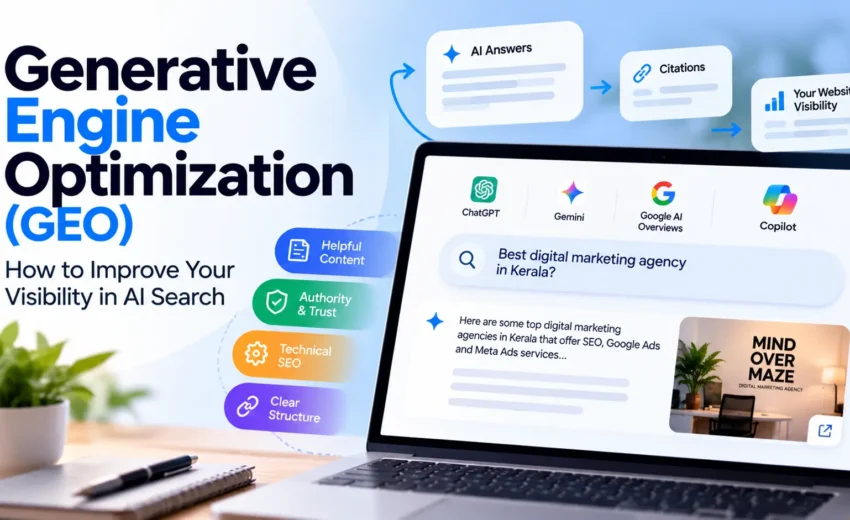
Search is changing. People no longer rely only on Google results to find information about products, services, and businesses. Many now use AI-powered tools such as ChatGPT, Gemini, and Google’s AI search features to ask questions and explore solutions.
This change creates a new opportunity for businesses: making their content easier to discover, understand, and reference in AI-generated answers.
This is where Generative Engine Optimization (GEO) comes in.
In this guide, we will explain what GEO means, how it relates to traditional SEO, and what businesses can do to improve their visibility as search continues to evolve.
What Is Generative Engine Optimization (GEO)?
Generative Engine Optimization is the practice of improving a website’s content and online presence so that it has a better chance of being discovered, referenced, or cited in AI-generated responses.
Traditional SEO focuses on improving a website’s visibility in search engine results. GEO focuses specifically on visibility within generative AI experiences, where systems may combine information from different sources to answer a user’s question.
For example, someone looking for a digital marketing agency might ask an AI tool to compare agencies, explain their services, or recommend what to look for when choosing a provider.
If a business publishes clear, relevant, trustworthy information about its services and expertise, that content may be useful to systems answering related questions.
However, there is no guaranteed method to make an AI tool mention or recommend a particular business. Visibility depends on the platform, the user’s query, available information, and the system’s selection process.
How Does GEO Work?
AI search experiences can use different methods to find information and generate answers. Some retrieve relevant web pages before producing a response, while others may rely on different sources or techniques.
A simplified retrieval-based process looks like this:
- A user asks a question. The AI system receives a request about a topic, product, service, or problem.
- Relevant information is retrieved. Depending on the platform, the system may search an index or access other available sources.
- Useful information is evaluated. The system identifies content that appears relevant to the question and its context.
- An answer is generated. The AI combines information into a response and may provide links or citations to supporting sources.
This process is often associated with Retrieval-Augmented Generation (RAG). Not every AI platform works in exactly the same way, so GEO should not be treated as a single technical formula.
For website owners, the practical goal is to create useful content that can be accessed, understood, and trusted.
Why Is AI Search Visibility Important for Businesses?
AI search gives users another way to research businesses, compare services, and understand their options.
For businesses, this creates several potential opportunities.
1. Reach People During Research
Users may ask AI tools questions before they are ready to contact a company. Useful content can help a business become part of the information people discover during this research stage.
2. Demonstrate Expertise
Detailed service pages, practical guides, original insights, and accurate explanations can help communicate what a business knows and how it helps customers.
3. Build Brand Awareness
A business may gain visibility when its website or brand is referenced in relevant AI-generated responses. Whether this happens depends on the platform and query.
4. Support the Customer Journey
People may use AI tools to understand a problem, compare possible solutions, and decide what to do next. Content that answers these questions can support potential customers throughout that journey.
GEO does not replace other marketing channels. It is an additional consideration within a broader strategy for online visibility.
How to Improve Your Website for GEO
There is no universal GEO checklist that guarantees AI citations. However, several practical improvements can strengthen your website’s usefulness and discoverability.
1. Create Helpful, Original Content
Content should provide genuine value rather than simply repeat information already available across many websites.
Answer the questions your audience actually asks. Explain processes clearly, address common problems, and include original insights from your work where possible.
For example, a digital marketing agency can publish a practical guide on how businesses should evaluate lead-generation campaigns, including which metrics matter and how to interpret the results.
Original experience and useful information give readers a reason to choose your content over a generic explanation.
2. Answer Important Questions Clearly
Organise your articles around the main questions your audience wants answered.
Use descriptive headings, concise explanations, and relevant supporting details. Provide a direct answer near the beginning of a section, then explain the reasoning or steps that follow.
This makes the page easier for people to read and helps clarify its purpose.
You do not need to shorten every paragraph or divide content into tiny sections specifically for AI. Choose a structure that serves the topic and the reader.
3. Strengthen Your Website’s Technical SEO
Your content needs to be discoverable before it can contribute to search visibility.
Review the technical foundations of your website, including:
- Important pages can be crawled and indexed.
- Robots.txt and noindex directives are configured appropriately.
- XML sitemaps include relevant, indexable URLs.
- Internal links help visitors and search engines discover important pages.
- Pages work well on mobile devices and load reliably.
- Canonical tags are configured correctly where needed.
These practices support traditional search visibility and can also help with eligibility for AI search experiences. Meeting technical requirements does not guarantee that a page will be selected or cited. <Cite refs={[“turn291532search4”]}/>
4. Demonstrate Experience and Expertise
Businesses should make it easy for visitors to understand who created their content and why they are qualified to discuss the topic.
Depending on your website and industry, useful signals may include:
- Accurate author biographies.
- Clear business and contact information.
- Detailed service descriptions.
- Original case studies and documented results.
- Practical explanations based on real work.
- Consistent, accurate information about the business.
Avoid making unsupported claims or publishing case studies that cannot be verified. Trust should come from the quality and accuracy of the information you provide.
5. Build Relevant Topical Coverage
A single article may not answer every question a potential customer has about a subject.
Create related content that covers the main topic from useful angles, and connect those pages through relevant internal links.
For example, a digital marketing agency could publish related guides about keyword research, technical SEO, content optimisation, search performance measurement, and AI search visibility.
This helps readers explore the subject in greater depth and gives your website a clearer content structure.
Avoid publishing multiple pages that repeat the same information simply to target slight variations of a keyword.
6. Use Structured Data Where Appropriate
Structured data helps search engines interpret certain types of information about a page or entity.
Depending on the page, relevant schema types may include Organization, Article, BreadcrumbList, or LocalBusiness.
Use only markup that accurately represents the visible content and follows the relevant guidelines.
Structured data can support your overall SEO strategy, but there is no special GEO schema that guarantees inclusion in AI-generated answers. Google states that its generative AI search features do not require special AI-specific markup. <Cite refs={[“turn291532search1”]}/>
7. Review AI Crawler Accessibility
Some AI services use their own crawlers to discover and retrieve publicly accessible website content.
If you want your content to be discoverable in ChatGPT search, for example, check that your robots.txt file and website security configuration do not unintentionally block OAI-SearchBot.
Crawler access differs by platform, and allowing a crawler does not guarantee that your content will appear in an answer. Review each platform’s official documentation before changing your settings. <Cite refs={[“turn291532search0″,”turn291532search8”]}/>
Common GEO Mistakes to Avoid
As interest in AI search grows, businesses may encounter optimisation advice that promises quick results. Distinguish practical improvements from unsupported claims.
Avoid these common mistakes:
- Abandoning traditional SEO: Technical SEO, helpful content, and sound website structure remain important.
- Publishing large amounts of generic AI content: Content that adds little original value may not serve readers well.
- Assuming keyword repetition guarantees AI citations: Relevant terminology helps explain a topic, but repeating phrases unnaturally is not a reliable strategy.
- Adding unnecessary structured data: Use schema that accurately describes your content rather than adding markup solely to target AI.
- Creating artificial brand mentions: Focus on genuine expertise, useful contributions, and credible references instead of manufactured mentions.
- Trusting guaranteed GEO rankings: No agency or tool can guarantee that an independent AI platform will cite a specific page.
Google’s guidance specifically emphasises valuable, original content and cautions against relying on supposed GEO or AEO shortcuts. <Cite refs={[“turn291532search1″,”turn291532search12”]}/>
How to Measure GEO Performance
Measuring AI search visibility can be more difficult than tracking traditional organic search because reporting varies by platform.
Still, businesses can monitor several useful indicators.
AI Referral Traffic
Use website analytics to identify visits from AI platforms when referral information is available. Review how these visitors engage with your website and whether they complete valuable actions.
Brand Mentions and Citations
Periodically check relevant questions in AI search tools to understand whether your brand or website appears in responses. Results may vary by query, location, account, and time, so treat these checks as observations rather than definitive rankings.
Conversions and Enquiries
Measure enquiries, sign-ups, purchases, or other business outcomes associated with available referral data. A mention alone does not necessarily create business value.
Traditional SEO Performance
Continue monitoring organic impressions, clicks, indexed pages, rankings, and conversions through tools such as Google Search Console and website analytics.
These indicators help you evaluate your broader search strategy. Do not rely on a single GEO score or assume that third-party tools have access to the internal ranking systems of AI platforms.
A Practical GEO Checklist for Businesses
Before investing in specialised AI optimisation services, review these fundamentals:
- Important pages are accessible to relevant crawlers.
- Key content is indexed where appropriate.
- Articles answer real customer questions.
- Content provides original insights and accurate information.
- Headings and internal links create a clear structure.
- Business details and author information are accurate.
- Structured data is relevant and correctly implemented.
- Analytics tracks useful traffic and conversions.
- Content is reviewed and updated when necessary.
Start with the areas that need improvement instead of trying to implement every possible tactic at once.
Final Thoughts
Generative Engine Optimization reflects a broader change in how people discover and evaluate information online. As AI-powered search experiences become more common, businesses have an opportunity to make their expertise easier to discover and understand.
However, GEO is not a replacement for traditional SEO, and there is no guaranteed shortcut to appearing in AI-generated answers.
The strongest starting point is a technically sound website with accurate business information, helpful original content, clear structure, and a consistent focus on the needs of your audience.
For digital marketing agencies and businesses alike, the goal is not simply to appear in an AI answer. It is to become a useful, credible source that helps people make informed decisions.


October 23, 2026