Generating leads is an important part of digital marketing, but not every lead is ready to become a customer. Some people are still researching their options, while others are ready to speak with a sales team and make a purchase decision.
This is where Marketing Qualified Leads (MQLs) and Sales Qualified Leads (SQLs) become important.
Understanding the difference between these two types of leads helps businesses identify potential customers, improve follow-up, and make their marketing and sales activities more effective.
What Is a Marketing Qualified Lead (MQL)?
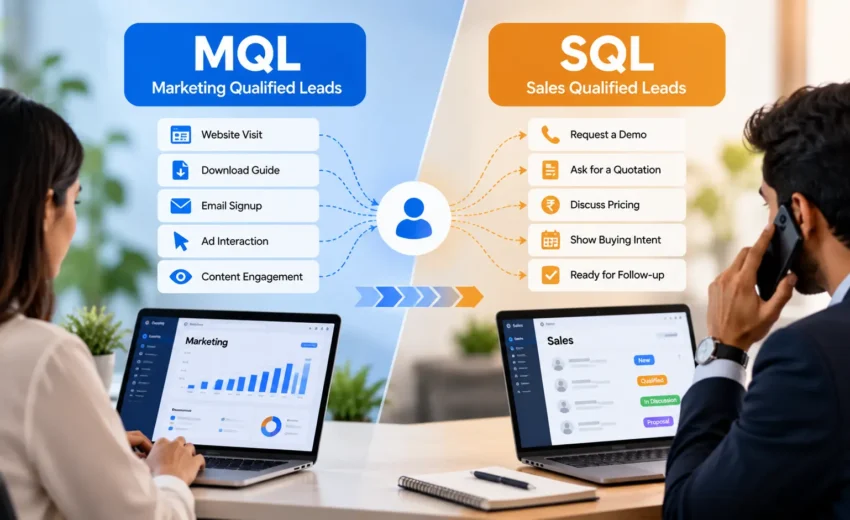
A Marketing Qualified Lead is a potential customer who has shown interest in a business’s products or services and meets certain criteria set by the marketing team.
These leads have engaged with the business in some way, but they may not be ready to make a purchase yet.
For example, someone might download a guide, sign up for a webinar, visit important service pages, or submit an enquiry to learn more about a product.
These actions can indicate interest, but they do not automatically mean the person is ready to buy.
The marketing team evaluates the lead’s behaviour and available information to decide whether they should receive further marketing communication or be passed to sales for review.
The main goal of an MQL is to identify people who show potential and may become customers with further engagement.
What Is a Sales Qualified Lead (SQL)?
A Sales Qualified Lead is a potential customer who has been assessed as having a stronger likelihood of moving forward with a purchase and is ready for direct sales engagement.
An SQL may have a clear requirement, a suitable budget, a relevant business need, or an intention to purchase within a reasonable timeframe.
For example, a person who requests a product demonstration, asks for a quotation, or discusses pricing and implementation may be ready for a sales conversation.
The sales team reviews the lead’s needs and suitability before deciding on the next steps.
However, being an SQL does not guarantee a sale. It means the lead is considered suitable for active sales follow-up.
The main goal of an SQL is to identify potential customers who are ready for a more direct sales conversation.
MQL vs SQL: Key Differences
Both MQLs and SQLs are potential customers, but they represent different stages of the lead qualification process.
Factor
Marketing Qualified Lead (MQL)
Sales Qualified Lead (SQL)
Main focus
Interest and engagement
Purchase readiness
Usually managed by
Marketing team
Sales team
Buying stage
Often researching or considering options
Usually closer to a purchase decision
Qualification
Based on marketing criteria and engagement
Based on sales assessment and buying needs
Typical next step
Nurturing and further qualification
Direct sales follow-up
Main objective
Build interest and identify potential
Move suitable opportunities towards a sale
The exact criteria can vary depending on the business, industry, product, and sales process.
How Does an MQL Become an SQL?
The transition from MQL to SQL happens when a lead shows stronger buying intent and meets the business’s agreed qualification criteria.
This process usually involves a few steps.
1. Lead Generation
The process starts when someone interacts with a business through a marketing channel, such as a website, search advertisement, social media campaign, or downloadable resource.
The business collects relevant information and records the lead in its lead management system.
2. Marketing Qualification
The marketing team evaluates the lead based on relevant actions and information. This might include the person’s interests, business requirements, engagement with content, or fit with the target audience.
Not every new lead should automatically be classified as an MQL.
3. Lead Nurturing
If the lead is interested but not ready to buy, the marketing team can continue providing useful information through email campaigns, educational content, remarketing, or other relevant communication.
The aim is to help the lead understand the offer and make an informed decision.
4. Sales Qualification
When the lead demonstrates stronger buying intent, it can be passed to the sales team.
Sales representatives assess the lead’s requirements, suitability, budget where relevant, and readiness to move forward.
If the lead meets the agreed criteria, it becomes an SQL and enters the sales process.
5. Sales Follow-Up
The sales team contacts the qualified lead to discuss requirements, answer questions, arrange a demonstration, provide a proposal, or agree on the next step.
A lead may still need further nurturing if the timing is not right.
Why Is the Difference Important for Digital Marketing?
Understanding the difference between MQLs and SQLs helps businesses measure the effectiveness of their marketing beyond the number of leads generated.
Better Lead Quality
Marketing teams can focus on attracting people who match the business’s target audience rather than prioritising lead volume alone.
More Effective Sales Follow-Up
Sales teams can spend more time on leads that meet agreed qualification criteria instead of contacting every enquiry with the same level of priority.
Improved Marketing Performance Measurement
A campaign that generates many leads may not necessarily generate many sales opportunities. Tracking MQLs and SQLs helps businesses understand whether their marketing efforts are attracting relevant prospects.
Better Alignment Between Marketing and Sales
When both teams agree on what makes a lead qualified, fewer suitable leads are overlooked, and the handover process becomes clearer.
More Efficient Use of Budget
Businesses can review which campaigns generate qualified leads and customers, then make better decisions about how to allocate their marketing budget.
How Can Businesses Track MQLs and SQLs?
A clear lead management process makes it easier to understand how potential customers move through the sales funnel.
Businesses can use a Customer Relationship Management (CRM) system to record lead details, track interactions, assign lead stages, and monitor follow-up activities.
Useful metrics include:
Number of MQLs: How many leads meet the marketing qualification criteria.
Number of SQLs: How many leads meet the sales qualification criteria.
MQL-to-SQL conversion rate: The percentage of MQLs that become SQLs.
Lead-to-customer conversion rate: The percentage of leads that eventually become customers.
Cost per qualified lead: How much it costs to generate a qualified lead.
These metrics help businesses identify where leads are progressing successfully and where improvements may be needed.
For example, if a campaign generates many MQLs but very few SQLs, the business may need to review its audience targeting, advertising message, lead form questions, or qualification criteria.
Common Mistakes to Avoid
Businesses sometimes treat every enquiry as a sales-ready opportunity. This can lead to wasted sales effort and poor follow-up experiences.
Other common mistakes include:
Defining MQLs and SQLs without clear criteria.
Passing leads to sales before they are ready.
Delaying follow-up after a lead becomes sales-qualified.
Measuring campaign success only through total leads or cost per lead.
Failing to share feedback between marketing and sales teams.
To avoid these problems, businesses should regularly review lead quality, agree on qualification standards, and use sales outcomes to improve future marketing campaigns.
Final Thoughts
Marketing Qualified Leads and Sales Qualified Leads are two important stages in the lead qualification process. MQLs show that a potential customer has demonstrated interest and may need further nurturing, while SQLs have been assessed as suitable for more direct sales engagement.
For digital marketers, the goal should not be limited to generating more leads. It should also be to attract relevant prospects, improve lead quality, and help the sales team convert suitable opportunities into customers.
When marketing and sales teams work together with clear qualification criteria, businesses can build a more effective lead generation process and make better use of their marketing investment.