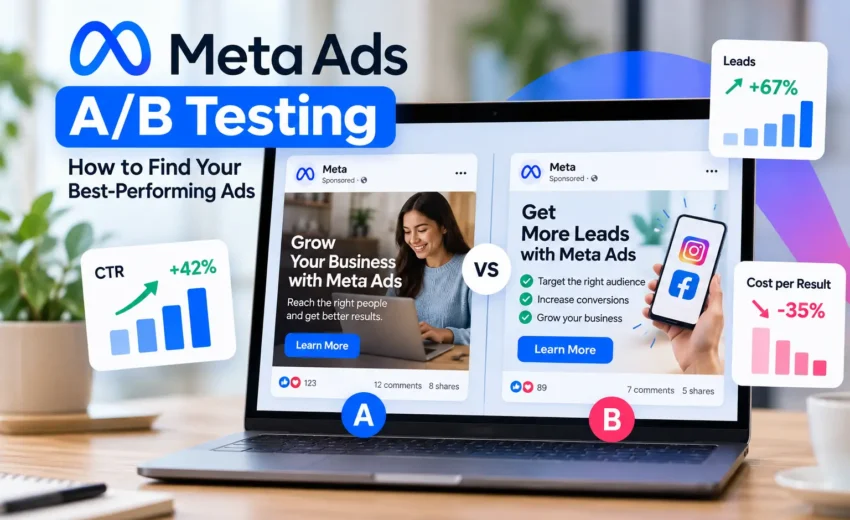
Running Meta Ads is not just about creating an attractive advertisement and setting a budget. Even a well-designed ad may not deliver the results you expect. Sometimes, a simple change in the headline, image, audience, or call to action can make a difference in campaign performance.
This is where A/B testing becomes useful. It helps marketers compare different versions of an ad, understand what works better, and make decisions based on actual campaign data rather than assumptions.
In this guide, we will explore how Meta Ads A/B testing works, what you should test, and how to use the results to improve your advertising campaigns.
What Is A/B Testing in Meta Ads?
A/B testing is a method of comparing two versions of an advertisement to understand which one performs better against a specific objective.
For example, you might compare two ad creatives promoting the same service. One uses a static image, while the other uses a video. By testing them under comparable conditions, you can evaluate which creative generates better results.
The goal is to identify which variation performs better for your chosen objective, such as generating leads, increasing purchases, or encouraging messaging conversations.
A/B testing can be useful for businesses of all sizes because it helps reduce guesswork and supports more informed advertising decisions.
Why Is A/B Testing Important for Meta Ads?
Without testing, marketers may continue using advertisements based on personal preferences rather than audience response.
A/B testing helps you:
- Improve campaign performance: Identify the creative, message, or audience that produces better results.
- Use your budget more effectively: Learn which approach deserves further investment.
- Understand your audience: Discover which messages, offers, and formats attract potential customers.
- Make data-driven decisions: Use campaign results instead of relying only on opinions.
- Improve future campaigns: Apply successful findings to new advertisements.
However, A/B testing does not guarantee better performance. Its value depends on how the test is designed, how much data it collects, and whether the results are interpreted correctly.
What Should You Test in Meta Ads?
You can test several elements of your campaigns. The important thing is to choose a clear variable for each test.
1. Ad Creatives
Your creative is one of the most visible parts of your advertisement. It can influence whether someone stops scrolling and pays attention.
You can compare:
- Static images against videos.
- Different product or service visuals.
- Different opening scenes in a video.
- Customer-focused creatives against product-focused creatives.
For example, a business promoting a service could compare a professionally designed graphic with a short video explaining the service’s benefits.
2. Ad Copy and Headlines
The wording of your advertisement can influence how people understand your offer and whether they take action.
Test different approaches, such as a headline focused on a customer problem versus one focused on a benefit. You can also compare different introductory messages while keeping the rest of the advertisement consistent.
Make sure each version communicates the offer clearly and accurately.
3. Call to Action
Your call to action tells people what to do next.
Depending on your campaign, you might compare suitable options such as Learn More, Sign Up, or Contact Us. The available options depend on the ad format and campaign setup.
Choose a CTA that matches the action you want people to complete. A button that attracts clicks is not necessarily the best choice if those clicks do not lead to meaningful results.
4. Audience Targeting
Audience testing helps you understand which eligible audience is more likely to respond to your offer.
For example, you could compare two relevant audience groups while keeping the creative, offer, and campaign objective consistent.
Avoid changing several targeting settings simultaneously. Otherwise, it becomes difficult to determine what caused the difference in performance.
5. Offers and Messaging
You can also compare different ways of presenting the same product or service.
One advertisement might emphasize convenience, while another highlights a particular customer benefit. Alternatively, you could test two different offers if both are commercially appropriate.
Keep the test focused so that the results provide a useful lesson for future campaigns.
How to Run an A/B Test in Meta Ads
A structured process makes your testing more reliable and easier to understand.
Step 1: Define Your Goal
Start by deciding what you want to improve.
Your objective might be to generate more qualified leads, increase purchases, reduce cost per result, or generate more valuable messaging conversations.
Choose a primary performance metric that reflects this goal. For example, if your campaign is designed to generate leads, cost per qualified lead may be more useful than click-through rate alone.
Step 2: Create a Clear Hypothesis
Before launching the test, write down what you expect to happen and why.
For example, you might believe that a short demonstration video will generate more qualified leads than a static image because it explains the service more clearly.
A clear hypothesis gives the test a purpose and helps you interpret the results afterwards.
Step 3: Change One Main Variable
Create two variations that differ in the element you want to test.
If you are testing creatives, keep the audience, offer, copy, and other major settings as consistent as possible. If you are testing audiences, use the same creative and offer for both groups.
For a more controlled experiment, Meta’s A/B testing feature can help compare variations by separating audiences and reducing overlap, depending on the test setup.
Step 4: Set a Suitable Budget and Duration
Your test needs enough budget and time to collect meaningful results.
The amount required depends on your objective, expected cost per result, audience size, and conversion volume. A campaign with very few conversions may not provide enough evidence to identify a reliable winner.
Avoid ending a test too early because one variation has temporarily performed better. Also, avoid making frequent changes during the test, as they can make the results harder to interpret.
Step 5: Monitor the Right Metrics
Review the metrics that match your campaign goal.
For a lead generation campaign, useful metrics may include:
- Number of leads generated.
- Cost per lead.
- Lead quality.
- Conversion rate.
- Amount spent.
For a sales campaign, purchases, cost per purchase, conversion value, and return on ad spend may be more relevant.
Metrics such as reach, impressions, CTR, and CPC can help explain performance, but they should not automatically determine the winner.
Step 6: Compare the Results
Once the test has collected enough data, compare both variations using the same primary metric and testing period.
Consider both the cost and the quality of the results. An advertisement that generates inexpensive leads may still be less valuable if those leads are unlikely to become customers.
If the difference is small or the data is limited, the result may be inconclusive. In that situation, further testing may be more useful than immediately declaring a winner.
Step 7: Apply What You Learn
If one variation clearly performs better, consider using the finding in your future campaigns.
You can then test another variable to continue improving performance. Keep a record of what you tested, the results, and what you learned so that future decisions are based on accumulated campaign knowledge.
Common Mistakes to Avoid in Meta Ads A/B Testing
Even when a test appears straightforward, a few mistakes can lead to misleading conclusions.
Testing too many variables at once: If you change the creative, headline, audience, and offer together, you cannot easily identify which change influenced performance.
Ending tests too early: Early results may fluctuate, especially when conversion numbers are low. Give the test enough time and data to produce a useful comparison.
Choosing the wrong success metric: A high CTR may indicate that an advertisement attracts attention, but it does not necessarily mean the ad generates sales or qualified leads.
Making frequent changes during testing: Editing budgets, targeting, or creatives during a test can make comparisons less reliable.
Ignoring lead or customer quality: The lowest cost per result is not always the best business outcome. Consider what happens after the initial conversion.
Assuming every test needs a winner: Sometimes, the evidence is insufficient to establish a meaningful difference. Recognizing an inconclusive result is better than making an unsupported decision.
How Often Should You Run A/B Tests?
There is no single testing schedule that works for every business. It depends on your budget, campaign volume, conversion frequency, and how quickly your audience responds.
Businesses with larger budgets and higher conversion volumes may be able to test more frequently. Smaller advertisers may need to focus on one important question at a time.
A practical approach is to prioritize the change most likely to improve business results, run a controlled test, document the findings, and use those findings to plan the next experiment.
You should also avoid testing simply for the sake of testing. Every experiment should help answer a meaningful marketing question.
Final Thoughts
Meta Ads A/B testing helps marketers understand which advertising approaches work better for their audiences and campaign objectives. By testing creatives, copy, audiences, and offers in a structured way, you can make more informed decisions about where to invest your advertising budget.
Start with a clear goal, change one main variable at a time, measure the right results, and give the test enough time to produce useful evidence. Most importantly, evaluate performance based on business outcomes rather than clicks or engagement alone.
Consistent testing and careful analysis can help you improve your Meta Ads strategy over time.


October 14, 2026