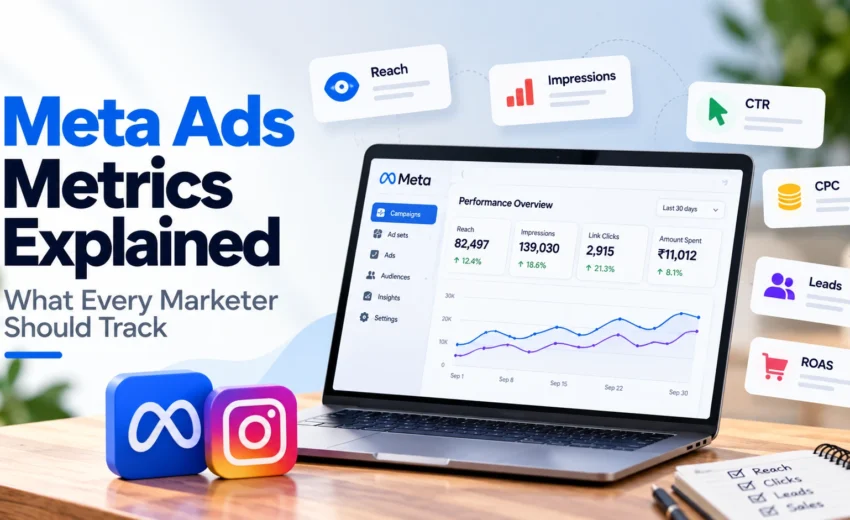
Running Meta Ads is not just about spending money and checking how many people saw your advertisement. To understand whether a campaign is working, you need to know which metrics to track and what they tell you about your results.
Meta Ads Manager provides data on ad delivery, clicks, engagement, leads, purchases, and advertising costs. The challenge is knowing which numbers matter most for your campaign.
For example, a campaign designed to generate WhatsApp enquiries should not be evaluated in the same way as a campaign focused on online sales. Each campaign has a different goal, and your performance analysis should reflect that.
In this guide, we’ll look at the important Meta Ads metrics, explain what they mean, and discuss how to use them to evaluate campaign performance.
What Are Meta Ads Metrics?
Meta Ads metrics are measurements that show how your advertisements perform across Facebook, Instagram, and other Meta placements.
They help you understand whether your ads are reaching people, encouraging them to take action, and delivering results within your budget.
However, no single metric can tell you everything about a campaign. Impressions show exposure, clicks indicate interaction, and conversion metrics help you understand whether people are completing the actions you want.
The best approach is to look at these measurements together and connect them to your business objectives.
1. Reach and Impressions
Reach and impressions are two basic metrics that help you understand how your advertisements are being delivered.
Reach is the estimated number of people or accounts that saw your advertisement during a selected period.
Impressions represent the number of times your advertisement was displayed. The same person can contribute multiple impressions.
These metrics are particularly useful for awareness campaigns. They help you understand how widely your advertisement is being distributed and how much exposure it receives.
However, high reach and impressions do not automatically mean that your campaign is successful. If your goal is to generate leads or sales, you also need to evaluate the actions people take after seeing the advertisement.
2. Frequency
Frequency measures the average number of times each reached person saw your advertisement.
It is calculated by dividing impressions by reach.
Frequency helps you understand how often your audience is exposed to your ad. If people repeatedly see the same creative, you may need to review its performance and consider whether a new message or creative variation would be useful.
However, a high frequency is not always a problem. Some audiences need several exposures before taking action. The right level depends on your campaign objective, audience, offer, and results.
3. CPM: Cost Per 1,000 Impressions
CPM measures the average amount you pay for every 1,000 impressions.
It helps you understand the cost of delivering your advertisement to an audience.
A lower CPM can allow your budget to generate more impressions, but it does not necessarily mean the campaign is performing better. Your ad might reach people at a low cost without generating meaningful engagement, enquiries, or sales.
Use CPM to understand advertising delivery costs, then evaluate it alongside the metrics that reflect your campaign’s actual objective.
4. CTR: Click-Through Rate
CTR measures the percentage of impressions that resulted in a particular type of click.
For campaigns designed to send people to a website, link CTR is often more relevant than CTR (all), which includes other types of clicks.
A higher link CTR can indicate that your advertisement is encouraging people to visit your destination. If the CTR is low, review the creative, message, offer, and audience relevance.
However, CTR does not tell you whether those clicks lead to valuable outcomes. People may click an advertisement without completing an enquiry or purchase.
That is why CTR should be evaluated alongside website activity and conversion performance.
5. CPC: Cost Per Click
CPC measures the average cost of the type of click specified in your reporting.
For website traffic campaigns, marketers often track cost per link click to understand how much they are spending to generate visits through ad links.
CPC is useful for evaluating traffic costs and comparing campaign performance. However, cheaper clicks are not always better.
If a campaign generates inexpensive clicks but attracts visitors who are unlikely to become customers, the low CPC may not contribute much business value.
Look at what happens after the click before deciding whether your advertising spend is being used effectively.
6. Results and Cost Per Result
Results refer to the outcomes reported for your campaign, depending on its objective and performance settings. These may include leads, messaging conversations, purchases, or other actions.
Cost per result shows the average amount spent to generate each reported result.
This is an important metric because it connects advertising costs with the outcome you want to achieve.
However, the meaning of a result depends on your business. A messaging conversation may not become a qualified enquiry, and a lead may not turn into a sale.
When evaluating cost per result, consider the quality and value of the results rather than focusing only on their quantity.
7. Conversion Rate
Conversion rate measures how effectively a defined group of visitors or clicks completes a desired action.
The calculation depends on what you are measuring. For example, a website conversion rate might represent the percentage of landing page views that result in a lead or purchase.
Conversion rate helps you understand whether your advertising is bringing people who take the next step.
If your campaign receives clicks but generates few conversions, review the landing page, offer, user experience, and audience relevance. Tracking problems can also affect the results, so confirm that your conversion events are configured correctly.
Improving campaign performance sometimes requires improving the website experience rather than changing the advertisement itself.
8. Cost Per Lead (CPL)
Cost per lead measures the average advertising spend required to generate a lead.
This metric is useful for businesses that use Meta Ads to collect enquiries through instant forms, websites, or other lead-generation methods.
A lower CPL can make lead generation more affordable, but it should not be the only measure of success.
Some campaigns generate many leads that are irrelevant or unlikely to become customers. Others generate fewer leads but attract people who are more likely to purchase.
For this reason, businesses should evaluate lead quality alongside CPL. The real objective is not simply to generate more leads, but to generate leads that support business growth.
9. ROAS: Return on Ad Spend
ROAS measures the revenue attributed to advertising compared with the amount spent on ads.
It is calculated by dividing attributed revenue by advertising spend.
ROAS is particularly useful for e-commerce businesses and campaigns where purchase values can be tracked reliably.
However, reported ROAS is not the same as profit. It does not automatically account for product costs, shipping, taxes, salaries, or other operating expenses.
It also depends on attribution settings and measurement. Reported revenue should not be interpreted as proof that advertising alone generated every sale.
Use ROAS alongside your business costs and sales data to understand whether your advertising is financially worthwhile.
10. Landing Page Views and Engagement
Landing page views help you understand how many visits Meta records after people click through to your website and the destination page loads.
Comparing landing page views with link clicks can reveal possible issues with page loading, redirects, mobile usability, or measurement.
Engagement metrics, meanwhile, show how people interact with your advertisements. Depending on the ad format, these interactions can include reactions, comments, shares, and other actions.
Both types of metrics are useful, but their importance depends on your campaign goal. Engagement may be valuable for an awareness campaign, while landing page views may be more relevant when sending visitors to a website.
Neither metric should be treated as a substitute for leads or sales when those are your primary objectives.
Which Meta Ads Metrics Should You Focus On?
The metrics you prioritize should depend on what you want your campaign to achieve.
For awareness campaigns, focus on reach, impressions, frequency, and CPM. For website traffic campaigns, pay attention to link CTR, cost per link click, and landing page views.
For lead generation, prioritize leads, cost per lead, lead quality, and conversion rate. If your campaign generates messaging conversations, evaluate the cost and quality of those conversations.
For e-commerce campaigns, purchases, cost per purchase, attributed revenue, and ROAS are generally more relevant.
You can still monitor other metrics, but your main decisions should be based on the results that matter most to your business.
How to Use Meta Ads Metrics to Improve Campaign Performance
Reviewing metrics is useful only when the information helps you make better decisions.
Start by checking whether your campaign is reaching the intended audience and whether people are responding to the advertisement. Next, evaluate what happens after they click or interact with it.
If people click but do not convert, investigate the landing page, offer, and tracking setup. If leads are coming in but few turn into customers, examine lead quality and the follow-up process.
Avoid making changes based on one metric alone. Consider the campaign objective, the amount of data available, and any recent changes to your budget, audience, or creative.
This approach helps you identify areas that need attention without making unnecessary changes to a campaign that may already be performing well.
Final Thoughts
Meta Ads metrics help you understand how your advertisements are delivered, how people respond, how much results cost, and whether your campaigns are achieving their goals.
The important thing is not to track every number equally. Choose the metrics that match your campaign objective, understand what each one measures, and evaluate the results in context.
For better decisions, look beyond impressions and clicks. Pay attention to the quality of your leads, the actions people take, and the value your campaigns contribute to the business.
Successful Meta Ads management is not about chasing impressive numbers. It is about understanding performance and using that information to make better advertising decisions.


October 12, 2026