For years, SEO has been closely connected with keywords. Find what people search for, include those terms in your content, optimize the page, and try to rank higher.
Keywords are still important. But search has become more sophisticated.
Search engines don’t only look at the words on a page. They also try to understand what those words refer to, how different concepts are connected, and what information a page provides about a subject.
This is where entity SEO comes in.
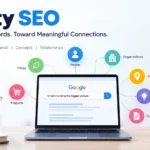
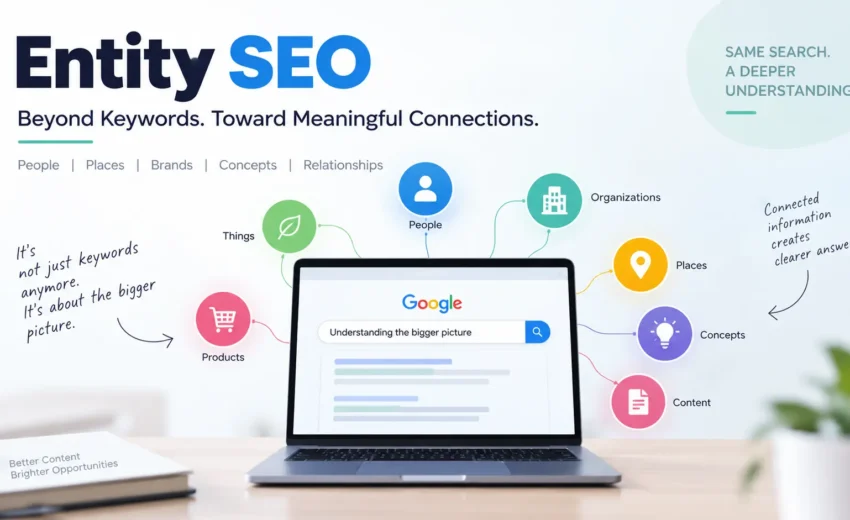
Entity SEO focuses on the people, places, organizations, products, concepts, and other identifiable things discussed in content. It also considers the relationships and context surrounding them. Search Engine Land and Ahrefs both describe entity-based SEO as a move beyond simple keyword matching toward better understanding of entities, context, relationships, and meaning.
The goal isn’t to add as many related terms as possible.
The goal is to make your content clearer, more complete, and easier to understand.
What Is an Entity in SEO?
An entity is a clearly identifiable person, place, organization, product, thing, or concept.
For example:
Google Search Console is an entity.
It has related concepts such as:
- Performance report
- clicks
- impressions
- CTR
- average position
- queries
- pages
- indexing
These aren’t just keywords.
They are different concepts connected to the main subject.
When these relationships are explained naturally, the content provides more context about what the page is actually about.
Entity SEO vs. Keyword SEO
The difference is easier to understand when you separate a keyword from the thing it represents.
A keyword is the word or phrase entered into a search engine.
An entity is the identifiable subject behind that word or phrase.
For example, “Apple” could refer to Apple Inc. or the fruit.
Similarly, “Python” could refer to the programming language or an animal.
The surrounding context helps distinguish between these meanings.
That’s why repeating a keyword isn’t enough.
A strong page should explain the topic and naturally cover the important concepts that help users understand it.
Why Entity SEO Matters
Search engines have developed from simple text matching toward systems that can understand relationships between information.
Search Engine Land’s entity SEO guide discusses this development through concepts such as semantic search, knowledge bases, and Google’s Knowledge Graph.
For SEO professionals, the practical lesson is simple:
Don’t optimize only for the words. Optimize for clear understanding of the subject.
Suppose a page is about technical SEO.
A useful article may naturally discuss:
- crawling
- indexing
- canonical URLs
- robots.txt
- XML sitemaps
- internal links
- structured data
- Core Web Vitals
The value isn’t in mentioning all these terms.
The value comes from explaining how they relate to technical SEO and when they matter to the reader.
Think About Relationships, Not Just Keywords
This is one of the most important ideas in entity SEO.
A topic rarely exists by itself.
For example, Kerala tourism is connected to destinations, transportation, accommodation, attractions, activities, and travel experiences.
Those relationships help create a broader understanding of the subject.
The same principle works in almost every industry.
A product can be connected to:
- its brand
- category
- features
- use cases
- customers
- alternatives
A local business can be connected to:
- its business category
- location
- services
- service areas
- products
- customer needs
The important question is not:
“How many related entities can I add?”
Instead ask:
“Which relationships are genuinely useful for someone trying to understand this topic?”
How to Find Missing Entities in Your Content
You don’t need a complicated process.
Start with the main entity of the page.
Then search for that topic on Google and study the current results.
Look for recurring:
- concepts
- products
- people
- locations
- services
- attributes
- questions
Next, compare a few strong competitor pages.
Don’t just look at their keywords.
Ask:
What useful information are they covering that my page doesn’t?
This can reveal an entity gap.
An entity gap doesn’t simply mean that your competitor used a word you didn’t. It may mean that the competitor explains an important part of the topic that your page hasn’t covered.
That is a much more useful content gap to work on.
Entity SEO and Internal Linking
Entity relationships can also help improve your website’s content structure.
Suppose a website has separate articles about:
- SEO
- Search Intent
- Content Decay
- Technical SEO
- SEO Competitor Analysis
- Entity SEO
These topics are connected.
When relevant, internal links can connect them so readers can move from one subject to another naturally.
For example, an Entity SEO article may link to related content about Search Intent or SEO Competitor Analysis.
The purpose isn’t to add internal links simply for SEO.
It’s to create a logical information structure where related pages support one another.
Where Structured Data Fits
Structured data provides search engines with information about the content of a page in a standardized format.
Depending on the page, this can include types such as:
- Organization
- LocalBusiness
- Product
- Article
- Person
- Event
- BreadcrumbList
Google explains that structured data can help it understand page content, but using structured data does not guarantee higher rankings or a rich result. It also needs to accurately represent the visible content on the page.
So don’t add schema simply because you want to associate more entities with a page.
Use structured data when it genuinely describes the content.
Clear content comes first.
Entity SEO and E-E-A-T
Entity SEO shouldn’t be treated as a replacement for Experience, Expertise, Authoritativeness, and Trustworthiness.
In fact, genuine expertise can make entity-focused content much stronger.
Instead of simply mentioning a product, destination, or service, experienced content can explain:
- how it works
- what users should consider
- common problems
- practical limitations
- real-world use cases
This adds information that keyword research alone cannot provide.
Google’s people-first guidance emphasizes useful, reliable content that provides original value and demonstrates appropriate experience and expertise.
Entity SEO and AI Search
Entity understanding is also relevant when thinking about AI-powered search.
AI search systems need to understand relationships between:
- brands
- products
- organizations
- people
- locations
- services
- concepts
However, entity SEO should not be presented as a special trick for getting cited by AI systems.
Google says AI Overviews and AI Mode rely on the same foundational SEO practices used for traditional Search. There are no separate technical requirements or special schema specifically required for these AI features.
That means the fundamentals remain important:
- useful content
- clear information
- strong internal linking
- crawlability
- accurate structured data
- genuine expertise
A Simple Entity SEO Audit
Before publishing an important page, ask:
What is the main entity?
Is the subject immediately clear?
What information describes it?
Have you covered the important attributes users care about?
Which related entities matter?
Are the relevant people, places, products, services, and concepts included?
Are the relationships clear?
Does the content explain how those concepts connect?
Does the website support the topic?
Are relevant pages connected through internal links?
Is structured data appropriate?
If used, does it accurately describe the visible content?
These questions can reveal gaps without turning your content strategy into a complicated technical exercise.
Common Entity SEO Mistakes
Entity SEO becomes ineffective when it turns into another form of keyword stuffing.
Avoid these mistakes:
- Adding unrelated entities just because they appear in competitor content.
- Repeating entity names without providing useful information.
- Creating separate pages for every related concept when one page could answer the need better.
- Using irrelevant structured data.
- Assuming entity SEO guarantees rankings.
- Ignoring the reader while optimizing for search engines.
More entities don’t automatically mean better content.
Relevant entities + useful context + meaningful relationships are what matter.
Final Takeaway
Entity SEO isn’t about replacing keywords.
It’s about going beyond keywords.
A keyword tells you what someone searches for. An entity helps identify the person, place, product, organization, or concept behind that search.
From there, context and relationships make the subject easier to understand.
A strong entity-focused content strategy therefore starts with:
The main topic → relevant entities → useful attributes → meaningful relationships → helpful content
Don’t add entities simply because they’re related.
Don’t create content simply because a competitor mentioned a concept.
And don’t expect schema or entity optimization to guarantee rankings.
Instead, focus on something more valuable:
Make the subject clear. Explain what matters. Connect related information. Add genuine expertise.

Alfik P S
hi

September 8, 2026