You find a keyword with great search volume. You do your research, write a detailed article, optimize your headings, and hit publish.
Then nothing happens.
Your page sits on page two. Or worse, it’s nowhere to be found.
The problem isn’t always the keyword. And it’s not always the quality of your writing.
Sometimes, you’re simply giving searchers the wrong type of answer.
Let me show you what I mean.
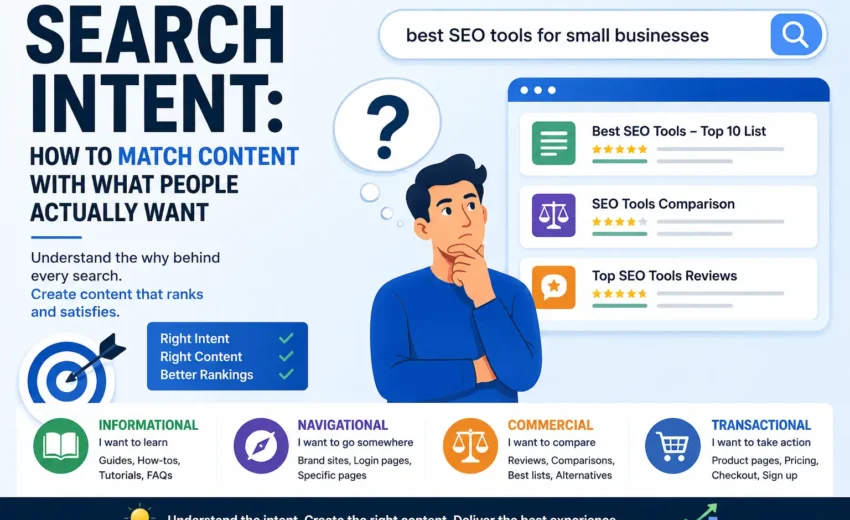
Imagine someone searches for “best SEO tools for small businesses.” You write a detailed article explaining what SEO tools are, how they work, and why businesses need them.
That’s useful information. But look at the searcher’s wording again.
They asked for the best tools. They’re probably comparing options. Google is more likely to favor comparison articles, reviews, lists, and buying guides than a general educational article.
That’s the fundamental idea behind search intent.
SEO isn’t just about targeting what people search. It’s about understanding what they expect to find when they search it.
Don't Start With the Keyword. Start With the Searcher.
A keyword tells you what someone typed into a search engine. It doesn’t always tell you exactly what they want.
Consider these three searches:
- “What is Google Search Console?”
- “Best SEO tools for small businesses”
- “Google Search Console login”
All three relate to online marketing and search. But the desired outcome is completely different.
The first person wants to learn. The second wants to research and compare. The third wants to reach a specific destination.
Creating the same type of page for all three would be a mistake.
Before creating content, ask yourself: What does this person actually want to accomplish?
This question should come before deciding whether you need a blog post, service page, product page, comparison, tutorial, or landing page.
Search Intent Is More Than Keyword Wording
Two keywords can use completely different words while representing almost the same need.
For example, “how to repair a leaking tap” and “how to fix a dripping faucet” are different phrases, but the underlying goal is similar.
The opposite can also happen.
Two keywords can contain almost identical words while representing different goals. Look at “SEO audit” and “SEO audit service.” The first could be informational or tool-oriented. The second has a much stronger commercial intent.
This is why simply inserting a keyword into your content isn’t enough.
Modern search engines use meaning, context, relationships between terms, and other signals to understand queries. Search intent is the practical SEO concept we use to describe the goal behind that search.
The Four Search Intent Types
Most SEO workflows group search queries into four broad categories. These categories are useful, but they’re not rigid boxes. Some queries contain more than one type of intent.
Informational Intent: “I Want to Learn”
The searcher wants an answer, explanation, instructions, or information.
Examples:
- What is keyword clustering?
- How does SEO work?
- How to improve website speed
Common content formats include guides, tutorials, how-to articles, FAQs, educational videos, and explanatory resources.
If the search results are dominated by educational guides, creating a product page probably won’t satisfy the dominant intent.
Navigational Intent: “I Want to Go Somewhere”
The searcher already has a destination in mind.
Examples:
- Google Search Console
- Semrush login
- Facebook login
For these searches, the user generally isn’t asking for a 2,000-word explanation. They want the website, brand, tool, or specific page.
This is why branded searches often show the official website or destination near the top of the results.
Commercial Intent: “I Want to Compare”
The searcher is considering an option but hasn’t necessarily made a final decision.
Examples:
- Best SEO tools
- Semrush vs Ahrefs
- Best WordPress SEO plugins
Typical content includes comparison articles, reviews, best-of lists, alternatives, and buying guides.
The searcher is gathering information that will help them make a decision.
Transactional Intent: “I’m Ready to Act”
The searcher has moved closer to taking an action. That action might be purchasing, booking, subscribing, downloading, or requesting a service.
Examples:
- Buy running shoes online
- SEO services in Kochi
- Semrush pricing
Appropriate pages include product pages, service pages, pricing pages, booking pages, landing pages, and checkout flows.
The content shouldn’t make the user work through a long educational article before they can take the action they came to complete.
Beyond the Four Categories
While most SEO workflows use four intent categories, Google’s own framework includes another type called “Know Simple.”
These are factual queries that can be answered in a sentence or two.
Examples include “Population of London,” “CEO of Google,” and “When was SEO invented.”
These queries typically trigger featured snippets and knowledge panels. A comprehensive guide would be overkill for these searches.
The SERP Is Your Best Intent Clue
If you aren’t sure what a keyword means, don’t guess. Search it.
The current Google search results page can show you what type of content Google is already considering relevant for that query.
Look at the first page and ask yourself:
- What types of pages are ranking?
- Are they blog posts or service pages?
- Are they listicles or tutorials?
- Are product pages appearing?
- Are videos prominent?
- Are there comparison articles?
- Is there a Local Pack?
- Is there a Featured Snippet?
- Are People Also Ask questions appearing?
- What themes are repeated across the top results?
You’re looking for a pattern.
For example, if “what is keyword clustering?” shows mostly guides, the intent is informational. If “best keyword clustering tools” shows lists and comparisons, the intent is commercial. If “Semrush keyword clustering” shows Semrush pages, the intent is navigational.
The important point isn’t that every search result page will fit perfectly into one category. It’s that the search results give you evidence about what Google currently believes satisfies the query.
One important caveat: the search results show what’s currently ranking, not necessarily what’s best for users. Sometimes Google’s algorithm gets intent wrong, creating opportunity for you. Look for gaps in the current results.
The 3 Cs: Content Type, Format, and Angle
Once you’ve identified the dominant intent, go one level deeper.
A useful search result analysis looks at three things.
Content Type
What kind of page dominates? Blog article, product page, service page, category page, landing page, tool, or video?
If you’re targeting “best SEO tools” and the first page is dominated by comparison articles, creating a generic service page is probably a poor match.
Content Format
Now examine how those pages are structured. Are the results mostly how-to guides, list posts, reviews, comparisons, step-by-step tutorials, or beginner guides?
For example, a search result page dominated by titles like “10 Best SEO Tools for Small Businesses” is a strong signal that users expect a list or comparison format.
Content Angle
Finally, look for the perspective that appears repeatedly. The dominant angle might be best for beginners, affordable, updated for 2026, best for small businesses, step-by-step, local, or comparison-focused.
The combination gives you a much clearer brief. Instead of simply “write an article about SEO tools,” you get “create a comparison article in a list format targeting small business owners.”
Understanding Intent Throughout the Customer Journey
Search intent maps directly to the buyer’s journey.
In the awareness stage, users have informational intent. They search for “what is,” “how to,” and “guide.” Content should be educational articles, guides, and explainers.
In the consideration stage, users have commercial intent. They search for “best,” “vs,” “review,” and “alternatives.” Content should be comparisons, reviews, and case studies.
In the decision stage, users have transactional intent. They search for “buy,” “pricing,” “services,” and “contact.” Content should be product pages, pricing pages, and demos.
In the retention stage, users have navigational and informational intent. They search for branded terms and “how to use [product].” Content should be tutorials, support articles, and community resources.
Understanding where your target audience sits in this journey helps you create content that actually moves them forward.
Search Intent and Keyword Clustering Work Together
This is particularly important when planning your content.
Keyword clustering asks which keywords could belong together. Search intent asks whether those keywords represent the same user goal.
Suppose your keyword research gives you “keyword clustering,” “keyword grouping,” “how to cluster keywords,” “keyword clustering tool,” and “keyword clustering software.”
They all sound related. But “keyword clustering tool” may have stronger commercial intent than the informational queries.
Before putting everything into one article, compare the search results. If Google shows similar pages for the first three queries but primarily tool and product pages for the last two, you may have discovered different intent groups within the same broader topic.
That’s where search-intent analysis makes keyword clustering more accurate.
What Happens When You Target the Wrong Intent?
You can have good keyword research, good writing, and good optimization, but if you target the wrong intent, you’ll get poor performance.
Here are some common symptoms.
High Impressions but Low Clicks
Your page appears in search but doesn’t offer what the searcher expects. They see your title and description, decide it’s not what they need, and click something else.
Good Content but Weak Rankings
Your article may be useful, but competing pages better match the dominant content type or format. Google ranks them higher because they satisfy the intent better.
Traffic Without Conversions
You may be attracting informational users to a commercial page. Or you might be sending people who are ready to buy to a purely educational article. Either way, you’re losing potential customers.
A Page That Keeps Getting Rewritten
If you continuously improve the wording but rankings don’t move, the problem may be the page type, not the writing.
Sometimes the right SEO fix isn’t “write better.” It’s “create the right page.”
Common Search Intent Mistakes
Choosing Keywords Only by Search Volume
A high-volume keyword isn’t useful if you create the wrong page for it. Always check intent before deciding.
Assuming Keyword Modifiers Tell the Whole Story
Words like “best,” “how,” “buy,” and “near me” provide clues, but the search results provide evidence. Always verify with search result analysis.
Ignoring the Existing Search Results
You don’t need to copy competitors, but you should understand what Google currently considers relevant. Study the patterns.
Treating Every Query as One Intent
Some searches contain mixed informational, commercial, and transactional needs. Check the search results for mixed signals.
Creating a Blog Post When Google Expects a Service Page
This is particularly common for commercial queries. Always check the search results before choosing your format.
Creating a Huge Article When the User Needs a Simple Destination
More content isn’t automatically more helpful. Match the length to the user need.
Never Revisiting Intent
Search results can change. Important pages deserve periodic review.
Pre-Publishing Checklist
Before you create or publish a page, ask yourself these questions:
- What is the searcher’s primary goal?
- What types of pages dominate the search results?
- What content format dominates?
- What angle appears repeatedly?
- Is the intent informational, navigational, commercial, transactional, or mixed?
- What search result features appear?
- What questions are users asking?
- Does an existing page already satisfy this intent?
- Does this keyword belong to an existing keyword cluster?
- Am I creating the right type of page?
- Is the amount of content appropriate for the query?
- What should the visitor be able to do after consuming the content?
If you can answer these questions clearly, you’re no longer optimizing blindly.
Final Thoughts
Search intent changes the way you approach SEO.
Instead of asking “how can I rank for this keyword?” start with “what does someone actually want when they search for this?”
Then look for evidence. Search the search results. Study the dominant content type, format, and angle. Understand whether the intent is informational, navigational, commercial, transactional, or mixed. Check your existing content and see where the keyword belongs.
Only then should you decide what to create.
Because the goal isn’t to produce the most content. It’s to produce the right content for the right search.
And that’s the difference between simply optimizing a page for a keyword and creating a page that genuinely satisfies the person behind the search.

Alfik P S
hi
August 10, 2026
Stop Competing with Yourself: A Smarter Approach to...
August 10, 2026