You create a Google Ads campaign, choose your keywords, set a budget, write your ads, and start the campaign.
Then you search for one of your keywords and don’t see your ad.
It can be confusing. If the campaign is active and the keyword is added, why isn’t the ad appearing?
The answer is that Google Ads does not show an advertisement every time someone searches for a related keyword. Every eligible search can trigger an ad auction, and Google uses several factors to decide which ads are eligible to show, where they appear, and whether they appear at all.
Understanding how the auction works can help you manage your campaigns more effectively and avoid the assumption that increasing your bid is always the solution.
What Is the Google Ads Auction?
The Google Ads auction is the process Google uses to determine which ads can appear for a particular search and how those ads are positioned.
An auction can happen every time someone searches for something that may trigger ads.
Google considers the available advertisers, their keywords and targeting, bids, ad quality, and other factors before determining which ads are eligible and how they are displayed.
This happens very quickly, so the person searching usually sees the final results almost immediately.
Does Every Advertiser Enter Every Auction?
No.
Your campaign may be active, but that does not mean your ad is automatically eligible for every search related to your keywords.
Google first determines whether an ad is eligible based on factors such as targeting settings, keyword and search relevance, location, language, budget, policy requirements, and other campaign conditions.
If your ad is not eligible for a particular search, it will not enter that auction.
This is one reason why simply having a keyword in your campaign does not guarantee that your ad will appear whenever someone searches for that term.
What Is Ad Rank?
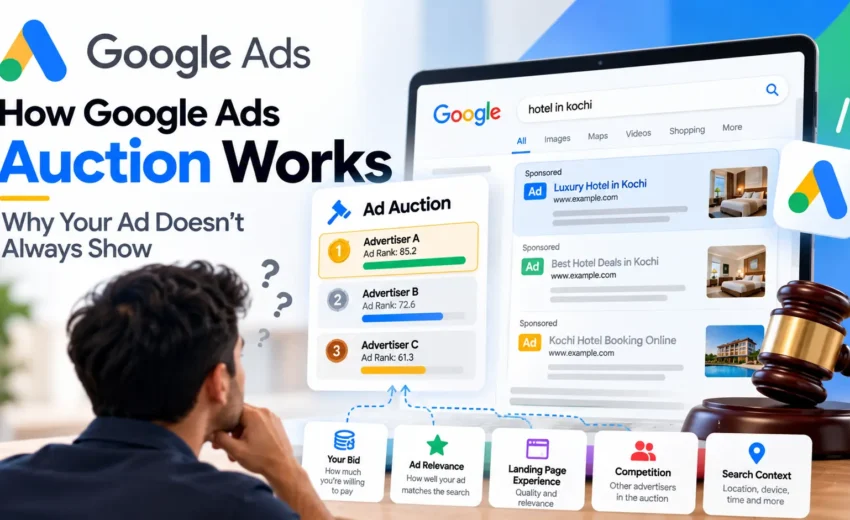
Once eligible ads are considered, Google uses Ad Rank to help determine whether and where an ad can appear.
Ad Rank is not simply your bid.
Google describes it as a combination of factors that can include your bid, the quality of your ad and landing page, the competitiveness of the auction, the context of the search, and the expected impact of ad assets and other formats.
This means two advertisers can bid different amounts and still see results that are not simply determined by the highest bid.
A Higher Bid Does Not Automatically Guarantee the Top Position
One of the most common misunderstandings about Google Ads is that the advertiser who pays the most always gets the first position.
That’s not how the auction works.
A higher bid can contribute to Ad Rank, but other factors also matter.
For example, an ad with strong relevance and a good user experience can compete effectively even when another advertiser has a higher maximum bid.
Google’s system is designed to consider more than just how much an advertiser is willing to pay.
Ad Relevance Matters
Your ad should be relevant to what the person is searching for.
If someone searches for a specific service and your advertisement clearly addresses that service, the ad is more closely aligned with the search.
Relevant ad copy can help users understand what they will find after clicking.
On the other hand, an advertisement that is too broad or unrelated to the search may provide a weaker experience.
This is why creating separate, relevant ad groups and writing ad copy that matches the user’s intent can be important when building Search campaigns.
Your Landing Page Also Matters
The auction does not end with the advertisement itself.
After someone clicks your ad, they are taken to a landing page or another destination.
Google considers the quality of the landing page as part of its assessment of the ad experience.
A useful landing page should provide information that is relevant to the advertisement and the user’s search.
If your ad promises a particular service but sends users to a generic homepage with little information about that service, the experience may not be ideal.
A strong connection between the search → ad → landing page can help create a better user experience.
Search Context Can Change the Auction
Google does not evaluate every search in exactly the same way.
The context of a particular search can affect the auction.
This can include factors such as:
The search query
Location
Device
Time of the search
Other search context
The user’s likely intent
Because of this, your ad may be eligible and visible for one search but not appear for another closely related search.
This is normal in an auction-based advertising system.
Your Budget Can Affect Visibility
Your campaign’s daily budget can also influence how often your ads are able to participate in auctions.
If your campaign is receiving more potential traffic than the available budget can support, your ads may not be shown for every eligible opportunity.
However, budget is only one part of the picture.
Increasing the budget does not automatically solve problems caused by poor targeting, weak ad relevance, low search demand, or other campaign issues.
Before increasing spending, understand what is actually limiting your campaign.
Search Volume Also Matters
Your ads cannot appear if there are no relevant searches.
Some keywords receive thousands of searches, while others have very limited search volume.
If you are targeting a very specific or low-volume keyword, your ad may simply have fewer opportunities to enter an auction.
This can make a campaign appear inactive even though there is nothing technically wrong with it.
Competition Can Change Your Results
The Google Ads auction is competitive.
Other advertisers may enter the same auctions and compete for similar searches.
If competition changes, the amount needed to achieve a particular Ad Rank can also change.
This can affect metrics such as cost per click and impression visibility.
You therefore cannot look at your campaign in isolation. The competitive environment can influence what happens in the auction.
Why Your Ad May Not Appear When You Search Yourself
Suppose you have a campaign targeting “hotel in Kochi” and you search that term yourself but don’t see your advertisement.
There are several possible explanations.
Your campaign may have limited budget, your ad may not be eligible for that particular search, another auction context may be different, or Google may determine that your ad does not meet the requirements to show in that particular auction.
Your own Google search is therefore not a reliable way to determine whether your campaign is running correctly.
Repeatedly searching your own ads can also create unnecessary impressions and does not give you a complete picture of campaign performance.
Instead, use the information available in Google Ads to understand your actual impression and delivery data.
The Bigger Picture
Google Ads is not a system where you simply pay for a keyword and receive a guaranteed position.
Every relevant search can involve an auction, and multiple factors influence whether your ad is eligible to appear and where it may be shown.
Bid matters, but bid is not everything.
Ad relevance, landing page experience, search context, competition, budget, and other factors can all influence the outcome.
So if you search for your keyword and don’t see your ad, don’t immediately assume that your Google Ads campaign is not working.
Check the campaign data first.
The better question is not:
“Why didn’t I see my ad?”
It is:
“What does my Google Ads data tell me about my eligibility, visibility, and performance?”
Once you understand how the auction works, it becomes much easier to make informed decisions about your bids, ads, keywords, budget, and overall campaign strategy.