
For an e-commerce business, getting people to discover a product is only the first step. The bigger challenge is turning that attention into product views, website visits, and purchases.
Meta Shopping Ads are designed to help businesses promote products across Meta’s advertising ecosystem using product information from a catalog.
Instead of creating every product advertisement manually, businesses can connect their product catalog with their advertising setup and use that information to promote products to potential customers.
Meta supports catalog sales as an advertising objective, making product catalogs an important part of product-focused advertising campaigns.
What Are Meta Shopping Ads?
Meta Shopping Ads are product-focused advertisements that can showcase items from an online store to people on platforms such as Facebook and Instagram.
The ads can use information from a product catalog, including details such as:
- Product name
- Product image
- Price
- Product description
- Availability
- Website URL
This allows businesses to promote multiple products without having to create a completely separate ad setup for every individual product.
For an online clothing store, for example, a catalog could contain different shirts, trousers, shoes, and accessories. The products can then be used in campaigns based on the business’s advertising strategy.
How Do Meta Shopping Ads Work?
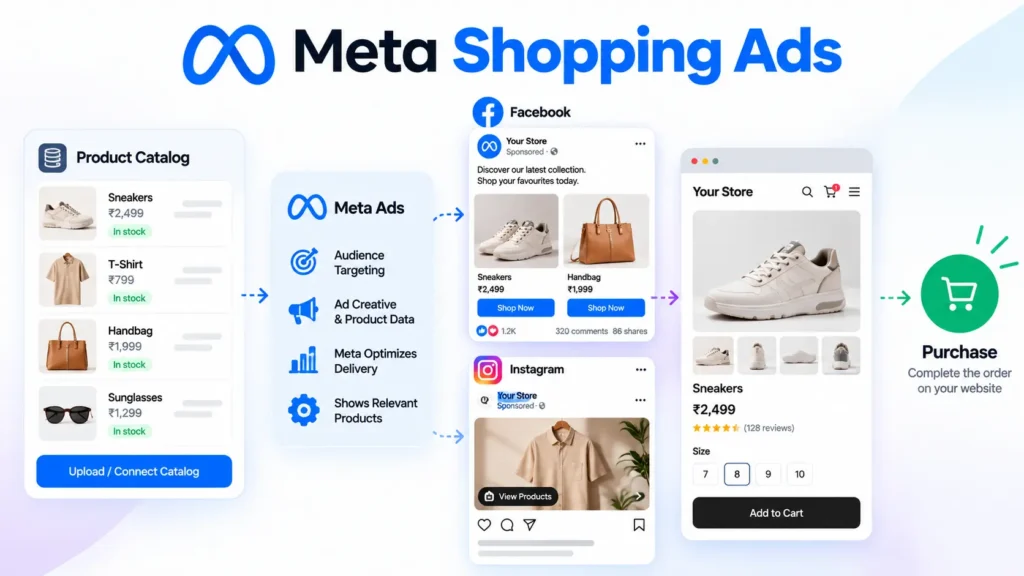
The process starts with a product catalog.
A business provides Meta with information about its products. This information can be added or connected through the available catalog tools and integrations.
Once the catalog contains the relevant products, those products can be used in advertising campaigns.
Meta’s delivery system can then determine which products and ads to show based on the campaign setup and available signals.
The exact delivery and optimization options can change as Meta updates its advertising platform, so businesses should always check the current options available in Ads Manager.
What Is a Product Catalog?
A product catalog is essentially a structured collection of the products a business wants to promote.
Think of it as a central product database for advertising.
Each product can contain information that helps Meta understand what the item is and how it should be displayed.
A properly maintained catalog is important because incorrect product information can affect what people see in the advertisement.
If a product is out of stock on the website but the catalog still shows it as available, for example, the advertising experience can become confusing for potential customers.
Why Product Information Matters
The quality of your product information matters because your catalog provides important information used in your product advertising.
Product images should clearly represent the product. Names should be understandable, prices should be accurate, and product links should take users to the correct product page.
The more carefully the catalog is maintained, the fewer problems you are likely to encounter when promoting your products.
This is particularly important for businesses with large product ranges where manually checking every item can become difficult.
Meta Shopping Ads vs Regular Meta Ads
Regular Meta Ads can promote a wide range of things, including services, offers, content, brands, and individual products.
Shopping-focused campaigns are more closely connected to a product catalog.
For example, a normal ad might promote:
“20% Off Our New Collection.”
A product-focused ad can instead present specific products from the collection with their individual product information.
This makes catalog-based advertising particularly relevant for e-commerce businesses with multiple products.
Who Can Benefit From Meta Shopping Ads?
Meta Shopping Ads are mainly useful for businesses that sell products online.
They can be relevant to:
- Fashion brands
- Electronics stores
- Beauty and skincare businesses
- Furniture stores
- Jewellery brands
- Sports and fitness brands
- Home and lifestyle stores
- Other e-commerce businesses
A business that sells services rather than physical products may have a different advertising setup and may not need product catalog advertising.
The Role of Meta Pixel and Conversion Tracking
Advertising performance depends heavily on measurement.
For an e-commerce business, tracking actions such as product views, add-to-cart events, checkout activity, and purchases can help provide information about what happens after people interact with an ad.
The exact tracking setup depends on the website, platform, and business requirements.
For businesses using Meta’s advertising tools, it is important to make sure the relevant events are being captured correctly before making decisions based on campaign performance.
Without reliable tracking, it becomes much harder to understand whether your advertising is actually generating sales.
Retargeting People Who Viewed Products
One useful aspect of catalog-based advertising is that product information can be used in campaigns aimed at people who have already interacted with products.
For example, someone may visit a product page without completing a purchase.
A business may then use appropriate retargeting strategies to reconnect with that audience.
This can be useful because the person has already shown some interest in the product.
However, retargeting should be part of a broader strategy rather than something every business should use in exactly the same way.
Your Product Page Still Matters
A good shopping ad cannot fix a poor product page.
Someone may see an attractive product advertisement and click through to the website, but the purchase decision happens after that.
Your product page should clearly communicate:
- What the product is
- How much it costs
- What the customer receives
- Available options or variations
- Shipping information
- Return or refund information
- How to complete the purchase
Trust also matters. Clear product information, genuine reviews (where available), a secure checkout, and a professional website can make the buying process easier.
Common Problems With Meta Shopping Ads
Several issues can affect product advertising performance.
Incorrect Product Information
Wrong prices, broken links, missing images, or outdated availability can create problems.
Poor Product Images
Product advertising is highly visual. Low-quality or unclear images can make products less appealing.
Weak Product Pages
If the landing page does not clearly explain the product or make purchasing easy, advertising traffic may not convert.
Poor Tracking
If important events are not being recorded correctly, campaign reporting can become unreliable.
Limited Product Selection
If the catalog does not contain the products you actually want to promote, the campaign has fewer relevant products to work with.
How to Improve Meta Shopping Ads
Start with the basics.
Make sure your product catalog is accurate and regularly updated. Use clear product images and useful product information.
Then look at the complete customer journey.
Ad → Product → Product Page → Checkout → Purchase
A problem at any stage can affect the final result.
Instead of looking only at clicks or impressions, pay attention to product views, add-to-cart activity, purchases, conversion rate, and cost per purchase where applicable.
The most useful metric depends on the actual goal of the campaign.
Don't Expect Every Product to Perform the Same
If you have a large product catalog, some products will naturally attract more attention than others.
Differences can come from price, demand, competition, product quality, seasonality, creative presentation, and other factors.
Therefore, looking at the overall campaign result alone may not tell you which products are driving performance.
Review product-level data when it is available and relevant to your campaign setup.
This can help you understand where your advertising budget is generating meaningful results.
When Should You Consider Meta Shopping Ads?
Meta Shopping Ads can be worth considering when you have:
- An online store
- A range of products
- Accurate product information
- A properly maintained catalog
- A reliable website
- Conversion tracking
- A clear e-commerce goal
If you only sell one service or depend mainly on enquiries, a product catalog campaign may not be the most relevant advertising approach.
The campaign should always match the business model and the result you want to achieve.
The Bigger Picture
Meta Shopping Ads are more than simply putting product images in front of people.
They connect your product catalog, advertising campaign, website, tracking, and customer journey.
When these parts work together, businesses can use Meta’s advertising ecosystem to promote products in a more structured way.
But the advertising platform is only one part of the process. Product quality, pricing, website experience, trust, and the overall offer still influence whether someone decides to buy.
So before increasing your advertising budget, make sure the foundation is ready.
A well-organized product catalog, accurate tracking, strong product pages, and a clear customer journey can make your shopping campaigns much easier to manage and evaluate.


September 25, 2026