Let’s start with a scenario that might feel familiar.
You’ve just finished digging through your favorite keyword tools. You have a long list of phrases people are searching for, and you feel a rush of excitement. Naturally, you think: “I need to write a separate article for each one of these.”
It makes sense on paper. More pages mean more chances to rank, right?
Unfortunately, this is one of the most common traps in modern SEO. A few months later, you look at your website and realize you have five different articles that all say basically the same thing. Instead of dominating the search results, your own pages are now competing for attention. Google gets confused, your traffic becomes unstable, and your hard work doesn’t pay off the way it should.
The real problem isn’t your content quality. It’s your content organization. And that’s exactly where keyword clustering comes in.
What Is Keyword Clustering, Really?
Keyword clustering is the practice of grouping similar search terms together and creating one comprehensive piece of content to cover them all.
It sounds straightforward, but there’s a catch: you don’t group keywords just because they look alike. You group them because they serve the same purpose.
Think about it from your reader’s perspective. If someone types in “how to fix a leaky faucet” and another person types “repair dripping tap,” they both want the same step-by-step guide. They don’t need two separate pages; they need one great resource that covers everything.
This shift in mindset — from “one keyword, one page” to “one intent, one page” — is the heart of this strategy.
Why Your Website Is Suffering From "Too Much Content"
Imagine you are a chef running a restaurant. You decide to offer five different variations of a classic pasta dish on your menu, each with a slightly different name. Your customers get overwhelmed trying to choose, and the kitchen struggles to cook them all efficiently.
Search engines face a similar problem when they crawl your website.
When Google finds several pages targeting nearly identical searches, it has to pick a favorite. It may rank one page today and a different one tomorrow, or it might fail to rank any of them clearly because none stands out as the definitive source. This is a well-documented issue known as keyword cannibalization, and it’s one of the more common technical reasons a site underperforms despite having plenty of content.
The best websites aren’t necessarily the ones with the most articles. They’re the ones where every page has a clear, distinct job.
The Golden Rule: Focus on Intent, Not Just Wording
This is where most people get tripped up.
Let’s look at a quick example:
- “SEO checklist”
- “SEO checklist for beginners”
At first glance, these look like two separate things. But if you search both on Google, you’ll notice that the top-ranking pages are almost identical. The intent is the same: users want a practical, action-oriented guide. These should live on the same page.
Now compare that to:
- “SEO checklist”
- “SEO audit services“
Despite sharing the word “SEO,” these two searches represent completely different needs. One person wants to learn; the other wants to hire a company. These require separate pages because the user’s goal is entirely different.
So before you start writing, set the wording aside for a moment and ask: What does the person actually want right now?
A Simple Three-Step Test Before You Write
Instead of jumping straight into creating new content, run your idea through this quick filter. It can save you hours of wasted effort.
- Does this already fit somewhere else? Look at your existing articles. If you already have a solid guide that briefly touches on this new subject, consider updating the old post rather than starting from zero. Strengthening an established page often moves the needle faster than waiting for a new one to age and earn trust.
- What does Google show for this search? Open an incognito window and search your keyword alongside a similar one. Look at the results. If the same websites appear in the top ten for both, that’s a signal these queries belong on the same page.
- Does this support a bigger topic? Think about your website’s main subjects. Does this keyword help build your depth on a broader topic, like “digital marketing” or “home renovation”? If so, make sure it links back to that central, overarching guide.
How to Structure Your Content Clusters
Once you’ve grouped your keywords, organize them into a logical structure.
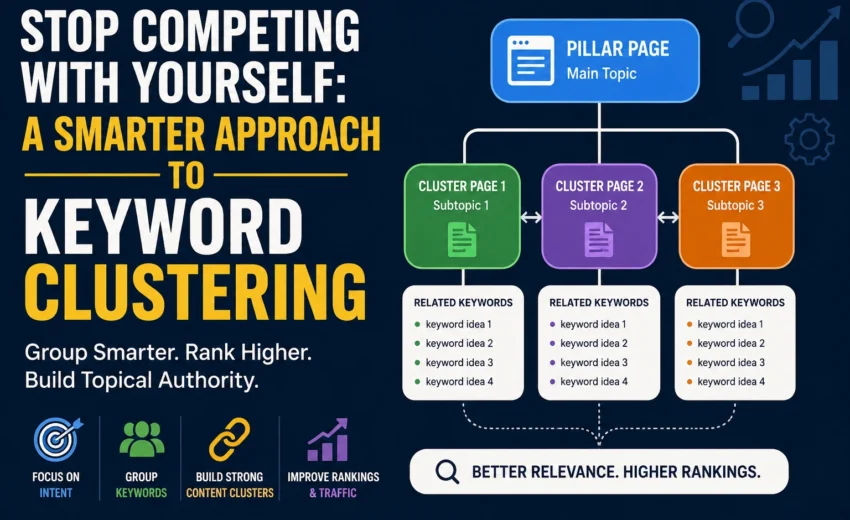
Think of a pillar page as the “parent” guide — a big-picture overview of a topic. Then create cluster pages that dive deeper into specific subtopics.
For example:
- Pillar: The Ultimate Guide to Coffee Brewing
- Clusters: Pour-Over Techniques, Choosing Coffee Beans, Cleaning Your Espresso Machine
Each cluster page explores one aspect in detail, and they all link back to the pillar page, as well as to each other where relevant.
This structure creates a clear roadmap for both readers and search engines. Sites that cover a topic this thoroughly, with pages that interlink in a logical hierarchy, tend to perform better on competitive terms within that subject — a pattern SEOs commonly describe as building “topical depth” or “topical authority.” It’s worth noting this isn’t an officially confirmed Google ranking factor; Google hasn’t named it as one. But related signals surfaced in the 2024 Content Warehouse API leak (such as attributes measuring how focused a site is on a given subject) are consistent with what practitioners have observed for years: a site that covers one topic deeply tends to outperform a site covering the same ground broadly and thinly.
Practical Steps to Get Started
If you’re feeling overwhelmed by a large spreadsheet of keywords, here’s a simple workflow to break it down:
- Collect all your keywords from research tools.
- Remove duplicates to clean up your list.
- Sort by intent — separate the people who want to learn from the people who want to buy.
- Create groups based on shared topics or overlapping search results.
- Pick the best keyword from each group as the main title (H1) of your page.
- Work the rest in naturally throughout the article, in subheadings, FAQs, or examples.
- Link everything together — connect related groups and always point back to your central pillar.
You don’t need expensive software for this. For smaller sites, you can do it manually by typing keywords into Google and comparing results. For larger sites with thousands of keywords, tools like Semrush, Ahrefs, or SE Ranking can speed up the grouping process.
Common Pitfalls to Watch Out For
Even once you understand the concept, it’s easy to slip back into old habits:
- Assuming every long-tail keyword needs its own page. Long-tail keywords are useful, but they’re often just variations of a broader topic. Tuck them into an existing guide instead.
- Grouping by wording alone. Two phrases sharing a word like “budget” doesn’t mean they belong together. Always check the intent.
- Forgetting to update old content. Sometimes the best “new” article is really an old one that just needs a refresh and a new section.
- Neglecting internal links. You can have perfect clusters, but if they aren’t linked together, the value gets lost.
Pre-Publish Checklist
Before you schedule or publish your next article, ask yourself:
- Is there already a page on my site that answers this question?
- Does this page have a single, clear primary focus?
- Are related keywords woven in naturally, or do they feel forced?
- Does this page link to a broader pillar page on my site?
- Does this page add unique value, or does it just repeat what I already have?
If you answered “yes” to most of these, you’re on the right track.
Wrapping It Up
Keyword clustering isn’t just an SEO trick. It’s a way of respecting your readers’ time and making your website easier to navigate. When you stop creating scattered, competing articles and start building interconnected, thorough resources, the difference shows up in both your rankings and your traffic stability.
So the next time you come across a promising new keyword, resist the urge to start a new document immediately. Ask whether it truly deserves its own page — or whether it’s a missing piece that belongs in a bigger resource you’re already building.
Alfik P S
hi