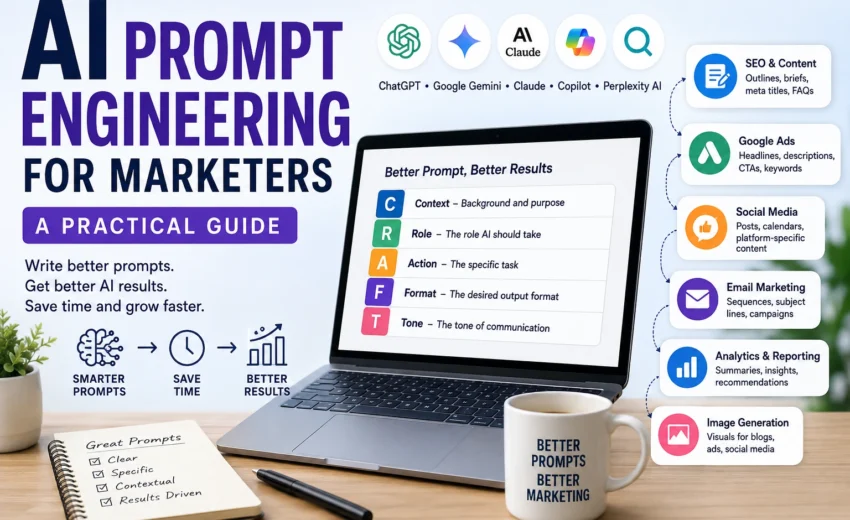
Artificial Intelligence (AI) has become an everyday tool for digital marketers. Whether the task is creating SEO content, writing Google Ads copy, planning social media campaigns, analyzing Google Analytics 4 (GA4) reports, or brainstorming marketing strategies, AI tools such as ChatGPT, Google Gemini, Claude, Microsoft Copilot, and Perplexity AI can help complete tasks faster and support day-to-day productivity.
Yet many marketers share the same frustration: AI often produces responses that feel generic, inaccurate, or don’t match expectations. In most cases, the issue isn’t the AI itself — it’s the prompt.
This is where AI prompt engineering becomes useful.
Prompt engineering is the skill of communicating effectively with AI by providing clear instructions, relevant context, and well-defined objectives. Rather than searching for a “perfect prompt,” marketers get better results by briefing AI the way they’d brief a copywriter, designer, or agency partner.
The quality of the output is generally tied to the quality of the input. A vague request tends to produce a vague result. A structured prompt that explains the audience, objective, format, tone, and constraints gives AI what it needs to generate responses that require fewer revisions.
As AI becomes more embedded in marketing workflows, prompt engineering is shifting from a nice-to-have skill to a practical one. Marketers who can collaborate effectively with AI tend to spend less time on repetitive drafting and more time on strategy, creativity, and execution.
This guide covers what AI prompt engineering is, why it matters for marketers, a practical framework for writing better prompts, and how to apply it across SEO, content marketing, advertising, and other digital marketing activities.
What Is AI Prompt Engineering?
AI prompt engineering is the process of designing prompts that guide generative AI models toward producing useful, accurate, and contextually relevant responses.
A prompt is the instruction given to an AI system. An effective prompt, though, is more than a simple question — it functions as a creative brief that explains what’s needed, who it’s for, how it should be written, and what outcome is expected.
Consider two examples.
Basic prompt: Write a blog about SEO.
This gives the AI very little to work with, so the response is likely to be broad and generic.
Improved prompt: Act as an experienced SEO strategist. Write a beginner-friendly 1,500-word article about local SEO for hotels, targeting hotel owners. Include practical examples, H2 headings, an FAQ section, and a conclusion. Use a professional tone and optimize for search intent.
The second prompt provides significantly more context, which generally produces a stronger first draft that needs fewer revisions.
Prompt engineering isn’t about discovering secret commands or “magic prompts.” It’s about providing clear direction so the AI understands the task and produces output aligned with the goal.
Why Prompt Engineering Matters for Marketers
Marketing teams are often expected to produce more content, launch campaigns faster, analyze larger volumes of data, and communicate across more channels — with limited time and resources.
A typical marketing workflow can include:
- Keyword research
- SEO content creation
- Google Ads campaigns
- Social media planning
- Email marketing
- Client reporting
- Competitor analysis
- Presentation development
Many of these tasks involve repetitive writing, organizing information, or summarizing data.
Prompt engineering helps marketers use AI to speed up these repetitive activities without replacing human expertise. Instead of spending hours on an initial draft or campaign outline, marketers can generate a structured first version, then review, refine, and improve it using their own judgment.
The aim isn’t to let AI think for you — it’s to let AI handle repetitive groundwork so more time goes toward strategy, creativity, and decision-making.
How Generative AI Understands Prompts
Generative AI models such as ChatGPT, Google Gemini, Claude, and Microsoft Copilot generate responses by identifying patterns in language and predicting an appropriate output based on the instructions they receive.
Unlike a search engine, AI doesn’t retrieve existing webpages — it interprets the prompt and generates a response using the context provided. That means output quality depends heavily on prompt quality.
Effective prompts typically include:
- Context — What is the background?
- Audience — Who is this for?
- Objective — What should the AI accomplish?
- Tone — Professional, persuasive, conversational, or formal?
- Format — Blog, table, email, presentation, checklist?
- Constraints — Word count, structure, specific requirements?
- Examples — Reference material that guides style and quality.
The more clearly these elements are communicated, the more likely the AI is to produce a relevant, usable response.
The CRAFT Framework for Writing Better Prompts
A consistent prompt structure makes it easier to avoid missing key details. CRAFT is one practical framework marketers can use.
C — Context
Explain the background and purpose of the task. Example: “We’re launching a new local SEO service for small businesses in Kerala.”
R — Role
Tell the AI what perspective to take. Example: “Act as an experienced digital marketing strategist with expertise in local SEO.”
A — Action
Describe the task clearly. Example: “Create a detailed blog outline for beginner-level readers.”
F — Format
Specify how the response should be presented — a blog article, bullet list, comparison table, presentation outline, email, social post, or checklist.
T — Tone
Define the writing style — professional, friendly, educational, persuasive, or conversational.
Using a structured framework like CRAFT reduces ambiguity and tends to produce more consistent AI output.
Before and After: Rewriting a Real Prompt
Here’s what applying CRAFT looks like on an actual marketing task.
Before (vague): Write a Facebook post about our SEO services.
After (CRAFT-structured): Act as a social media manager for a digital marketing agency. Write a Facebook post promoting local SEO services for small businesses. Keep it under 150 words, use a friendly and professional tone, explain the benefit of improved Google visibility, and close with a natural next step for interested readers.
The second version gives the AI a role, a format constraint, a tone, and a clear objective — which is generally what separates a usable first draft from one that needs a full rewrite.
Prompt Engineering for SEO and Content Marketing
SEO and content marketing are among the areas that benefit most from structured prompting. Rather than asking AI to write an entire article from scratch, marketers can use prompts to support each stage of the content process:
- Keyword clustering
- Search intent analysis
- Content brief creation
- Blog outlines
- Meta titles and descriptions
- FAQ generation
- Internal linking suggestions
- Content repurposing
- Content gap analysis
Example prompt: Act as an SEO content strategist. Create a detailed content brief for a 1,500-word article targeting the keyword “local SEO for hotels.” Include search intent, H2 headings, FAQs, semantic keywords, internal linking suggestions, and a conclusion. The audience is hotel owners with limited SEO knowledge.
Used this way, AI functions as a research assistant and first-draft collaborator rather than a replacement for the writing and editing process.
Prompt Engineering for Google Ads and PPC
Structured prompting can help marketers plan, draft, and iterate on Google Ads campaigns faster. AI can help generate:
- Responsive Search Ad (RSA) headlines
- Ad descriptions
- Call-to-action variations
- Landing page copy
- Audience ideas
- Negative keyword suggestions
- A/B testing concepts
Example prompt: Act as a Google Ads specialist. Create 15 Responsive Search Ad headlines and 4 descriptions for a digital marketing agency offering local SEO services to small businesses. Stay within Google’s character limits, emphasize trust and measurable results, and encourage a next step.
As with any AI output, ad copy should be reviewed against current Google Ads character limits and policy requirements before publishing, since these are updated periodically.
Prompt Engineering for Social Media Marketing
Creating content for multiple platforms is time-consuming. Prompt engineering helps marketers adapt one piece of content into several platform-specific posts while keeping the core message consistent.
Example prompt: Act as a social media strategist. Rewrite this blog into platform-specific posts for LinkedIn, Instagram, Facebook, and X. Keep the tone professional but engaging, use platform-appropriate formatting, and end each post with a relevant next step.
This speeds up drafting, but the final copy should still be reviewed to make sure it reflects brand voice and current platform norms.
Prompt Engineering for Analytics and Reporting
Marketing teams spend a meaningful amount of time preparing reports and presentations. Prompt engineering can help organize campaign data into a more concise, actionable summary — drawing on exports from GA4, Google Search Console, Google Ads, Meta Ads Manager, or a CRM.
Example prompt: Act as a digital marketing analyst. Review this exported campaign report and summarize the five most important insights. Identify positive trends, potential concerns, and three practical recommendations for improving performance. Present the results in a table suitable for a client presentation.
AI-generated summaries should support decision-making, not replace a careful review of the underlying data.
Prompt Engineering for AI Image Generation
Prompt engineering applies to image generation tools as well, including Midjourney, Adobe Firefly, Stable Diffusion, and ChatGPT’s built-in image generation.
Instead of: Create a marketing image.
Try: Create a realistic 3D illustration of a digital marketer working with AI-powered marketing tools, analytics dashboards, and creative content across multiple monitors. Use modern office lighting, a blue and white color palette, and leave negative space for a headline.
The more descriptive the prompt, the more closely the output tends to match the intended creative direction. Note that image-generation tools and their capabilities change frequently, so it’s worth checking each platform’s current features before relying on specific claims about resolution, editing, or output limits.
Role Prompting and Prompt Chaining
Role prompting means assigning the AI a specific role instead of asking it to complete a task directly — for example, “Act as an SEO strategist” or “Act as a content editor.” This tends to produce responses from a more appropriate perspective.
Prompt chaining means breaking a large task into smaller prompts:
- Research the topic
- Create a detailed outline
- Write the introduction
- Expand each section
- Generate FAQs
- Improve readability and SEO
Breaking complex tasks into steps generally produces more accurate and consistent results than asking AI to complete everything in a single prompt.
20 Ready-to-Use AI Prompts for Marketers
SEO
- Create a content brief targeting the keyword “local SEO for hotels.”
- Suggest ten blog ideas for a digital marketing agency.
- Generate semantic keywords for this topic.
- Create ten FAQ questions for this article.
- Suggest internal linking opportunities for this piece.
Google Ads 6. Write 15 Responsive Search Ad headlines. 7. Suggest negative keywords for this campaign. 8. Create three landing page headline variations. 9. Generate five call-to-action options.
Social Media 10. Rewrite this article as an Instagram carousel. 11. Create a 30-day social media content calendar. 12. Write five LinkedIn thought leadership posts. 13. Suggest ten hooks for short-form videos.
Email Marketing 14. Write a welcome email sequence. 15. Create five subject line variations. 16. Draft a product launch email.
Analytics and Reporting 17. Summarize this GA4 report. 18. Create a monthly marketing report. 19. Identify campaign optimization opportunities from this data. 20. Convert this report into presentation slide bullets.
Common Prompt Engineering Mistakes
- Writing vague prompts
- Not identifying the target audience
- Ignoring tone and brand voice
- Forgetting to specify the desired output format
- Expecting a finished answer from the first response
- Publishing AI-generated content without editing
- Sharing confidential customer or business information without following internal AI policies
Prompt engineering is iterative — refining the prompt usually improves the output.
Best Practices
- Clearly define the objective
- Provide sufficient background information
- Identify the target audience
- Specify the preferred format
- Explain the desired tone
- Include examples where possible
- Break large tasks into smaller prompts
- Review, edit, and fact-check every AI-generated response
- Build a reusable prompt library for recurring tasks
- Treat AI as a collaborative assistant, not an autonomous decision-maker
Final Thoughts
AI prompt engineering is becoming a practical, everyday skill in digital marketing. As generative AI becomes more integrated into content creation, advertising, analytics, and communication, the ability to write clear, structured prompts has a direct effect on the usefulness of the output.
The most effective marketers don’t rely on AI to think for them — they use it to accelerate research, generate ideas, organize information, and reduce repetitive tasks, while keeping strategy, fact-checking, and final editorial judgment in human hands.
Prompt engineering isn’t about finding one perfect prompt. It’s about learning to communicate clearly with AI, refining instructions based on results, and building repeatable workflows that improve efficiency over time.

Alfik P S
hi

August 4, 2026
Google Gemini for Marketing: Features, Use Cases &...
August 4, 2026