
If you have ever sat in front of a blank screen wondering how to stretch your article to 2,000 words because “that is what ranks,” you are not alone. For years, the SEO community has pushed the idea that longer content automatically performs better. The logic seems simple: more words mean more keywords, more value, and higher rankings. But that logic is flawed.
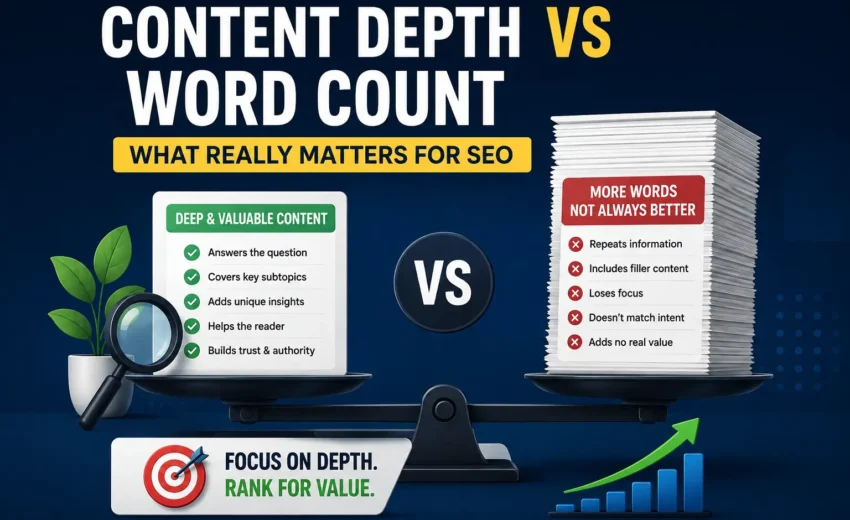
The reality is far more practical. Google’s systems are designed to surface helpful content that satisfies what people are looking for. Writing more words by itself does not guarantee better rankings. A short, focused article can easily outperform a long, rambling one if it gives the reader exactly what they came for. The key is not word count. It is content depth.
What Does Content Depth Really Mean?
Content depth is about thoroughness. It measures how well your page answers a user’s question and addresses the underlying intent behind their search. It has very little to do with the number of words on the page.
Deep content satisfies the reader completely. It answers the main question clearly, explains important concepts in plain language, covers relevant subtopics, and even anticipates follow-up questions the reader may have. It provides context, gives practical advice, and leaves the user feeling informed and confident.
Think of it this way. If someone searches for a simple definition, a short, direct paragraph can be deeply satisfying. If someone searches for a comprehensive guide, they likely expect a longer, more detailed breakdown. The length depends entirely on the need.
Word Count vs. Content Depth
It is easy to confuse these two concepts, but they are not the same.
Word count is simply a number. It tells you how much text is on the page, but it says nothing about quality or usefulness. Content depth, on the other hand, is about value. It tells you how well the information serves the reader.
Consider two articles on the same topic. One runs 2,500 words, but it repeats the same ideas, has a drawn-out introduction, and includes unrelated tangents. Another runs just 1,000 words, but it answers the primary question immediately, covers every important subtopic, and provides actionable examples. The second article is clearly deeper, even though it is significantly shorter.
Chasing a high word count often forces you to add filler. You repeat yourself, pad your introduction, and include generic advice just to reach a number. That does not help your reader, and it certainly does not help your rankings.
What Does Google Actually Say About Length?
Google has never issued a preferred word count. You will not find a recommendation for 1,500 or 2,000 words anywhere in their official guidelines. Instead, Google emphasizes creating helpful, reliable, people-first content. They want you to focus on the reader, not on arbitrary metrics.
The people-first approach is clear. Your content should exist to serve the user, not to game an algorithm. If you start an article by saying, “I need 2,000 words,” you are starting from the wrong place. Start by asking what the searcher actually needs to know. Let the complexity of the topic determine the length.
A complex topic will naturally require more words. A simple, straightforward question will not. Trust that natural process.
The Hidden Cost of Chasing Word Count
Making your content longer for the sake of length creates several problems. These issues can actually harm your performance rather than help it.
First, it encourages filler. Once you have already answered the reader’s question in 800 words, forcing yourself to add another 1,200 words leads to repetition, generic statements, and unnecessary explanations. The article becomes longer without becoming more useful.
Second, it makes information harder to find. Most readers scan a page before deciding to commit. If the main answer is buried under paragraphs of unnecessary introduction, they will get frustrated and leave. Clear headings, short paragraphs, and direct answers are essential for a good user experience.
Third, it can move you away from search intent. If someone wants to know the meaning of a specific term, they do not want a history lesson. Adding unrelated content to inflate your word count only dilutes your message and frustrates the reader.
What Actually Makes Content Deep and Valuable?
If word count is not the goal, what should you focus on? The answer lies in a combination of relevance, originality, and trust.
Start by answering the main question right away. Do not make the reader scroll through multiple paragraphs to find what they need. Place the core answer upfront, and then build on it logically.
Next, cover the important subtopics. Think beyond the primary keyword. What else might the reader be wondering about? If someone is reading about SEO content length, they may also want to know whether long-form content is always better, how to identify gaps in their own content, or when to update old articles. Address those related concerns naturally.
Anticipate follow-up questions. A strong article creates a smooth journey for the reader. It answers the initial query and then guides them to the next logical piece of information. This keeps them engaged and signals to Google that your page is comprehensive.
Finally, add genuine value. Generic advice is everywhere. If you simply repeat what five other articles have already said, you are not offering anything new. Use your own experience, provide real examples, share original data, or offer a unique perspective. This is what sets your content apart.
How I Decide Whether an Article Needs More Content
When reviewing an article, I do not start by checking whether it has reached a particular word count. I first look at the search intent, the queries bringing impressions in Search Console, the questions users are asking, and whether the existing page actually answers those questions.
If I find a genuine information gap, I add a useful section. If I do not, I do not add words simply to make the article longer. This approach keeps the content focused and ensures every paragraph serves a purpose.
Let Search Intent Be Your Guide
Search intent is one of the most important factors when deciding how much content a page needs. You have to understand why someone is typing a query into Google.
If the intent is informational, the user wants to learn something. A clear, focused explanation may be enough, but a detailed guide may be appropriate for broader topics. If the intent is commercial, the user is comparing options and likely expects features, pros and cons, and pricing details. This naturally requires more depth. If the intent is transactional, the user wants to make a purchase. They care about price, availability, and reviews, not lengthy articles. If the intent is navigational, they simply want to reach a specific page. A huge block of text is unnecessary.
There is no universal answer to how long an article should be. The answer depends entirely on what the searcher is trying to accomplish.
The Information Gain Factor
There is a concept in SEO called information gain. In simple terms, it means providing useful information that the reader cannot easily find elsewhere.
If every competitor article says the exact same thing, repeating that advice does not make your content valuable. To achieve information gain, you need to go beyond the obvious. Instead of saying “write good titles,” show the reader how to write a title that actually improves click-through rates. Share a real-world example of what worked for you. Provide a simple workflow they can follow.
Adding original insights, practical experience, and useful information beyond what competing pages provide can make your content more valuable and differentiated. That is much more powerful than simply adding more words.
A Practical Way to Build Depth Without Fluff
If you feel your article is incomplete, do not just start adding paragraphs randomly. Follow a structured approach instead.
Begin by identifying the primary search intent. Ask yourself what the reader truly wants to achieve. Then, define the core answer. What is the one thing they must understand before leaving your page?
Next, research related questions. Look at search autocomplete, the People Also Ask section, customer support tickets, or community discussions. These sources reveal what real users are asking. Compare those questions against your current draft. Where are the gaps?
Add value in those gaps using your own experience. Provide examples, data, or practical steps that are genuinely helpful. Then, read through your article critically. If a paragraph does not contribute to the reader’s goal, remove it. Improving depth often means deleting fluff, not adding it.
When to Write Long and When to Keep It Short
Long-form content makes sense when the topic is naturally broad and complex. A complete guide to performing an SEO audit, for example, may need to cover crawling, indexing, technical issues, on-page factors, and reporting. That requires significant space.
Shorter content is better when the searcher’s need is narrow. A question like “What does HTTP 404 mean?” can be answered in a few clear paragraphs. Adding another 1,500 words to that page would only waste the reader’s time.
The goal is never to write short content or long content. The goal is to write necessary content. Provide everything the reader needs and nothing they do not.
A Final Word on AI and Updating Old Content
AI tools have made it incredibly easy to generate thousands of words quickly. But that is exactly why word count matters even less now. Producing large amounts of text does not guarantee accuracy, originality, or usefulness. If you use AI, always review the output carefully. Check the facts, remove unnecessary sections, and add genuine expertise. The challenge is producing better information, not more text.
When updating old content, do not automatically add words either. Ask what is outdated, what questions are missing, and whether search intent has shifted. Sometimes, updating means replacing old information with new insights, not making the article longer.
Final Thoughts
Longer content does not automatically rank better. Shorter content is not automatically better either. The right length is whatever it takes to satisfy the searcher completely.
So the next time you sit down to write, do not ask how many words you need. Ask what your reader needs to accomplish. Research the topic, answer the important questions, add genuine value from your own experience, and remove everything that does not serve the reader’s goal.
If that takes 600 words, write 600. If it takes 2,500, write 2,500. Write for the person on the other side of the screen, and you will give your content a stronger foundation for earning search visibility.
Alfik P S
hi