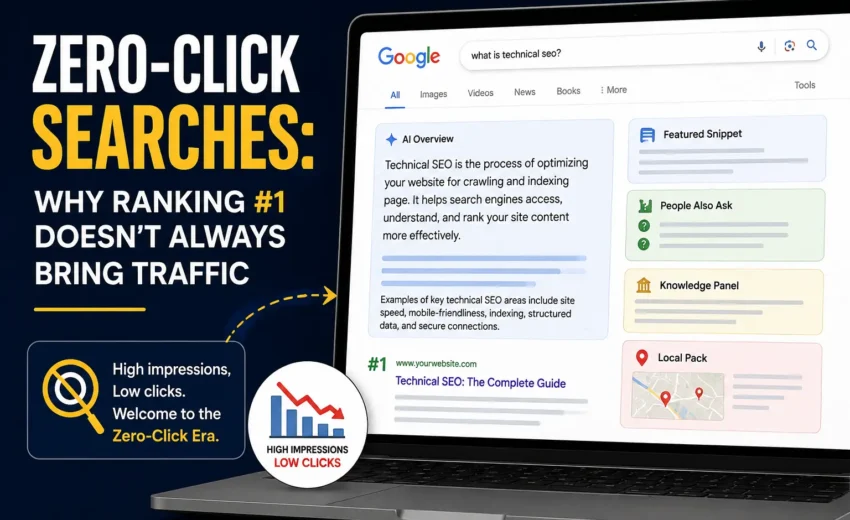
Quick answer: A zero-click search happens when a searcher gets the information they need directly on the Google results page — through an AI Overview, Featured Snippet, Knowledge Panel, or similar feature — without clicking through to any website. It’s increasingly common, and it doesn’t mean your SEO is failing; it means clicks and visibility need to be measured as two different things.
Imagine your website ranks #1 on Google for an important keyword. You check performance and notice something odd: plenty of impressions, but far fewer clicks than you’d expect.
What’s happening? In many cases, the answer is a zero-click search — and understanding it changes how you should read your own analytics.
What Is a Zero-Click Search?
A zero-click search is exactly what it sounds like: someone searches, gets their answer on the results page itself, and never visits a website.
For example, someone searching “How many grams are in one kilogram?” gets the answer instantly from Google — no click needed.
This behavior shows up through several features:
- AI Overviews
- Featured Snippets
- People Also Ask
- Knowledge Panels
- Local Packs
- Image and video results
- Shopping results
The key takeaway: an impression doesn’t always turn into a website visit. Your brand can still be seen — and remembered — even without a click.
Why Can a #1 Ranking Get Fewer Clicks?
Ranking #1 gives you visibility, but visibility and traffic aren’t the same thing. Compare:
Search A — “What is SEO?” Likely wants a quick definition. Google can often answer this directly.
Search B — “Best SEO agency for a small business in Kochi“ Likely wants to compare providers, pricing, and reviews — and will probably visit several sites before deciding.
Both may have similar search volume, but very different click potential. That’s why evaluating a keyword means looking beyond volume and rank position:
- Search intent
- SERP features present
- Competition
- Realistic CTR
- Business relevance
- Conversion potential
- Whether the searcher genuinely needs to leave the results page
Why Zero-Click Searches Still Matter
The natural reaction is: “If people don’t click, why should I care?”
Because a click isn’t the only value a search result delivers. If someone searches for your business and sees your name, rating, location, hours, and phone number, they might call or walk in without ever opening your site. Or they might simply notice your brand now and remember it later, when they’re ready to buy.
SEO outcomes form a chain, and not every search completes the whole chain:
Visibility → Awareness → Click → Website Visit → Lead → Customer
The right question isn’t “did they click?” — it’s “which outcome matters for this specific query and this specific business?”
SERP Features That Create Zero-Click Results
1. AI Overviews
AI Overviews generate a synthesized answer for certain queries, often with supporting links. This shifts the typical search journey from Search → Browse → Click → Read to Search → Read AI answer → Explore further only if needed.
Google has been explicit that ranking in AI Overviews isn’t a separate game with its own tricks — it draws from the same index and the same quality signals as regular Search results, and rewards content that is original, expert-led, and genuinely useful rather than written to “hack” an AI answer.
2. Featured Snippets
A Featured Snippet pulls a direct answer — as a paragraph, list, or table — from a ranking page and displays it prominently. Some searchers stop there; others click through for more depth. Either way, the placement itself is valuable exposure.
3. People Also Ask (PAA)
PAA shows related questions searchers commonly explore next. For “SEO audit,” that might include:
- What does an SEO audit include?
- How long does an SEO audit take?
- How often should a website be audited?
- Can I do an SEO audit myself?
These are a free source of subheading ideas — they show you what your reader wants to know after the main question.
4. Knowledge Panels
Knowledge Panels display information about entities such as people, brands, organizations, and places, using information from Google’s Knowledge Graph and other sources. A searcher can learn the basics about your business without visiting your site, which makes accurate business listings and structured data increasingly important.
5. Local Packs
A search like “best laundry service near me” can surface a map with business name, reviews, hours, and directions — enough for someone to call or visit without a click. For local businesses, website traffic is only one piece of the picture.
6. Images, Video, and Shopping Results
Visual and commercial results appear directly in Search too. This means visibility isn’t limited to written pages — your images, videos, and product listings all contribute to discoverability.
Should You Avoid Zero-Click Keywords?
No. A zero-click result doesn’t make a keyword worthless. The real question is: can this search create value for the business?
“What is a meta description?” has low commercial value regardless of clicks. “SEO services for small business” carries strong commercial intent — visibility there is valuable even if some searchers see SERP features first.
Don’t strip zero-click keywords from your strategy by default. Evaluate each one by intent and business value instead.
How to Find Zero-Click Opportunities
Start in Google Search Console. Look at:
- Queries
- Impressions
- Clicks
- CTR
- Average position
- Top pages
The pattern to watch for: high impressions with surprisingly low clicks. That’s a signal to investigate — not automatic proof of a zero-click search. Other causes include a weak title tag, poor intent match, strong competition, or an unappealing SERP snippet.
Then search the keyword manually and check the actual result page:
- Is there an AI Overview, Featured Snippet, or Knowledge Panel?
- Are PAA or a Local Pack present?
- Do images or videos dominate the results?
- Is the intent informational or commercial?
- Does the searcher have any real reason to click through?
Example
An article targeting “What is keyword mapping?” ranks near the top with thousands of impressions but a low CTR. A manual search shows Google answering the question directly, with several PAA results below it.
Rather than rewriting the article from scratch, the better move is recognizing its role: it may build topical authority and brand awareness rather than drive high traffic — and it can be used to guide readers toward a next step, e.g., Keyword Mapping Guide → Keyword Mapping Service → Contact.
How to Optimize Content for Search Visibility
There’s no guaranteed formula for a Featured Snippet or AI Overview placement, but a few practices consistently help:
Answer directly, early. If the query is “What is a zero-click search?”, give the definition in the first few lines — not buried under a long intro.
Cover the logical follow-up questions. Structure content around the natural sequence: What is it? → Why does it happen? → Is it a problem? → How do I check for it? → What should I do about it?
Add something competitors don’t have. This is the real differentiator — original examples, first-hand data, screenshots, tests, comparisons, or expert commentary. Don’t just re-summarize what’s already ranking; give readers a specific reason to choose your version.
Build in E-E-A-T signals. Use clear authorship, demonstrate relevant first-hand experience, and cite reliable sources where appropriate. These elements help readers understand who created the content and why they should trust it — and they’re part of the “people-first content” quality signals Google says its ranking systems reward.
How to Measure Zero-Click SEO
Rankings alone don’t tell the full story. Track:
Metric | What it tells you |
Impressions | Are people seeing your content? |
CTR | Are they clicking when they see it? |
Organic traffic | Are visitors reaching the site? |
Engagement | What happens after they arrive? |
Conversions | Are they becoming leads, customers, subscribers, or bookings? |
Brand visibility | Are you showing up across relevant SERP features, click or not? |
A keyword sending 100 highly relevant visitors who convert can be more valuable than one sending 1,000 who never take action.
Common Zero-Click SEO Mistakes
- Chasing volume alone — high search volume doesn’t guarantee traffic or business value.
- Assuming every zero-click search is bad — some zero-click visibility still builds brand awareness.
- Looking only at rank position — position doesn’t tell you what the rest of the SERP looks like.
- Ignoring SERP features — always check your important keywords manually.
- Writing only for search engines — content still has to satisfy a real person.
- Trying to “hack” AI answers — there’s no reliable trick that forces an AI system to cite a page; useful, original, accessible content is still the lever that works.
Final Thoughts
Zero-click searches have changed how SEO should be measured, but not why it matters. Ranking still matters. Traffic still matters. But visibility is no longer limited to a blue link someone clicks — your brand can show up through an AI Overview, a Featured Snippet, a Local Pack, or an image result.
The better question isn’t “did they click?” It’s: is my website visible when my audience searches, and am I giving them enough reason to choose my brand when they’re ready for the next step?
Alfik P S
hi