When most people hear “SEO competitor analysis,” they think of one thing: keyword research. Pull a competitor’s rankings, find the keywords you’re missing, drop them into a spreadsheet, start writing.
That’s a starting point. It isn’t the analysis.
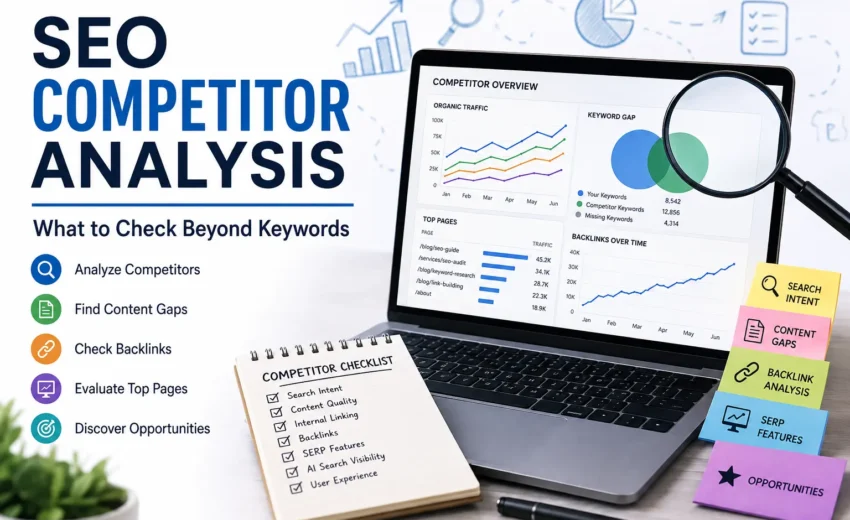
Keyword data tells you what a competitor ranks for. It doesn’t tell you why their pages perform — how the site is structured, what earns them links, which topics build their visibility, or where their strategy is actually weak. A useful competitor analysis looks at the whole picture: content, links, site structure, SERP presence, and increasingly, how competitors show up in AI-powered search.
This guide walks through that full picture, plus a quick-scan framework you can run in under 15 minutes and a checklist to keep you on track.
What Is SEO Competitor Analysis?
SEO competitor analysis is the process of examining competing websites to understand their organic visibility, content, search intent, backlinks, site structure, SERP presence, and overall strategy.
Your SEO competitors aren’t always your business competitors.
Say you run an SEO agency. Your direct business competitor might be another agency in your city. But for a search like “how to improve website rankings,” you could be competing for visibility against:
- SEO agencies
- SEO software companies
- Marketing blogs
- Industry publications
- Individual SEO professionals
These sites may never compete with you commercially, but they compete with you for the same search real estate. That’s why it helps to separate direct competitors from organic search competitors early on.
Why Keyword Research Alone Isn't Enough
Keyword gap analysis is genuinely useful. It surfaces:
- Keywords competitors rank for that you don’t
- Keywords where competitors outrank you
- Content and commercial opportunities you may be missing
What it won’t tell you is why a competitor’s page holds the #1 spot. That answer is usually one of:
- Stronger search-intent alignment
- Better internal linking
- Original research or data
- More relevant backlinks
- Broader topical coverage
- Established brand recognition
- A better on-page experience
Treat keyword research as the entry point into competitor analysis — not the whole analysis.
Step 1: Identify Your Real SEO Competitors
Find the websites that repeatedly show up for the queries that matter to your business. You can surface them by:
- Manually searching your target keywords
- Reviewing keyword-overlap reports from an SEO tool
- Noting which domains keep appearing across your target SERPs
You don’t need to analyze dozens of sites. Start with 3–5 relevant competitors, then split them into two buckets:
- Direct competitors — businesses offering a similar product or service
- Organic competitors — sites competing for the same queries, regardless of what they sell
This distinction matters because your organic competitors often outnumber your business competitors, and they’re the ones you’re actually up against in the SERPs.
Step 2: Analyze Search Intent
Search intent is the underlying goal behind a query — informational, commercial investigation, transactional, or navigational.
Search your target keyword and look at what Google is currently rewarding. If the results are mostly long-form guides, a product page won’t compete well. If the results are mostly product or service pages, a blog post probably won’t either.
Competitor analysis, done well, tells you which content format is winning before you write a word.
Step 3: Study Competitors’ Top-Performing Pages
Don’t stop at the homepage. Find the specific pages driving organic visibility, then look closely at:
- Structure and headings
- Topic and subtopic coverage
- Examples and depth
- Internal links and calls to action
- Trust signals
- Content freshness
The goal isn’t to copy the page — it’s to understand what it does well and where you can do it better.
Step 4: Find Content Gaps
A content gap is useful information your audience needs that your site doesn’t adequately cover. Competitor research typically surfaces four kinds:
- Topics you don’t cover at all
- Questions you technically answer but poorly — the content exists, but doesn’t address what searchers actually want to know
- Outdated information competitors are still ranking with — an opening for something more current
- Missing perspective — when several competitors publish near-identical content, there’s room to add first-hand experience, original data, or a clearer explanation
The goal isn’t longer content. It’s more useful, more differentiated content.
Step 5: Compare Content Quality and Depth
Word count is a weak proxy for quality. A 2,500-word article isn’t automatically better than a 1,000-word one. Ask instead:
- Does it answer the core question quickly?
- Does it cover the relevant subtopics and follow-up questions?
- Are the examples actually useful?
- Is the information accurate and current?
- Does it add anything original?
Sometimes a competitor’s long article simply doesn’t serve the reader well — and your opportunity is to be clearer and more focused, not longer.
Step 6: Examine Internal Linking
Internal links reveal how a competitor organizes their content, usually in a pattern like:
Main topic → supporting article → related article → service/product page
For example, an SEO site might connect a “SEO Audit Guide” to pages on technical SEO, keyword research, internal linking, on-page SEO, and services.
When you study this, ask which pages receive the most internal links, whether informational content connects to commercial pages, and whether important pages are easy to discover. Use it to spot gaps in your own structure — not to replicate theirs exactly.
Step 7: Analyze Backlinks
Don’t stop at “how many backlinks does my competitor have.” Look at referring domains, editorial mentions, resource-page links, and backlink growth over time — then ask the more useful question: why did this site earn that link?
Often it’s because they published original research, a free tool, a statistics page, or an industry guide others found genuinely link-worthy. That tells you what kind of content attracts attention in your space — and not every competitor backlink is one worth chasing. Prioritize links from sites where your content would genuinely serve their audience.
Step 8: Check SERP Features
Organic blue links aren’t the only visibility that matters. Depending on the query, Google may surface Featured Snippets, People Also Ask boxes, local packs, image or video results, shopping results, or AI Overviews.
When you log a keyword, don’t just note “competitor ranks #1” — note what else is happening on that results page. If a competitor consistently wins a particular SERP feature, study their formatting. But don’t assume format alone guarantees the feature; it’s one input among several.
Step 9: Analyze AI Search Visibility
Search visibility now extends past traditional rankings. Depending on your audience, it’s worth checking how competitors appear in AI-powered experiences like Google AI Overviews, Google AI Mode, ChatGPT, Perplexity, and Gemini.
Ask whether a competitor is mentioned or cited, on which topics, and whether there are queries where they appear and you don’t. There’s currently no rank-tracker-equivalent standard for this — most of it is manual spot-checking — but it’s a distinct visibility channel from traditional search, and worth tracking separately rather than treating a mention as equivalent to a #1 ranking.
Step 10: Look at Communities and Brand Mentions
Competitor research shouldn’t stop at websites. Read where real customers actually talk about your competitors — Reddit threads, forums, industry communities, review sites — and note both praise and complaints.
If customers repeatedly say a competitor’s pricing page is confusing, that’s a gap keyword tools will never surface, and a genuine opportunity: make yours clearer.
Step 11: Analyze Local SEO (When Relevant)
If you serve a specific location, compare competitors’ Google Business Profiles, review volume and sentiment, location pages, and business information. Look for patterns — one competitor might have far more reviews, another stronger location content. You don’t need to match everything; identify where your local presence can become more useful and trustworthy than theirs.
Step 12: Examine Technical SEO and User Experience
Look at mobile usability, page performance, navigation, URL structure, indexability, structured data, and overall page layout. You’re not trying to replicate their implementation — you’re asking, “is there something here worth investigating on my own site?”
Also compare the experience itself: is it easy to find information and take action? A competitor’s real advantage is sometimes nothing more than a cleaner path from landing to conversion.
Step 13: Analyze E-E-A-T Signals
Look at how competitors establish credibility: author bios, demonstrated expertise, first-hand experience, company and contact information, original research, citations, and expert contributions.
Don’t add an author bio just because a competitor has one. Ask instead: what evidence does my site give readers that they should trust this information? The goal is genuine credibility, not a checklist of superficial signals.
A 15-Minute Quick-Scan Framework
This is a lightweight first pass, not a substitute for the full analysis above — useful for triaging which competitors deserve a deeper look.
Minutes | Task |
1–2 | Search your target keyword; note the main competitors and result types |
3–4 | Skim 2–3 competing pages for structure, coverage, and obvious weaknesses |
5 | Write down questions or topics competitors don’t explain well |
6 | Check how competitors internally link related content |
7 | Look for patterns in what’s attracting their backlinks |
8 | Note Featured Snippets, PAA, local, image/video, or AI Overview presence |
9 | Ask whether this competitor’s visibility is actually tied to a valuable topic for your business |
10–15 | Pick your three highest-value opportunities — resist making a longer list |
A Simple Competitor Analysis Example
Say you run an SEO services site for small businesses. After analyzing three competitors:
Area | Competitors | Your Site | Opportunity |
Keyword coverage | Strong | Average | Build out relevant topic coverage |
Content depth | Strong | Average | Improve core guides |
Internal linking | Strong | Weak | Add contextual links between related pages |
Backlinks | Strong | Average | Create link-worthy resources |
Local SEO | Average | Strong | Maintain and defend this advantage |
Original content | Weak | Average | Add first-hand insights and data |
Service pages | Strong | Average | Improve clarity and trust signals |
That’s a far more actionable output than simply learning a competitor ranks for 500 more keywords than you do.
How to Prioritize Competitor Opportunities
Not every competitor success is worth chasing. Rank what you find by Impact × Relevance × Effort:
- High impact, high relevance, low effort → do first
- High impact, high effort → plan for, don’t rush
- Low impact, low effort → fit in when resources allow
- Low impact, high effort → usually skip
A competitor ranking well on a topic closely tied to your services, where you currently have no useful page, will almost always beat chasing an unrelated high-volume keyword.
Common SEO Competitor Analysis Mistakes
- Copying competitor content instead of using it to find your own opportunities
- Chasing every keyword, relevant or not
- Looking only at rankings and ignoring traffic, links, SERP features, UX, and brand visibility
- Assuming more backlinks automatically means better SEO — relevance and quality matter more than raw count
- Treating third-party traffic estimates as exact — use SEO tool data directionally, not as a stand-in for a competitor’s real analytics
- Ignoring search intent — a high-ranking page isn’t a good model if its intent doesn’t match your audience
- Copying every competitor tactic rather than filtering through your own audience, expertise, and goals
SEO Competitor Analysis Checklist
Competitors
- Identified main organic competitors
- Separated business competitors from search competitors
Keywords
- Logged which valuable keywords they rank for
- Logged which relevant keywords I’m missing
Search Intent
- Noted what type of content is currently ranking
- Confirmed my page matches that intent
Content
- Mapped topics competitors cover
- Identified missing questions
- Found where I can add original value
Internal Linking
- Reviewed how competitors connect related pages
- Checked whether my important pages are well linked
Backlinks
- Identified what kinds of sites link to competitors
- Identified what content is earning those links
SERPs
- Logged which search features appear
- Noted where competitors gain extra visibility
AI Search
- Checked whether competitors are mentioned or cited
- Noted which topics trigger that visibility
User Experience
- Compared navigation and ease of finding information
Action Plan
- Ranked opportunities by business value
- Chosen what to work on first
Conclusion
SEO competitor analysis is about much more than finding keywords your competitors rank for. Keywords can show you where competitors are visible, but a deeper analysis helps you understand how they earn that visibility and where opportunities exist for your website.
Look at their content, search intent, internal linking, backlinks, SERP features, AI search visibility, user experience, and customer feedback. Then compare those findings with your own website and focus on the gaps that are most relevant to your audience and business.
Most importantly, don’t try to copy your competitors. Use their strategies as a source of insight, identify what they are doing well, find where they are falling short, and create something more useful for your audience.
A successful competitor analysis should end with a clear action plan—not just a spreadsheet full of keywords.
Study the competition. Find the gaps. Build something better.

Alfik P S
hi

August 31, 2026