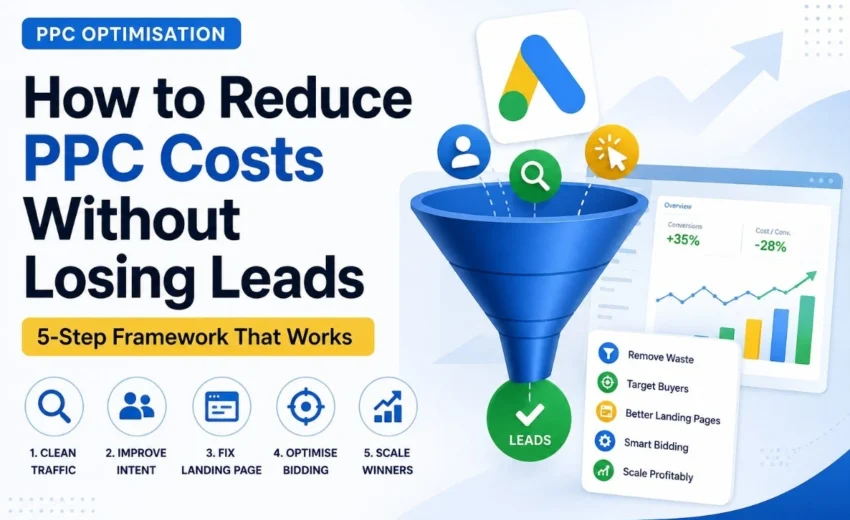
TL;DR – The 5 steps in one sentence: Clean irrelevant traffic → target buyers, not browsers → fix your landing page → let automation bid only after you have clean data → scale winners by increasing budgets, not duplicating campaigns.
Below is the full framework – practical PPC strategies for 2026.
You run ads. You see results. But lately, every time you increase the budget, your profits stay flat – or shrink.
Many businesses are in the same position. Platforms have become more competitive, and costs keep rising. The old trick of “just spend more” no longer works.
The good news? You do not need a bigger budget. You need a smarter system. Most campaigns contain avoidable waste that can be reduced through better optimisation – without losing conversions.
Here is a simple but powerful framework. Call it the 5‑Step Ad Cost Reduction Framework.
The 5‑Step Ad Cost Reduction Framework
Follow this order – don’t skip around.
Clean Traffic – Stop paying for irrelevant clicks.
Improve Intent – Show ads only to people ready to buy.
Fix the Landing Page – Convert more of the traffic you already have.
Optimise Bidding – Let data (not guesses) set your bids.
Scale What Works – Invest more in winners without breaking auction dynamics.
Now let’s walk through each step.
Step 1: Clean Traffic – Stop Paying for Clicks That Will Never Convert
Most ad waste comes from showing your ads to the wrong people. The platform doesn’t know who your ideal customer is unless you tell it.
In many local campaigns, irrelevant searches are often the first source of wasted spend we uncover. A business targeting “digital marketing” might pay for clicks from students looking for free courses or people searching for job openings. That budget never had a chance to convert.
What to do first – Google Ads (search): Run a search term report. Look for searches that have nothing to do with your offer. Add those as negative keywords. Examples: free, tutorial, job, cheap, DIY. For expert help, see our Google Ads management services.
What to do first – Meta (Facebook/Instagram): Meta does not use negative keywords. Instead, review audience insights and exclude irrelevant demographics, interests, behaviours, or placements. Use brand safety blocklists if needed. Learn more in our Meta advertising guide.
Why this matters: Cleaning traffic is the fastest way to lower costs. It requires no budget increase and no creative changes – just regular review.
Step 2: Improve Intent – Target Buyers, Not Browsers
Once you’ve stopped paying for completely wrong traffic, focus on people close to buying.
The mistake many make: Bidding on short, broad keywords like digital marketing or travel packages. These bring high volume but low purchase intent.
The fix – search ads: Use longer, more specific keywords such as digital marketing agency for small business or last-minute Kerala tour packages under 30000. These have lower volume but higher conversion rates – and often lower CPC.
The fix – social ads: Use engagement‑based targeting (e.g., people who have interacted with similar pages) or retargeting lists. Avoid broad “interested in” categories.
Search intent almost always beats raw traffic volume.
Step 3: Fix the Landing Page – Convert More Without Increasing Spend
You’ve cleaned traffic and improved intent. Now the person clicks – and lands on a slow, confusing, or generic page. You lose them.
This is the most overlooked opportunity. You can significantly lower your cost per acquisition by optimizing your landing page. Explore our conversion optimisation resources for detailed tactics.
What a good landing page needs:
Match the ad’s promise – Same headline, same offer. No bait‑and‑switch.
Load quickly – Especially on mobile. A delay of just a few seconds causes many visitors to leave.
One clear goal: remove navigation menus, social media links, and other distractions.
Show trust signals – Testimonials, clear guarantees, security badges where relevant.
Why this works: Better landing page performance often means lower CPA and stronger ROAS. More of your existing traffic converts → more leads or sales from the same spend → lower cost per result without changing bids or keywords. Want deeper CRO strategies? Learn how to improve landing page conversion rates.
Step 4: Optimise Bidding – Let Automation Work, But Only With Clean Data
Automated bidding (Target CPA, Maximise Conversions) can lower costs – but only if you feed it good data.
A safety guideline (not a hard rule): Smart bidding performs more predictably when campaigns have consistent recent conversion data – roughly 20–50 conversions in the last 30 days. Google’s machine learning can work from launch, but without historical data, you risk volatile spending. Treat this as a safety recommendation.
Once you have sufficient data: Set a realistic Target CPA. Start slightly higher than your current average, then let the system learn for 1–2 weeks. Monitor to ensure it doesn’t overspend on low‑value clicks.
Important even with automation: You still need to review search terms and add negatives. Automation amplifies your strategy – it does not replace human oversight.
Step 5: Scale What Works – Double Down on Winners, Avoid Common Mistakes
Many advertisers spread their budget evenly across campaigns. That’s a mistake.
A better approach – the 80/20 rule: Identify the 20% of keywords, audiences, or ads that produce most of your conversions. Move more budget there. Reduce or pause everything that consistently misses your target CPA.
How to scale without breaking your campaigns:
Increase the budget on the winning ad set gradually – 10–20% every few days. Avoid large jumps that reset the learning phase.
Introduce new creative variations into the same winning ad set – do not duplicate the entire campaign. Duplication in modern Meta and Google environments (Advantage+, Performance Max) can cause audience fragmentation and auction overlap.
Pause keywords with many clicks and zero conversions.
Slightly increase bids on high‑converting keywords (search only).
Many business owners obsess over cost per click. That’s a distraction. A low CPC does not guarantee a low cost per sale.
Focus on these three numbers instead:
Cost per acquisition (CPA) – How much you pay for a lead or sale.
Conversion rate – The percentage of clicks that turn into customers.
Return on ad spend (ROAS) – Revenue divided by ad cost.
If your CPA is profitable, you can afford a higher CPC. If your CPA is too high, fix your landing page or targeting before touching bids.
Final Thoughts – The Framework Works If You Work It
Lower ad costs come from a repeatable system: clean traffic, raise intent, fix your landing page, bid smart, and scale winners without duplication.
Start with Step 1 today.
Google Ads: run a search term report, add five negative keywords.
Meta: review placements and exclude irrelevant audiences.
Within a few weeks, you should see a noticeable difference – not because you cut your budget, but because you stopped paying for clicks that never had a chance to convert.
Want a Smarter PPC Campaign?
At Mindovermaze Digital Marketing Agency, we apply this exact framework – practical, transparent, and results‑driven.
We can help you:
Get a free PPC waste audit
Implement the 5‑step framework for your account
Lower CPA while protecting conversions
👉 Request a PPC audit – or explore our PPC services, digital marketing services, and Google Ads management.