The way you bid in Google Ads has a direct impact on your results. You can have great keywords and a strong landing page, but if your bidding strategy does not match your business goals, you will likely waste money.
Many advertisers focus on getting more clicks. That can be useful in some situations, but successful campaigns are built around what really matters: leads, sales, profit, or brand awareness.
In this guide, I will explain how Google Ads bidding works, describe each main bid strategy in plain language, and help you choose the right one without unnecessary complexity.
What Is a Google Ads Bid Strategy?
A bid strategy is the method Google uses to set or adjust your bids during ad auctions. Every time someone searches, Google runs an instant auction. It looks at your maximum bid, how relevant your ad is to the search, how likely someone is to click your ad, the quality of your landing page, and signals like the person’s device, location, and time of day.
All these factors together decide your Ad Rank – whether your ad shows up and where it appears.
The purpose of a bidding strategy is not simply to buy traffic. It is to make sure your spending drives a specific result, such as a form submission, a phone call, or a product sale.
How Bidding Really Works
A common myth is that the highest bidder always wins. That is not true.
Google also cares about user experience. If your ad is very relevant to the search and your landing page is helpful, you can win auctions even with a lower bid than a competitor.
For example, an advertiser with a lower maximum cost‑per‑click but a much higher Quality Score can end up in a better ad position than a competitor who bids more but has a poor Quality Score.
This matters because improving your ad relevance and landing page experience often reduces your advertising costs more effectively than simply increasing bids.
Manual Bidding vs Smart Bidding
Google Ads gives you two main types of bid strategies: manual and smart.
Manual Bidding (Manual CPC)
You control bids at the keyword level yourself. You decide how much to pay for each click.
This works well for small campaigns, testing new keywords, or when you are an experienced advertiser who wants full control. The benefits are complete control and easy budget management. The downsides are that it is time‑consuming and cannot react instantly to real‑time signals like device or location.
Smart Bidding
Smart Bidding uses Google’s machine learning to adjust bids in real time for each auction. It looks at dozens of signals – device, browser, location, audience, time of day, search intent, and more.
A common old rule said you needed at least 30 conversions in the last 30 days before using Smart Bidding. That is no longer a strict requirement. Google’s algorithms have evolved. You can use Smart Bidding on day one for a new campaign because it can learn from pixel‑level data, global account history, and broader industry signals. However, having consistent conversion data still leads to more stable performance. It is a best practice, not a hard gate.
Smart Bidding works well when you have accurate conversion tracking and want to save time. The trade‑off is that you have less visibility into why bids changed.
There is also a middle option called Enhanced CPC. It starts with your manual bids and automatically adjusts them when a conversion seems likely. It is a safe first step toward automation.
The Main Bidding Strategies Explained
Let me walk through each strategy in simple terms.
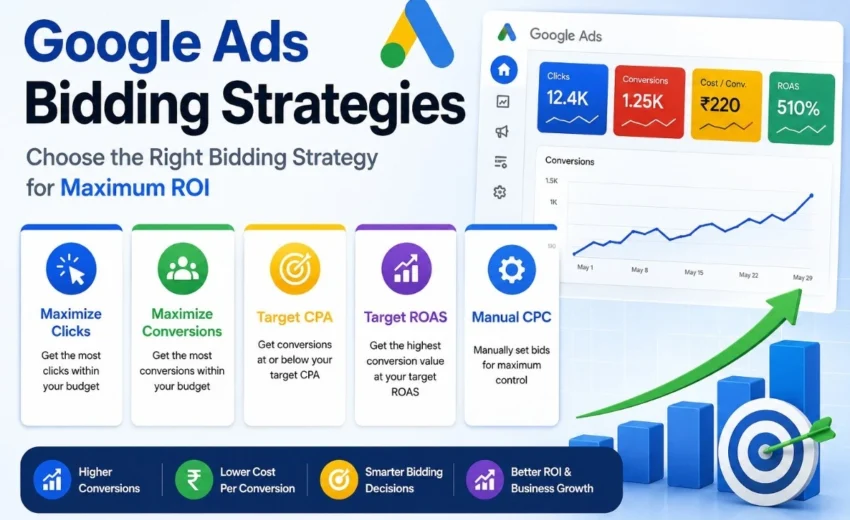
Maximize Clicks
This strategy tells Google to get you as many clicks as possible within your daily budget. It is best for brand new campaigns or when you just want to collect traffic and initial data. The main risk is that you can spend your budget very quickly on low‑quality clicks, so it is wise to set an optional maximum cost‑per‑click limit.
Manual CPC
You set bids for individual keywords or ad groups, and Google does not change them automatically. This is ideal for experienced advertisers who know exactly which keywords perform best. It gives you full control but requires constant attention.
Maximize Conversions
Instead of focusing on clicks, this strategy focuses on getting the highest number of conversions within your budget. Conversions can be form fills, calls, purchases, or any action you care about. This works well for lead generation businesses, service companies, and appointment bookings. The one limitation is that it treats all conversions equally, even if some are worth more than others.
Target CPA (Now a Setting Within Maximize Conversions)
In the current Google Ads interface, you no longer find a standalone “Target CPA” strategy. Instead, you choose Maximize Conversions and then check the box that says “Set a target cost per action (CPA).” You enter the average cost per conversion you want to aim for. Google then tries to get as many conversions as possible while keeping your average CPA at or below that target. This is useful when you know exactly how much a lead is worth to your business.
Maximize Conversion Value
This strategy focuses on the total value of your conversions, not the number. If you sell products at different prices, Maximize Conversion Value tries to get you more high‑value sales. It is best for eCommerce stores or any business that tracks different conversion values, such as a service business where some contracts are larger than others.
Target ROAS (Now a Setting Within Maximize Conversion Value)
Similarly, Target ROAS is no longer a standalone strategy. You select Maximize Conversion Value and then check the box “Set a target return on ad spend (ROAS).” You enter a percentage – for example, 500% means you want five rupees in revenue for every one rupee spent. Google then optimises bids toward that goal. This is ideal for online retailers who know their profit margins and want to scale profitably.
Target Impression Share
This strategy prioritises visibility over clicks or conversions. You can target the absolute top of the page, the top of the page, or just anywhere on the search results. It is best for brand awareness campaigns, product launches, or defending your brand name against competitors. The downside is that it can be expensive and does not optimise for conversions or revenue.
How to Choose the Right Strategy
Instead of memorising complex tables, ask yourself three simple questions.
First, do you have conversion tracking set up? If no, start with Maximize Clicks or Manual CPC. If yes, move to the second question.
Second, do you have different conversion values? If all conversions are equal to you – for example, every lead is worth the same – use Maximize Conversions. You can optionally add a Target CPA if you want cost control. If your conversions have different values – like different product prices – use Maximize Conversion Value. You can optionally add a Target ROAS if you have a profitability target.
Third, is your main goal brand visibility rather than conversions? If yes, use Target Impression Share.
For those who want maximum control regardless of the answers above, Manual CPC is always an option.
When to Switch Bidding Strategies
One of the most common mistakes is switching strategies too frequently. Every major change resets Google’s learning process.
A sensible path for a new campaign is to start with Maximize Clicks or Maximize Conversions (if you have conversion tracking from day one). After a week or two, if you started with Maximize Clicks and have gathered some conversion data, you can switch to Maximize Conversions. Once you have consistent conversion volume – even 10 to 15 conversions per month can work, though more is better – you can turn on Target CPA or Target ROAS within the respective strategies.
Always allow at least one to two weeks after a bid strategy change before judging performance. For low‑volume campaigns, it may take three or four weeks.
Also, keep in mind that Smart Bidding needs enough budget to explore. If your budget is very small compared to your average cost per click, manual bidding may still perform better.
Common Mistakes to Avoid
Switching strategies too often is the top mistake. Each change resets learning.
Skipping conversion tracking is another. Without accurate tracking, Smart Bidding cannot make good decisions.
Setting unrealistic targets is also common. If you set a Target CPA that is too low or a Target ROAS that is too high, you will get very few conversions or no traffic at all.
Looking for more ways to improve campaign efficiency? Check out our guide on reducing PPC costs without losing leads, where we cover Quality Score improvements, negative keywords, and landing page optimization techniques.
Finally, do not ignore your landing page. Even the perfect bid strategy cannot save a slow or confusing landing page.
How Quality Score Affects Your Bidding
Quality Score is Google’s rating of your ad and landing page. It has three components: expected click‑through rate, ad relevance, and landing page experience.
A higher Quality Score helps you in three ways. You pay less per click. You win better ad positions. And your conversions often cost less.
Before you raise your bids, always check if you can improve your Quality Score. Sometimes, a small improvement here gives you a better return than a large budget increase.
Best Practices for Smarter Bidding
Track your conversions carefully using Google Ads conversion tags or by importing from Google Analytics.
Give Smart Bidding time to learn. Do not judge it after two days.
Add negative keywords regularly to filter out irrelevant searches.
Make sure your landing page loads quickly and matches what your ad promises.
Test different strategies using Google Ads experiments instead of guessing.
Review your search term reports to find wasted spend.
And always align your bid strategy with your real business goal, not with vanity metrics like “more clicks.”
Final Thoughts
No single bid strategy works for every business.
A local service provider who needs leads might do well with Maximize Conversions and a Target CPA. An online store with products at different price points might prefer to maximize conversion value with a Target ROAS. A brand new company that just wants visitors might start with Maximize Clicks.
The smartest advertisers do not chase the lowest possible cost per click. They chase profitability, conversion quality, and long-term return on investment. If improving ROI is your primary goal, read our guide on maximizing Google Ads ROI without wasting your budget. When your bid strategy aligns with your business goals, Google Ads becomes a powerful growth tool rather than a black hole for your budget.
Start simple, track your results, and adjust slowly. You will get there.
Alfik P S
hi
How to Reduce PPC Costs Without Losing Leads...