If you’re planning to advertise with Google Ads, one of the first decisions you’ll need to make is choosing the right campaign type. Among the many options available, Search Campaigns and Performance Max (PMax) are two of the most popular.
Although both are designed to help businesses generate leads and sales, they work in very different ways.
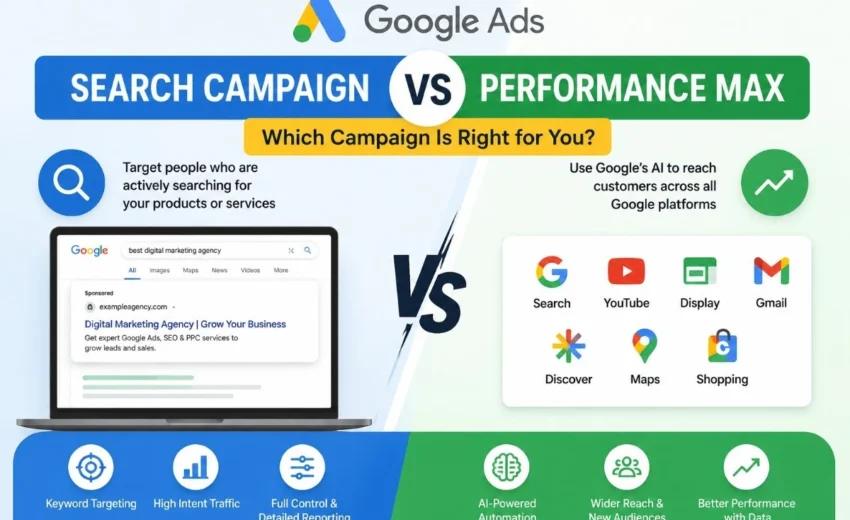
A Search Campaign targets people who are actively searching for products or services using specific keywords. Performance Max, on the other hand, uses Google’s AI to display your ads across multiple Google platforms, including Google Search, YouTube, Display, Gmail, Discover, Google Maps, and Google Shopping.
So, which campaign should you choose?
There isn’t a single answer that works for every business. The right campaign depends on your goals, budget, available conversion data, and the level of control you want over your advertising. In this guide, we’ll compare Search Campaigns and Performance Max, explain their key differences, and help you decide which option best suits your business.
Key Takeaways
- Search Campaigns target people actively searching for your products or services.
- Performance Max uses Google’s AI to advertise across multiple Google platforms.
- Search Campaigns provide greater control over keywords, bids, and reporting.
- Performance Max offers wider reach through automation and machine learning.
- Many businesses achieve the best results by using both campaign types together.
What Is a Google Ads Search Campaign?
A Search Campaign displays Responsive Search Ads on the Google Search Network when someone searches for keywords related to your business.
For example, if you run a digital marketing agency and target the keyword Google Ads Management, your ad could appear when users search for:
- Google Ads agency
- PPC management services
- Google Ads consultant
These users already have a clear intent—they’re looking for a solution, making them more likely to become leads or customers.
One of the biggest strengths of Search Campaigns is the level of control they provide. You can choose your keywords, write your ad copy, set bidding strategies, add Negative Keywords, review the Search Terms Report, and optimise campaigns based on actual search behaviour.
Because of this flexibility, Search Campaigns are often the preferred choice for local businesses, service providers, B2B companies, and brands focused on lead generation.
What Is a Performance Max Campaign?
Performance Max is Google’s AI-powered campaign type that allows advertisers to promote their business across all of Google’s advertising channels from a single campaign.
Instead of relying mainly on keywords, Performance Max uses machine learning, Audience Signals, Search Themes, Asset Groups, conversion data, and creative assets to determine where your ads are most likely to perform well.
Depending on Google’s optimisation, your ads may appear across:
- Google Search
- Google Shopping
- YouTube
- Google Display Network
- Gmail
- Google Discover
- Google Maps
Performance Max combines your headlines, descriptions, images, logos, and videos into different ad formats using Asset Groups. Google’s AI then tests different combinations to find the ones most likely to achieve your campaign goals.
It’s important to understand that Audience Signals don’t restrict who sees your ads. Instead, they provide Google’s AI with a starting point, helping it identify users who are more likely to convert before expanding to similar audiences.
Because much of the optimisation happens automatically, Performance Max requires less manual management. However, it also gives advertisers less visibility into search queries and placements than traditional Search Campaigns.
Search Campaign vs Performance Max: Key Differences
Here’s a quick comparison:
Feature | Search Campaign | Performance Max |
Primary Targeting | Keywords | AI, Audience Signals & Search Themes |
Where Ads Appear | Google Search | Search, YouTube, Display, Gmail, Discover, Maps & Shopping |
Level of Control | High | Moderate to Low |
Keyword Management | Full control | Limited |
Reporting | Detailed keyword & search term reports | Limited search query visibility |
Best For | Lead generation & high-intent searches | Scaling campaigns & reaching new audiences |
Creative Assets | Mainly text ads | Text, images, logos & videos |
Learning Curve | Easier to understand | Requires conversion data for better optimisation |
Search Campaigns allow advertisers to manage keywords, match types, bidding strategies, ad copy, and Negative Keywords with precision. Performance Max automates many of these decisions, relying on machine learning to optimise bidding, placements, and audience expansion.
Reporting also differs significantly. Search Campaigns provide detailed insights into keyword performance, search queries, conversions, and click-through rates. Performance Max offers useful reporting on Asset Groups and overall campaign performance, but advertisers have less visibility into individual search queries and placements.
When Should You Choose a Search Campaign?
A Search Campaign is the best choice when your goal is to reach people who are actively looking for your products or services. Since your ads appear in response to specific search queries, you’re targeting users with clear intent, making them more likely to convert.
Search Campaigns are a great option if you:
- Want to generate leads or sales from high-intent searches.
- Have a limited advertising budget.
- Need full control over keywords, bids, and ad copy.
- Regularly optimize campaigns using the Search Terms Report and Negative Keywords.
- Want detailed reporting to understand what’s working.
For example, if you run a plumbing business, a Search Campaign allows your ad to appear when someone searches for “emergency plumber near me” or “plumbing service in Kochi.” Since these users are already looking for help, they’re much more likely to contact your business.
When Should You Choose Performance Max?
Performance Max is designed for businesses that want to reach customers beyond Google Search.
Instead of relying only on keyword searches, Google’s AI looks for potential customers across YouTube, Gmail, Discover, Display, Shopping, and Maps based on signals such as browsing behavior, interests, and previous interactions.
Performance Max is a good choice if you:
- Want to increase brand awareness.
- Run an eCommerce business with a well-optimized Google Merchant Center feed.
- Have high-quality images, videos, and other creative assets.
- Already receive consistent conversions.
- Want to scale your campaigns across multiple Google platforms.
Keep in mind that Audience Signals don’t limit who sees your ads. They simply give Google’s AI a starting point to find users who are more likely to convert before expanding to similar audiences.
If you’re launching a brand-new Google Ads account with little or no conversion history, starting with a Search Campaign is usually the safer option. Once you’ve collected enough conversion data, Performance Max can become a valuable addition to your advertising strategy.
Can You Run Both Campaign Types Together?
Absolutely.
Many successful advertisers don’t choose one campaign over the other—they use both.
A Search Campaign helps capture users who are actively searching for your products or services, while Performance Max expands your reach by introducing your brand to potential customers across Google’s advertising network.
Think of them as working together rather than competing.
For example, an online furniture store might use a Search Campaign to target keywords like “buy office chair online”, while Performance Max promotes the same products through YouTube, Google Shopping, and the Google Display Network to users who have shown similar interests but haven’t searched yet.
This combination allows businesses to capture existing demand while also creating new opportunities for future sales.
Common Mistakes to Avoid
Even experienced advertisers can make mistakes when choosing campaign types. Here are some of the most common ones.
Launching Performance Max Without Conversion Tracking
Performance Max relies heavily on conversion data. If Google Ads Conversion Tracking or Google Analytics 4 (GA4) isn’t configured correctly, Google’s AI won’t have enough information to optimize bidding and placements effectively.
Expecting Performance Max to Replace Search Campaigns
Performance Max is a powerful campaign type, but it isn’t a replacement for Search Campaigns. If your business depends on targeting specific keywords or protecting branded searches, Search Campaigns remain an important part of your advertising strategy.
Using Low-Quality Creative Assets
Performance Max automatically combines headlines, descriptions, images, logos, and videos into different ad formats. Poor-quality creative assets can reduce your campaign’s effectiveness across Google’s platforms.
Ignoring Campaign Optimisation
Whether you’re running Search Campaigns or Performance Max, regular optimization is essential.
Review your Search Terms Report, update your Negative Keywords, improve landing pages, test new ad creatives, and monitor conversion performance. Even automated campaigns benefit from ongoing management.
Making Changes Too Frequently
Performance Max goes through a learning phase after launch. Making significant changes every few days can interrupt Google’s optimization process and delay performance improvements. Give campaigns enough time to collect data before making major adjustments.
Best Practices
To get the most from your Google Ads campaigns:
- Define clear campaign goals before you start.
- Set up accurate Google Ads Conversion Tracking and Google Analytics 4 (GA4).
- Use Search Campaigns to capture high-intent traffic.
- Introduce Performance Max once you have enough conversion data.
- Keep your Google Merchant Center feed updated for Shopping campaigns.
- Upload high-quality images, videos, headlines, and descriptions.
- Monitor important metrics such as CTR, Conversion Rate, Cost Per Acquisition (CPA), and Return on Ad Spend (ROAS).
- Test, analyse, and optimise your campaigns regularly rather than relying entirely on automation.
Google Ads isn’t a “set it and forget it” platform. Consistent testing and optimization usually produce better long-term results than making one-time campaign changes.
Final Thoughts
Choosing between a Google Ads Search Campaign and Performance Max depends on your business goals, budget, and advertising strategy. If your priority is reaching people who are actively searching for your products or services, Search Campaigns offer greater control and precise keyword targeting. If you want to expand your reach across Google’s platforms using AI-driven automation, Performance Max can help you discover new customers and scale your campaigns.
For many businesses, using both campaign types together delivers the best results. Search Campaigns capture high-intent traffic, while Performance Max helps expand your reach across Google’s advertising ecosystem.
As you optimise your campaigns, don’t forget to review your Search Terms Report, track conversions accurately, and create relevant landing pages. You can also explore our guides on Google Ads Match Types Made Simple: Broad, Phrase & Exact Match and Maximizing Google Ads ROI Without Wasting Your Budget to strengthen your Google Ads strategy further.
The best-performing Google Ads accounts aren’t built by choosing a single campaign type—they’re built through continuous testing, optimisation, and making decisions based on real campaign data. Over time, these improvements can help you achieve better results while making the most of your advertising budget.

Alfik P S
hi

July 15, 2026
Google Ads Match Types Made Simple: Broad, Phrase...
July 15, 2026