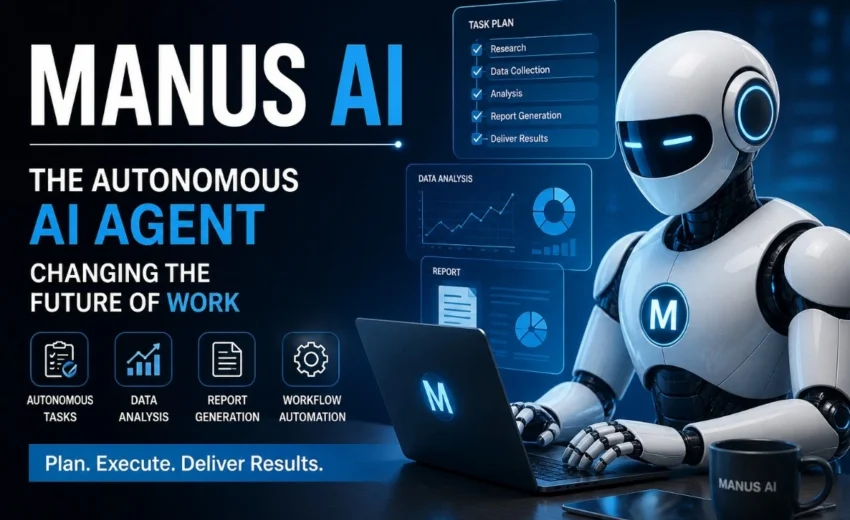
Artificial intelligence is rapidly evolving from simple chatbots to autonomous AI agents capable of completing real tasks. Instead of just generating text responses, modern AI systems are being designed to plan, execute, and deliver outcomes with minimal human input.
One of the newest platforms in this emerging space is Manus AI. The tool represents a growing trend known as agentic AI, where intelligent systems can manage complex workflows, analyze information, and produce completed results.
As businesses and individuals increasingly rely on automation, tools like Manus AI are beginning to reshape how work is done in areas such as research, marketing, data analysis, and productivity management.
What is Manus AI?
Manus AI is a general-purpose autonomous AI agent designed to convert instructions into completed tasks. Unlike traditional AI chatbots that simply answer questions, Manus AI focuses on task execution and workflow automation.
The system combines several advanced technologies, including:
Large Language Models (LLMs)
Autonomous agent frameworks
Cloud computing infrastructure
Data processing tools
Automation systems
Together, these technologies allow Manus AI to function like a digital assistant, analyst, and project manager working simultaneously.
Instead of requiring step-by-step instructions from users, the AI can break down a request, plan the process, and produce the final output.
The Rise of Agentic AI
The concept behind Manus AI belongs to a new generation of systems called AI agents.
Traditional AI tools such as ChatGPT, Claude, and Google Gemini mainly operate as conversational assistants. They generate responses based on prompts but rely heavily on users to guide each step of a task.
Agentic AI works differently.
These systems are designed to:
Interpret complex goals
Break them into smaller tasks
Use tools and data sources
Execute workflows automatically
Deliver completed results
This shift is transforming AI from information providers into autonomous problem-solving systems.
Major technology companies such as OpenAI, Google DeepMind, Meta, Microsoft, and Anthropic are actively researching and developing similar AI agent technologies.
One of the most important capabilities of Manus AI is its ability to perform multi-step tasks independently.
After receiving a goal, the AI can analyze the request, gather relevant information, and generate structured outputs.
Examples of tasks Manus AI can assist with include:
Industry and market research
Financial and data analysis
Report generation
Marketing strategy planning
Travel itinerary planning
This makes the platform useful for business professionals, entrepreneurs, marketers, and researchers.
Virtual Computing Environments
Manus AI reportedly operates tasks through virtual computing environments. These environments allow the system to simulate a digital workspace similar to how humans use computers.
Within these environments, the AI can:
Process large datasets
Execute automated scripts
Manage multi-step workflows
Generate dashboards and reports
This architecture enables the system to manage complex operations without constant supervision.
Multi-Modal Intelligence
Another key capability of modern AI systems is multi-modal processing, meaning they can understand and work with different types of data.
Manus AI can process:
Text-based information
Structured data and spreadsheets
Documents and reports
Images and digital assets
Combining multiple data formats allows the system to produce more comprehensive insights and analyses
Real-World Applications of Manus AI
The flexibility of Manus AI makes it useful across several industries.
Market Research
Companies can use Manus AI to gather and analyze information about:
Market trends
competitor strategies
customer behavior
industry reports
Instead of manually collecting data from different sources, the AI can compile findings into structured reports.
Content Creation and SEO
Digital marketers and bloggers can use Manus AI to support tasks such as:
keyword research
content planning
blog outline generation
SEO audits
marketing strategy development
This can significantly reduce the time required to produce high-quality digital content.
Data Analysis
Businesses frequently deal with large datasets containing sales metrics, financial reports, and operational data.
Manus AI can analyze these datasets and generate summaries such as:
revenue trends
performance insights
growth indicators
This helps decision-makers quickly understand complex information.
Personal Productivity
Beyond professional use cases, Manus AI can also assist individuals with everyday productivity tasks.
Examples include:
travel planning
study guides and learning materials
project organization
scheduling workflows
This makes the tool useful for both businesses and individual users.
Manus AI vs Traditional AI Tools
To better understand the role of Manus AI, it helps to compare it with traditional AI systems
Feature
Traditional AI Tools
Manus AI
Primary Function
Answer questions
Execute tasks
Workflow Automation
Limited
Advanced
Multi-step reasoning
User-guided
Autonomous
Output
Responses
Completed outcomes
Performance and Benchmarks
Reports suggest that Manus AI performs strongly in the GAIA benchmark, which evaluates AI systems based on their ability to complete real-world multi-step tasks.
Benchmarks like GAIA are designed to measure practical problem-solving ability, rather than simple question answering.
Strong performance in such benchmarks indicates that systems like Manus AI may play a significant role in the future of AI-driven automation.
Limitations and Challenges
Despite its promising capabilities, Manus AI still faces some challenges.
Like many AI systems, it may encounter difficulties with:
complex decision-making tasks
restricted or paywalled data sources
verification of sensitive information
Because of these limitations, human oversight remains important, particularly when AI is used for financial, legal, or strategic decision-making.
The Future of Autonomous AI Agents
Autonomous AI agents are becoming one of the most important trends in artificial intelligence.
Technology companies including OpenAI, Microsoft, Google, and Meta, are investing heavily in systems that can automate complex workflows.
As these technologies continue to evolve, AI agents like Manus AI could become essential tools for businesses and professionals looking to increase efficiency, reduce manual work, and improve productivity.
Conclusion
Manus AI represents a significant step forward in the evolution of artificial intelligence. By combining large language models, automation systems, and virtual computing environments, it transforms AI from a simple assistant into a powerful autonomous agent capable of executing real tasks.
Although the technology is still developing, platforms like Manus AI demonstrate how agentic AI could reshape digital marketing work, automation, and productivity in the coming years.