
By 2026, over half of all search queries could be answered directly by AI — not a list of blue links. If your content isn’t optimized for Generative Engine Optimization (GEO), your competitors will get cited instead of you. Here’s exactly how to fix that.
Search is evolving faster than ever. For years, businesses focused on traditional search engine optimization (SEO) to rank higher in search results. But with the rise of AI-powered search systems, a new optimization approach is emerging — Generative Engine Optimization (GEO).
AI-powered search platforms now generate direct answers instead of simply listing links. This means businesses must optimize their content not only for search engines but also for AI systems that analyze and summarize information.
In this guide, you’ll learn what AI search SEO is, how AI systems evaluate content, and the practical strategies businesses can use to increase their chances of appearing in AI-generated answers.
What Is AI Search?
AI search refers to search systems powered by artificial intelligence that generate conversational answers to user queries.
Unlike traditional search engines that display a list of websites, AI search tools analyze multiple sources and generate summarized responses.
Examples include:
- OpenAI AI assistants
- Google AI Overviews
- Perplexity AI answer engine
These platforms use advanced language models that read and interpret web content before generating answers for users.
For website owners, this raises an important question:
How can your content be included in AI-generated answers?
The answer lies in Generative Engine Optimization (GEO).
What Is Generative Engine Optimization (GEO)?
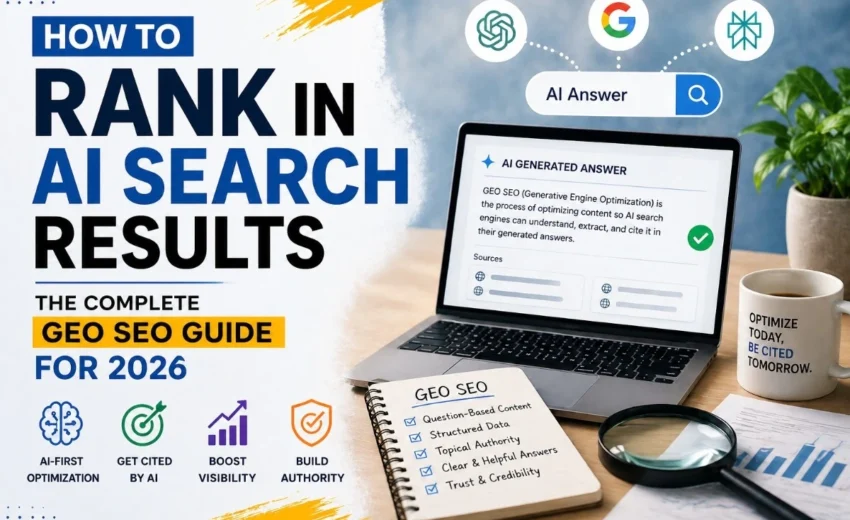
Generative Engine Optimization (GEO) is the process of structuring and optimizing content so that AI-powered search engines can easily understand, extract, and reference it.
Traditional SEO focuses on ranking webpages in search results through factors like keywords, backlinks, and page authority.
GEO SEO focuses more on:
- structured information
- question-based content
- authoritative expertise
- clear explanations
The goal is to make your content easy for AI systems to interpret and include when generating responses.
Why GEO SEO Matters in 2026
AI search adoption is growing rapidly as more users turn to conversational search tools for quick answers.
Research from several digital marketing studies suggests that AI-powered search experiences are becoming increasingly common, especially for informational queries.
Instead of visiting multiple websites, users can receive a summarized response instantly.
For businesses, this shift creates a new opportunity: being cited by AI answers can significantly increase brand visibility.
Benefits of GEO SEO include:
- Greater Visibility – If AI systems reference your content, your brand can reach a wider audience.
- Increased Authority – When AI tools consistently cite your content, it strengthens your reputation as a reliable source of information.
- Long-Term SEO Advantage – Businesses that adapt early to GEO SEO can stay ahead of competitors as AI-driven search grows.
Real-world proof: At MindoverMaze, we helped a B2B SaaS client increase its AI citation rate by 67% in just 60 days using a combination of question-based content and structured data. Their brand started appearing inside Google AI Overviews and Perplexity answers — without spending a dime on ads.
How AI Search Engines Evaluate Content
Although AI search systems use complex machine learning models, several common factors influence which content they reference.
1. Content Clarity
AI systems prefer content that clearly answers questions with simple explanations.
Example:
Question: What is GEO SEO?
Answer: Generative Engine Optimization is the process of structuring content so AI systems can extract accurate answers from webpages.
Clear definitions like this are easier for AI models to interpret.
2. Topical Authority
Websites that consistently publish high-quality content on a specific topic are more likely to be referenced.
For example, a digital marketing website that regularly publishes articles about SEO strategies, link building, AI search optimization, and content marketing is more likely to be recognized as an authoritative source.
3. Structured Content
Well-organized content helps AI systems understand information.
Helpful structures include headings, bullet points, numbered lists, and FAQs. This makes it easier for AI models to identify important information.
4. Credible Sources
AI systems often prioritize content that references reliable information and trusted websites. Including statistics, research findings, and expert insights can increase credibility.
7 Strategies to Rank in AI Search Results
Businesses can improve their chances of appearing in AI-generated answers by following these GEO SEO principles.
1. Create Question-Based Content
AI searches are often conversational. Examples include:
- What is generative engine optimization?
- How do websites rank in AI search results?
- What are AI search ranking factors?
Creating content that directly answers these questions increases the likelihood that AI systems will reference it.
2. Use Clear and Structured Formatting
AI models prefer content that is easy to read and understand.
Best practices include: short paragraphs, descriptive headings, bullet points, and step-by-step explanations. This improves readability for both users and AI systems.
3. Build Strong Topical Authority
Instead of publishing random articles, focus on becoming an expert within a specific niche.
For example, a marketing blog could build topical authority by publishing articles about SEO techniques, digital marketing strategies, content marketing, and AI search optimization. Consistent publishing helps search engines and AI systems recognize your expertise.
4. Support Content With Data and Research
Including data and statistics increases credibility.
Example:
Studies from SEO research platforms show that webpages with strong backlink profiles and authoritative content tend to perform better in search results.
Reliable information improves trust signals for both search engines and AI systems.
5. Optimize for Featured Snippets
Many AI-generated answers pull information from pages that already rank in featured snippets.
To increase your chances: answer questions directly, summarize key points, and use concise definitions. This improves your visibility in both traditional search results and AI-generated answers.
6. Strengthen Website Authority
Backlinks from trusted websites remain an important signal of authority.
Guest blogging, partnerships, and content collaborations can help build these links naturally. High-authority backlinks increase the credibility of your content. (Need help with link building? [Explore our SEO authority services →])
7. Implement Structured Data
Structured data helps search engines understand the context of your content.
Examples of schema markup: articles, FAQs, organizations, and authors. This structured information improves how search engines and AI systems interpret your content. (Our team at MindoverMaze specializes in technical SEO and schema implementation
Common GEO SEO Mistakes to Avoid
As businesses experiment with AI search optimization, several common mistakes appear.
- Creating Generic Content – Content that simply repeats existing information without new insights is less likely to be referenced by AI systems.
- Ignoring Author Expertise – Content without a clear author or credible source may appear less trustworthy. Including author information helps strengthen E-E-A-T signals.
- Overusing Keywords – AI search systems focus more on meaning and context than keyword repetition. Content should prioritize clarity rather than keyword density.
The Future of SEO in the Age of AI
The future of search will likely combine traditional SEO with AI-driven answer engines.
Businesses that focus on high-quality content, structured information, and credible expertise will be better positioned to succeed in this evolving search landscape.
Instead of competing only for search rankings, websites will increasingly compete for visibility inside AI-generated answers. Brands that ignore GEO won’t just drop in rankings — they’ll become invisible inside AI-generated answers entirely.
This shift highlights the growing importance of Generative Engine Optimization (GEO).
Conclusion
AI-powered search is transforming how people discover information online.
While traditional SEO remains important, optimizing content for AI search results is becoming increasingly valuable.
By implementing GEO SEO strategies such as structured content, question-based writing, and authoritative information, businesses can increase their chances of appearing in AI-generated answers.
Organizations that adapt early to this new search environment will gain a strong advantage in the future of digital visibility.
🚀 Ready to Future-Proof Your SEO?
Traditional SEO isn’t dying — but it’s not enough anymore. MindoverMaze helps you stay ahead with:
- GEO audits that reveal whether your current content is AI-friendly
- Content restructuring for AI citation and featured snippets
- Technical SEO and schema implementation
- Authority building through ethical link acquisition
📅 Book a free 20-minute GEO Audit today.
We’ll analyze one of your key pages and show you three quick wins to start appearing in AI-generated answers — no obligation.
Alfik P S
hi
Guest Blogging in 2026: The Secret SEO Strategy...