
You find a keyword with 20,000 monthly searches and think, “This is the keyword I should target.”
Then you search Google.
The results are filled with big websites, established brands, and pages that have been ranking for years. Competing for that keyword may take a lot of time and resources.
Then you find another keyword with only 100 searches a month.
It looks small.
But what if those 100 people are searching for exactly what your business offers?
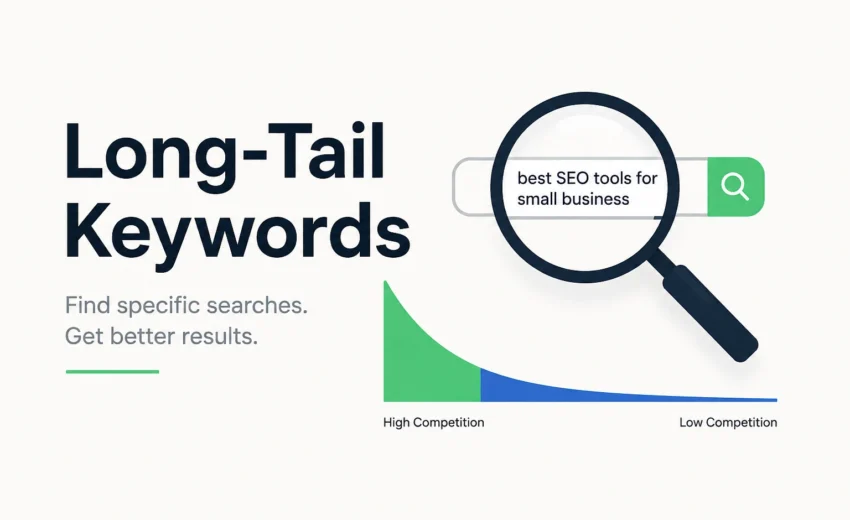
That’s where long-tail keywords become useful.
Long-tail SEO isn’t about finding keywords with the lowest possible search volume. It’s about finding specific searches that reveal what people actually want and creating content that answers those needs.
What Are Long-Tail Keywords?
Long-tail keywords are generally specific search queries with relatively low search demand compared with broader keywords.
For example:
- Broad: office chair
- More specific: ergonomic office chair
- Long-tail: best ergonomic office chair for short people
The last search gives us much more information.
The person isn’t looking for just any office chair. They’re looking for an ergonomic chair and have a specific requirement.
But here’s an important point:
Long-tail doesn’t simply mean “a keyword with many words.”
A keyword doesn’t automatically become long-tail because it contains four or five words. There is no fixed word-count or search-volume rule that defines every long-tail keyword. What matters is the keyword’s specificity and position within the broader search-demand landscape. Ahrefs — Long-Tail Keywords
So instead of counting words, ask:
What does this search tell me about what the person wants?
Why Target a Keyword With Only 100 Searches?
This is a common question for beginners.
If one keyword gets 10,000 searches and another gets 100, why would you choose the smaller one?
Because search volume isn’t everything.
Compare:
“SEO”
with:
“SEO agency for small businesses in Kochi”
The first search is very broad. The person could be looking for an SEO definition, course, tool, tutorial, or service.
The second search is much more specific.
The searcher has already indicated:
- They are interested in SEO.
- They may be looking for a service.
- They are interested in small-business solutions.
- They have a specific location in mind.
This doesn’t guarantee that the keyword will be easier to rank for or generate customers.
But it gives you a much clearer idea of the searcher’s intent.
That’s one of the biggest advantages of long-tail keywords.
Are Long-Tail Keywords Easier to Rank For?
Sometimes—but don’t assume they are always easy.
A common SEO misconception is:
“Long-tail keyword = easy ranking.”
That’s not true.
A highly specific commercial keyword can still have strong competition.
For example:
“best CRM software for real estate agencies”
could be valuable enough to attract software companies, review websites, and established publishers.
So don’t use this formula:
Long keyword = low competition
Instead, check:
- Who is ranking?
- What type of content is ranking?
- How useful are those pages?
- What is the search intent?
- How difficult is the keyword?
- Is the topic relevant to your business?
Three Useful Types of Long-Tail Keywords
Not every long-tail keyword needs its own page.
A useful way to understand them is to divide them into three practical groups.
1. Supporting Long-Tail Keywords
These are specific variations of a broader topic.
For example:
- keyword research for beginners
- beginner keyword research guide
- how to do keyword research
- keyword research tips for beginners
These searches may have slightly different wording but can have the same basic intent.
If Google shows similar results for them, one strong article may be enough to cover them naturally.
This is where long-tail keyword research and keyword clustering work together.
2. Topical Long-Tail Keywords
Some specific searches represent a different topic or need.
For example:
- keyword research
- keyword research for ecommerce
- keyword research for local SEO
Depending on the search results, these may deserve separate pages.
The important thing is not to decide based only on the words.
Search the keywords on Google.
If Google shows very different types of pages, that can be a sign that the search intent is different.
3. Conversational Long-Tail Keywords
People don’t always search using short phrases.
They may ask detailed questions such as:
“What’s a good office chair for someone who works eight hours a day and has lower back pain?”
Traditional keyword tools may not show every possible version of a conversational question.
The lesson isn’t to add every question to your article.
Instead, understand the problem behind the question and make sure your content provides a useful answer.
Where Can You Find Long-Tail Keywords?
You don’t need an expensive SEO tool to get started.
Google Autocomplete
Start typing your main topic into Google.
For example:
best SEO tools for…
Google may show more specific suggestions.
These can give you useful ideas, although you shouldn’t treat autocomplete as exact search-volume data.
People Also Ask
Search your main topic on Google and look at the People Also Ask section.
These questions can give you ideas for:
- FAQs
- Subheadings
- Supporting sections
- New content
But first check whether the questions actually belong to the same topic.
Google Search Console
Google Search Console is especially useful because it shows the searches your website is already appearing for.
You may discover that an existing article receives impressions for a specific search you never intentionally targeted.
For example, your article about:
“SEO for Small Businesses”
might receive impressions for:
“SEO tips for small businesses with low budgets.”
Before creating another article, check whether your existing page already answers that question.
If it doesn’t, you may have found an opportunity to improve the page.
Look at Your Competitors
Competitor research is another useful way to discover long-tail opportunities.
Tools such as Ahrefs and Semrush can show keywords your competitors rank for that your website doesn’t.
Suppose competitors rank for:
- SEO tools for small businesses
- affordable SEO strategies
- local SEO tips for small businesses
- SEO tools for beginners
Don’t immediately create four articles.
First ask:
- Are these keywords relevant?
- Do they have different search intent?
- Do the Google results overlap?
- Do I already have related content?
- Can one page answer several of these searches?
This connects long-tail keyword research with competitor analysis, keyword clustering, and content gap analysis.
Don't Ignore Your Customers
Some of your best long-tail ideas may not come from keyword tools.
Look at:
- Customer questions
- Sales enquiries
- Product reviews
- Reddit discussions
- Quora
- Industry forums
- Website search queries
- YouTube comments
For example, an SEO client might ask:
“Do I need SEO if my business only serves customers in one city?”
That is a specific question and could become useful content, even if the exact wording has very little measurable search volume.
Why?
Because it represents a real information need.
Can AI Help Find Long-Tail Keywords?
Yes, but use AI mainly for idea generation.
You could ask ChatGPT:
“What specific questions might a beginner have before choosing an SEO tool?”
AI can generate useful ideas you may not have considered.
But don’t assume every AI-generated keyword has search demand.
Validate important ideas using:
- Google Search
- Google Search Console
- Google Keyword Planner
- Ahrefs
- Semrush
- SERP analysis
Use AI to generate ideas. Use real search data to validate them.
How to Decide If a Long-Tail Keyword Is Worth Targeting
Before adding a keyword to your content plan, ask five simple questions:
1. Is it relevant?
Does it relate to your audience and business?
2. What is the search intent?
What does the person actually want?
3. Who is already ranking?
Look at the current Google results.
4. Do you already have a page for it?
Maybe you can improve an existing page instead.
5. Is it valuable to your business?
Would attracting this audience actually help your business?
A keyword with 50 searches isn’t automatically better than one with 5,000.
But if those 50 searches come from exactly the people you want to reach, they shouldn’t be ignored.
One Long-Tail Keyword Does Not Always Mean One Page
This is one of the most important lessons.
Suppose you find:
- best SEO tools for beginners
- SEO tools for new marketers
- beginner SEO tools
- easiest SEO tools for beginners
You could create four articles.
But that may create unnecessary overlap.
Search each keyword and compare the results.
If Google shows largely the same pages, these keywords may belong to the same content cluster.
One strong article could cover the main topic and naturally include the related searches.
If the intent is clearly different, a separate page may make more sense.
The process is:
Find → Understand intent → Compare SERPs → Group → Decide
A Simple Long-Tail Keyword Workflow
If you’re new to SEO, follow this process:
- Choose a broad topic.
- Find specific search variations.
- Check Google Autocomplete and People Also Ask.
- Review Google Search Console.
- Research competitor keywords.
- Remove irrelevant ideas.
- Group related keywords by search intent.
- Check the Google results.
- Decide whether you need a new page or an existing-page update.
- Create genuinely useful content and monitor its performance.
You don’t need expensive software for every step.
The important part is making the right decision from the information you collect.
Common Long-Tail Keyword Mistakes
Defining long-tail by word count
A keyword isn’t long-tail simply because it has four or five words.
Assuming low volume means easy ranking
Competition can still be strong.
Creating a page for every keyword
Related searches can often be covered by one useful resource.
Ignoring search intent
Similar-looking keywords can have completely different purposes.
Looking only at search volume
Relevance and business value matter too.
Trusting AI-generated keywords without checking them
AI can generate ideas, but it doesn’t prove search demand.
Forcing keywords into your content
Use keywords naturally and focus on answering the reader’s question.
Final Thoughts
Long-tail keywords aren’t valuable simply because they’re long.
They’re valuable because they reveal specific questions, problems, and needs that broad keywords can hide.
A keyword with 50 searches may look insignificant next to one with 10,000.
But if those 50 searches come from people who are exactly looking for what your business provides, that smaller opportunity may be worth pursuing.
And when you study long-tail searches, you start doing more than keyword research.
You start understanding your audience.
What are they trying to accomplish?
What problem are they trying to solve?
Why are they being so specific?
Those questions can help you discover opportunities that your competitors haven’t covered—and create content that is genuinely useful.
So the next time you find a keyword with surprisingly low search volume, don’t dismiss it immediately.
Ask yourself:
“What does this search tell me about the person behind it?”
That question may lead you to an SEO opportunity that a simple search-volume report would have made you ignore.
Alfik P S
hi