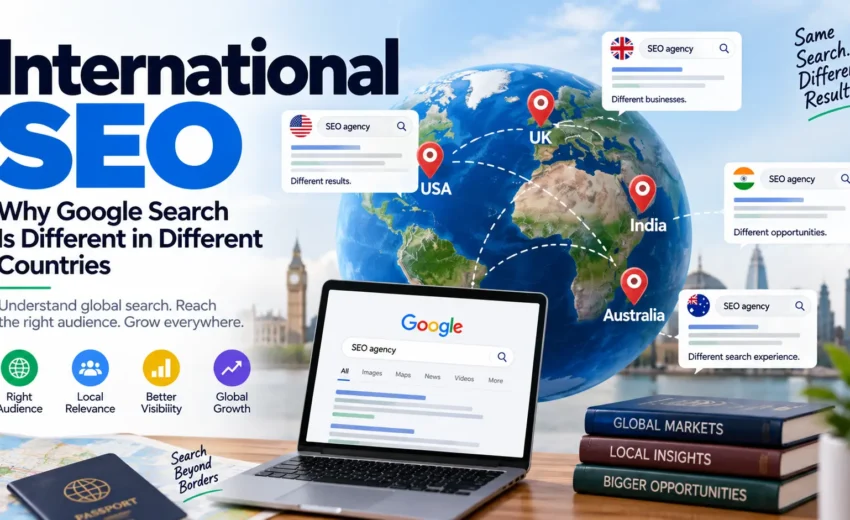

A website can rank well in one country and perform very differently in another.
You may search for a keyword from India and see your website near the top. A customer searching the same keyword from the UK may see a different set of results. Someone in the US may see another variation again.
This doesn’t necessarily mean your SEO is broken. Google Search can change depending on the searcher’s region, language, query, and the type of search experience available in that market — and in 2026, those regional differences are wider than they’ve ever been.
Why Google Search Now Differs More by Country
On September 8, 2026, Google Search Central published new documentation specifically covering regional differences in the Search experience. It maps out features — including aggregator units, supplier units, and various carousels — that only appear in certain countries or regions.
This wasn’t a routine documentation update. It followed a European Commission non-compliance decision under the Digital Markets Act (DMA), which required Google to change how it displays certain commercial results to EEA users. The redesigned results page introduced two new EEA-only units:
- Aggregator unit — gives approved Vertical Search Services (online travel agencies, comparison shopping services, metasearch engines, directories) a dedicated block on the results page for hotel, flight, ground transportation, and product queries.
- Supplier unit — gives direct suppliers, such as individual hotels or airlines, their own placement alongside the aggregator unit.
Google also documented an ecosystem carousel (weather, sports, finance, translation) and a jobs carousel, both EEA-specific, plus separate regional features for Türkiye and South Africa covering travel, local business, and product searches.
The practical takeaway: the same business can have meaningfully different search opportunities depending on which country its audience is searching from — not just because of language or competition, but because Google is literally running a different results page in some markets.
Search Intent Doesn't Travel Well Either
Language and location also change what people expect from a search, independent of any regional feature rollout.
Consider a broad query such as “SEO agency”:
- Someone searching from India may be looking for an agency serving Indian businesses.
- Someone searching from the UK may expect agencies that understand the UK market.
- Someone elsewhere may be looking for a local provider.
The keyword hasn’t changed. The context has. This is why international SEO can’t be reduced to translating keywords — you also need to understand what people in each target market are actually trying to find.
Translation Is Not the Same as Localization
This is one of the most important distinctions in international SEO.
Translation changes the language. Localization adapts the content to the market. A localized page may need to account for:
- Local spelling and terminology
- Currency
- Address and contact information
- Local services and regulations
- Units of measurement
- Local examples and customer expectations
- Market-specific offers
A page written for US customers may be understandable to someone in the UK, but that doesn’t make it the best result for UK searchers. The goal isn’t to create near-identical pages for every country you’d like to target — it’s to build useful regional versions where the audience genuinely needs them.
Where hreflang Fits In
If you maintain different versions of a page for different languages or regions, hreflang helps Google understand which version is intended for which audience.
For example, you might have an English page for the US, an English page for the UK, and a French page for France.
Same Language, Different Region: Use Canonical and hreflang Together
When regional versions are in the same language — separate US and UK URLs with substantially similar content — Google’s own canonicalization guidance recommends using canonical tags and hreflang together, with each page canonicalizing to itself rather than to another region’s URL. This is specifically called out for same-language regional variants, because Google would otherwise treat them as plain duplicates rather than intentional regional versions.
hreflang Is Not a Ranking Guarantee
hreflang isn’t a directive Google is obligated to follow. Google treats canonical signals as hints rather than absolute instructions, and it can choose a different canonical URL to show in search results based on other signals — even when your hreflang and canonical tags are technically correct. The technical setup needs to be backed by genuinely useful, genuinely different regional content, or Google has little reason to keep the versions separate.
Don't Create Country Pages Just to Get More URLs
A common international SEO mistake is creating near-identical pages for every country:
- /seo-services-india/
- /seo-services-uk/
- /seo-services-usa/
- /seo-services-australia/
If the only meaningful difference is the country name in the URL, these aren’t four valuable resources — they’re one resource split four ways.
Google’s guidance is clear that duplicate content across URLs is not automatically a spam violation. But multiple near-identical versions still make it harder for Google to determine which page to show, and they create a worse experience for users who land on a page that clearly wasn’t written for them.
Before creating a regional page, ask whether the audience actually needs different information. If yes, build a properly localized page. If no, don’t create the page just to add another URL to the sitemap.
Your Ranking Reports Need Location Context
“We rank #4 for this keyword” doesn’t tell the full story for an international website. You should also know:
- Which country and language
- Which page and device
- Which search type
- Which competitors and Search features appear in that market
A ranking that looks strong globally can hide a real problem in an important market — a site can perform well at home while having almost no visibility somewhere that generates significant business. International SEO reporting should be separated by market wherever that market matters to the business.
Local Search Still Overlaps With All of This
If you operate in several countries and also have physical locations, you’re working at multiple levels at once: global, country, region, and city. Google’s regional documentation already reflects this — several of the newly documented features are specifically for local businesses and location-sensitive searches. A single global page rarely serves every location equally well.
How to Audit Your International SEO
You don’t need a complicated toolset to start. Work through these steps in order.
1. Identify Your Target Countries
Prioritize by where you actually have customers, leads, revenue, operations, or concrete expansion plans — not by population size alone.
2. Compare Search Results by Market
Search your important keywords from each relevant market and look for differences in ranking pages, competitors, search features, local results, content formats, and intent.
3. Check Your Regional Pages
Confirm the content actually serves the intended audience — language, currency, contact information, services, and other market-specific details.
4. Review hreflang Implementation
If you have language or regional versions, verify the relationships between those pages are correctly implemented and that canonical tags point to the right version.
5. Check Search Console by Market
Separate performance by country, query, and page. A page performing well overall may be significantly weaker in one market that matters to the business.
What If You Only Have One Website?
You don’t need a separate domain for every country. Common structures include country-code domains, subdomains, and subdirectories. The right choice depends on the business, technical setup, branding, and how different the target markets actually are — not on a general claim that one structure is automatically better for SEO. Whatever you choose, make it easy for both users and search engines to understand which content is intended for which audience.
International SEO Is More Than Translation
International SEO isn’t: translate → publish → wait for rankings.
It’s closer to: understand the market → understand the search intent → localize the experience → implement the technical signals → measure each market → improve.
A page can be technically flawless and still fail because it doesn’t provide what people in that market actually want. A translated page can be grammatically correct and still feel unnatural to local users. Good international SEO combines technical accuracy with genuine market relevance — and in 2026, it also means tracking which regional Search features apply to your business in each market, since the results page itself is no longer identical everywhere.
SEO Audit: What to Check First and What...