Here is a number that might surprise you: businesses using AI-driven ad campaigns are reporting cost-per-acquisition improvements of 15% or more within the first few months. That is not a prediction for the future—it is happening right now, for businesses as small as a single-location jewellery store in Mumbai or a B2B consultancy in Bangalore.
Cloud AI is no longer a futuristic concept reserved for tech giants. It is the engine behind the ads you see, the product recommendations you receive, and the chatbots you interact with daily. For businesses in India, it has become an accessible tool rather than an exclusive luxury.
But here is the catch: using Cloud AI well requires more than just turning it on. You need to understand what it does, where it helps, and where it can mislead you.
What Exactly Is Cloud AI?
In simple terms, Cloud AI refers to artificial intelligence tools that are hosted on remote servers and accessed over the internet. Providers like Google Cloud, AWS, and Microsoft Azure handle all the heavy computing, so you do not have to build your own infrastructure.
Instead of spending crores (or millions of dollars, depending on where you are) on in-house AI development, you pay for only what you use—similar to how you pay for electricity or internet bandwidth.
However, it is important to be clear: Cloud AI gives you access to powerful intelligence, but the quality of results still depends heavily on your data and your strategy. It is not a magic button that fixes everything automatically.
Where Cloud AI Is Making a Real Difference
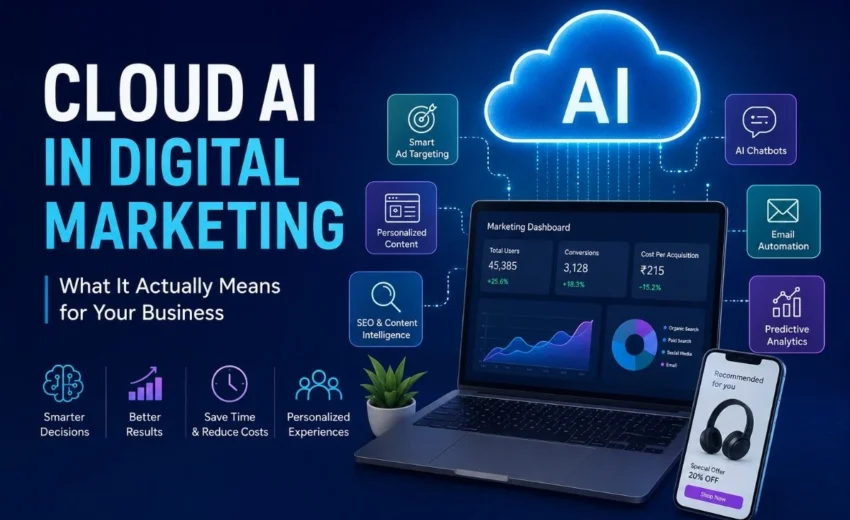
Cloud AI is not one single tool. It is a layer of intelligence that now touches almost every part of the marketing funnel.
1. Understanding Your Audience Better
AI processes large volumes of data—purchase history, browsing patterns, and engagement signals—to predict what a customer is likely to do next. Platforms like Google and Meta use this continuously to decide who sees your ads and when.
The benefit is simple: your campaigns adjust in real time, directing budget toward people most likely to buy, rather than wasting money on broad, untargeted reach.
2. Smarter Ad Campaigns
Google’s Performance Max and Meta’s Advantage+ campaigns are built on Cloud AI. They test different ad combinations, adjust bids, and shift budget across channels without manual intervention.
But here is a practical reality check: these systems are often described as “black boxes.” They work well, but you may not always know exactly why they made a particular decision. To get the best out of them, ensure your conversion tracking is set up correctly. Otherwise, the AI will optimise toward the wrong goal without you even realising it.
3. Personalised Content at Scale
Cloud AI enables websites and email platforms to show different content to different visitors based on their behaviour. A returning customer sees loyalty offers, while a first-time visitor sees introductory messaging.
Tools like HubSpot and Klaviyo handle this in the background, removing the need for endless manual segmentation. This level of personalisation, which used to require large teams, is now available to businesses of any size.
4. Chatbots That Actually Help
AI-powered chatbots can handle customer queries, qualify leads, and guide users through the sales process around the clock.
One clarification is worth making here: most commercial chatbots used in marketing today are still largely rule-based with some natural language understanding. They are not yet fully conversational AI like ChatGPT in most business applications. However, for handling frequently asked questions and basic support, they save significant time and ensure you never miss an inquiry.
5. SEO and Content Research
Cloud AI tools now analyse search intent, identify content gaps, and cluster related keywords much faster than manual research ever could. Platforms like Semrush and Ahrefs use AI to surface insights that would take a human researcher days to uncover.
6. Email Marketing That Adapts
From deciding the best time to send an email to predicting which customers are likely to stop engaging, AI has made email marketing far more precise. The right message reaches the right person at the right moment, improving open rates and conversions without extra effort from your team.
What This Means for Indian Businesses
India presents a unique opportunity for Cloud AI adoption. Here are a few ways it specifically matters:
- Language Support: AI chatbots can now converse in Hindi, Tamil, Bengali, and other regional languages. This helps businesses reach the large majority of internet users who prefer local languages over English.
- Payment Preferences: AI can detect whether a user prefers UPI or cash on delivery and adjust the checkout flow accordingly, which can directly improve conversion rates.
- Festival Season Optimisation: During Diwali, Independence Day, or Republic Day, AI models automatically detect surges in search activity and shift ad budgets toward high-intent shoppers in real time.
Also, while India’s Digital Personal Data Protection Act (DPDP Act) has been passed, the full rules are still being rolled out. It is wise to start preparing now—ensure your consent mechanisms are clear and your customer data handling is transparent.
The Practical Benefits
Speed: AI makes decisions in milliseconds. Campaigns react to changes as they happen, not after a weekly review.
Cost Efficiency: You pay for what you use, and the tools get smarter over time without requiring additional investment from you.
Accessibility: A local business today can access the same targeting intelligence that only large enterprises could afford a decade ago.
Continuous Improvement: Cloud AI models are constantly updated by the providers. Your tools improve automatically, with no effort on your end.
Tools Worth Knowing
Here is a quick look at some popular Cloud AI platforms and what they do best. This will help you decide where to start without feeling overwhelmed.
Tool | Best Used For |
Google Performance Max | Full-funnel ad campaigns across Search, Display, and YouTube |
Meta Advantage+ | Automated ad testing and targeting on Facebook and Instagram |
HubSpot AI | Predictive lead scoring and smart CRM automation |
Klaviyo | AI-driven email and SMS personalisation for e-commerce |
Semrush / Surfer SEO | Content research, keyword clustering, and SEO briefs |
Yellow.ai / Gupshup | Multilingual chatbots optimised for Indian languages and consumer behaviour |
Each tool serves a specific purpose. Start with the one that addresses your most immediate need rather than trying to adopt everything at once.
What to Watch Out For
Cloud AI is powerful, but it comes with a few risks that are often overlooked.
Data Quality Matters
If your customer data is messy or your tracking is incorrect, AI will optimise in the wrong direction—and it will do so faster than manual methods. Strategy and clean data must come first.
Brand Voice Can Suffer
AI can generate content at scale, but if you rely on it completely, your messaging may start sounding generic or robotic. Human oversight is still essential to maintain authenticity.
Avoid Over-Reliance
It is tempting to let AI handle everything, but marketing still requires strategic thinking. AI amplifies your expertise; it does not replace it. The best results come when you use AI to execute faster, not when you let it run unsupervised.
Stay Privacy-Conscious
Ensure that any platform you use is compliant with applicable data protection regulations. Even though the DPDP Act rules are not fully detailed yet, building a privacy-first approach now will save you trouble later.
A Simple Way to Get Started
You do not need to transform your entire marketing operation overnight. A practical 90-day approach works well:
- Month one: Audit your current data quality and tracking setup. Pick one AI tool—perhaps Performance Max or Klaviyo—and set it up properly.
- Month two: Run a pilot campaign with a modest budget. Give the AI at least two weeks to learn before you judge its performance.
- Month three: Compare the results with your previous benchmarks. If the AI campaign is performing better, gradually scale it and apply similar logic to other channels.
This phased approach reduces risk and gives you clear data on what is actually working.
The Bottom Line
Cloud AI is not coming in the future—it is already shaping how digital marketing works today. Businesses that understand its strengths and limitations are already gaining an edge over those still relying on manual guesswork.
The good news is that you do not need to become a data scientist to benefit. You need a clear strategy, the right tools, and a willingness to test and learn. Start small, stay consistent, and let AI handle the heavy lifting while you focus on the bigger picture.
Ready to Put This into Practice?
At Mind over maze, we help businesses cut through the hype and build practical marketing strategies powered by the latest AI tools—without losing the human touch.
We combine Cloud AI platforms with proven marketing experience to deliver campaigns that actually move the needle.
Book a free 30-minute AI Strategy Audit and we will analyse your current campaigns to identify three quick improvements you can make within a week.
Alfik P S
hi