Artificial intelligence has become a regular part of the advertising industry. Today, marketers can generate headlines, images, video scripts, and full campaign concepts in just a few minutes using widely available AI tools. At the same time, AI-powered advertising platforms like Google, Meta, and TikTok are integrating AI into their core systems to handle bidding, targeting, and creative optimization.
This shift has raised an important question: Are AI-generated ads better than those created by human teams?
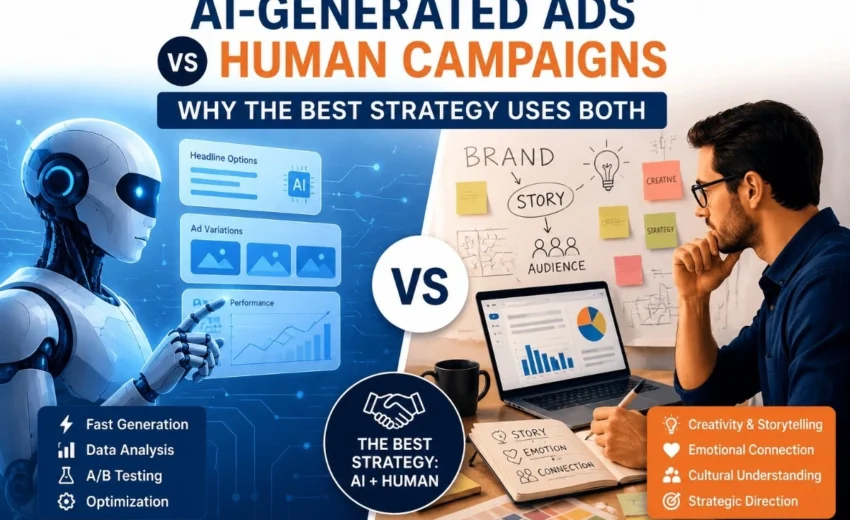
The reality is more balanced than most people expect. AI and human marketers each bring different strengths to the table. The most successful campaigns today are not built by AI alone or by humans alone. They are built by combining the best of both.
What AI Brings to Advertising
AI is particularly effective at handling the mechanical and data-heavy parts of advertising.
Speed and Volume
AI can produce a large number of creative variations in a short time. Generating dozens of headlines, multiple ad descriptions, and several visual concepts takes minutes rather than hours. This speed allows businesses to launch campaigns faster and react quickly to changing market conditions.
Data Processing
AI systems analyze large amounts of information effortlessly. They look at user behavior, conversion rates, device preferences, and geographic patterns simultaneously. This helps identify opportunities that might be difficult for a human analyst to notice manually.
Continuous Testing and Optimization
Human marketers typically review performance once or twice a day. AI can adjust bids, shift budgets, and refine audience targeting in real time. This constant fine-tuning often leads to better efficiency and lower costs over time.
Many of these AI-powered optimization capabilities are made possible through cloud-based AI platforms that analyze vast amounts of campaign data in real time. To understand how these systems work behind the scenes, read our guide on Cloud AI in Digital Marketing.
What Research Shows
Recent industry studies have found that AI-generated ads often achieve similar click-through and conversion rates to human-created ads in performance-driven campaigns. This is largely because AI enables faster testing and more efficient optimization. Research from major advertising platforms has shown that automated creative testing can improve campaign efficiency by double digits in certain cases.
However, the same studies consistently emphasize that human oversight remains critical. Campaigns that combine AI-generated variations with human strategic direction outperform those relying entirely on automation, particularly in areas like brand recall and long-term customer engagement. The data suggests that AI improves execution, while humans improve meaning.
What Humans Bring to Advertising
While AI works well with data and speed, humans remain essential for the creative and strategic side of marketing.
Emotional Connection
People buy products for emotional reasons as much as logical ones. They remember stories, experiences, and how a brand makes them feel. Human marketers understand how to build narratives that resonate on a personal level. They know when to use humor, empathy, or inspiration to connect with an audience.
Cultural and Social Awareness
AI can generate grammatically correct text, but it often misses cultural context. It may not understand regional humor, local traditions, or current social sensitivities. Human marketers bring this awareness naturally. They know what feels appropriate and what might seem out of touch, which is especially important in diverse markets.
Brand Consistency
Every brand has a distinct voice. A premium brand communicates differently from a budget-friendly one. A healthcare brand sounds different from an entertainment brand. Humans ensure that every campaign aligns with the brand’s identity and long-term goals. AI, left on its own, often produces generic AI-generated content that lacks this distinct personality.
Strategic Direction
AI is good at executing tasks, but it does not set the overall direction. Strategic decisions—such as which markets to enter, how to position a new product, or how to respond to a competitor—still require human judgment. These choices involve business goals, risk assessment, and industry experience that AI cannot fully replace.
Why Some AI-Generated Ads Underperform
Not every AI-generated campaign succeeds. When AI ads fail, it is usually due to one of these common reasons:
- Weak Prompts: Vague or incomplete instructions given to the AI produce vague, unhelpful output.
- Poor Audience Targeting: AI relies on the data it receives. If the audience settings are off, the ads reach the wrong people.
- Incorrect Conversion Tracking: If tracking pixels or goals are set up incorrectly, the AI optimizes toward meaningless metrics.
- Lack of Human Review: Errors, awkward phrasing, and generic messaging often slip through when there is no human editor.
- Generic Messaging: Without proper brand guidance, AI tends to produce ads that sound like every other competitor, making the brand invisible.
Addressing these issues usually requires a human touch. The technology is powerful, but it still needs direction and quality control.
A Practical Example
Consider a small local business launching a Facebook advertising campaign. Instead of spending hours brainstorming and writing copy, the business owner uses AI to generate 20 headlines, 10 descriptions, and 5 rough image concepts in just a few minutes.
The marketing team then reviews this raw output. They select the strongest few options, adjust the tone to match their friendly and trustworthy brand voice, and launch the campaign within the same day.
The result is faster production without sacrificing quality. The human team saves time on repetitive writing, while still maintaining full control over how the brand is presented to its local customers.
How the Smartest Marketers Combine Both
Rather than choosing between AI and humans, effective marketing teams use a clear workflow that leverages both.
Step One: AI Generates the Foundation
The team starts by using AI to create a wide range of raw materials. This includes multiple headline options, ad copy variations, and suggested audience segments. The goal here is volume and variety.
Step Two: Humans Refine and Shape
The marketing team reviews the AI-generated content. They remove ideas that do not fit the brand, adjust the tone, add emotional depth, and ensure the messaging is clear and accurate. This step turns raw drafts into finished concepts.
Step Three: AI Tests and Measures
The ads are launched, and the advertising platforms use AI to test different combinations. Headlines, images, calls to action, and audience groups are tested automatically. The system learns which versions perform best.
Step Four: Humans Interpret and Plan
Once the data comes in, human marketers analyze the results. They look beyond the numbers to understand why certain versions worked and others did not. These insights inform the next campaign strategy and help the team make smarter decisions.
Common Mistakes to Avoid
Many businesses try to adopt AI too quickly and make avoidable errors.
Publishing Raw AI Output
AI-generated content should be treated as a draft, not a final product. Publishing it without review often results in generic or slightly off-target messaging.
Ignoring Brand Voice
If every ad sounds like it could belong to any competitor, the brand becomes invisible. Human oversight is necessary to maintain a unique and recognizable voice.
Over-Reliance on Automation
AI optimizes toward the goals it is given. If those goals are poorly defined or tracking is inaccurate, the system may optimize for the wrong outcomes. Strategy must always come before automation.
Replacing People with Tools
The businesses that benefit most from AI are those that use it to enhance their teams, not replace them. AI handles repetitive tasks so that marketers can focus on creativity, strategy, and relationship building.
The Future of AI Advertising
As AI tools become more sophisticated, marketers will spend less time creating variations manually and more time focusing on strategy, customer insights, and brand development. The future is likely to be collaborative rather than fully automated.
Final Thoughts
The debate over AI versus human creativity is largely unnecessary. These are not competing forces; they are complementary tools.
AI brings speed, scale, and analytical power. It helps marketers test ideas faster and optimize campaigns continuously. Humans bring emotional intelligence, cultural awareness, and strategic vision. They give campaigns meaning and ensure that brands stay authentic.
Marketers who understand this balance will have a clear advantage. They will move faster than those who reject AI, and they will connect more deeply than those who rely on it entirely.
The future of advertising is not about AI replacing people. It is about people using AI to work smarter, create better campaigns, and achieve stronger results.
Alfik P S
hi