
You’ve already done the obvious SEO work.
You researched keywords, published blog posts, optimized your pages, and checked what your competitors are doing.
But there’s still a problem.
Your competitors are ranking for topics you haven’t covered. Some of your existing pages appear in Google but don’t perform as well as competing pages. And when you look at your content calendar, you aren’t always sure whether you need a completely new article or simply need to improve something you’ve already published.
This is where content gap analysis becomes useful.
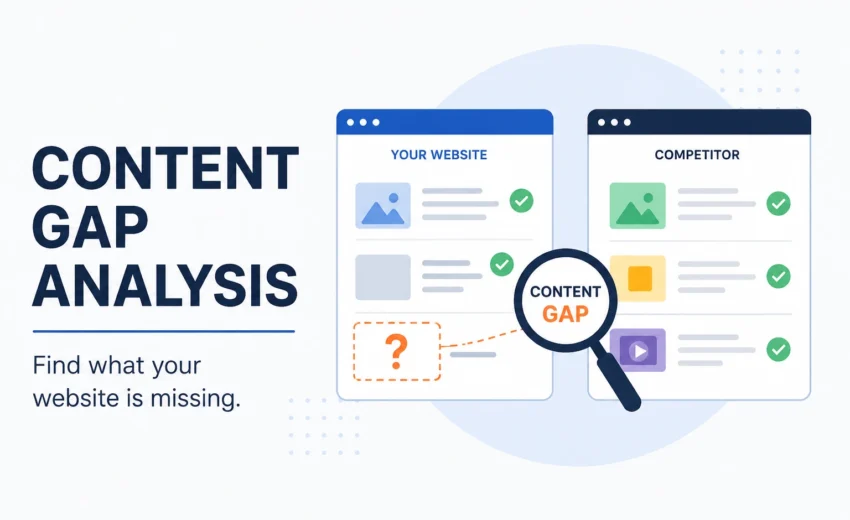
At its simplest, content gap analysis means finding the difference between what your audience needs and what your website currently provides.
But there’s more to it than putting your website and a competitor into an SEO tool.
The more valuable part is deciding which gaps are actually worth fixing—and what the right solution is.
What Is a Content Gap?
A content gap exists when your website doesn’t fully satisfy an information need that is relevant to your audience.
That can happen in several ways.
Topic gap
You don’t cover an important topic at all.
For example, a website selling ergonomic office chairs might have articles about office chairs but nothing about choosing a chair for people with lower back problems.
Intent gap
You cover the topic, but your page doesn’t answer what the searcher actually wants to know.
Someone searching for “best office chair for back pain” probably wants help comparing suitable chairs. A general article explaining what an office chair is may not satisfy that need.
Quality gap
Your page covers the right topic and intent, but the information may be outdated, difficult to understand, incomplete, or poorly structured.
Originality gap
Your page contains the same general information found on competing pages but doesn’t give readers a strong reason to choose it over the alternatives.
These gaps require different solutions. That’s why content gap analysis shouldn’t automatically mean “create another blog post.”
Step 1: Find the Topics Your Competitors Cover
The traditional starting point is competitor keyword research.
Tools such as Ahrefs and Semrush can compare the keywords your competitors rank for with the keywords your website ranks for.
Suppose you run a website selling ergonomic office chairs and compare your site with three relevant competitors.
You might discover keywords such as:
- Best office chair for lower back pain
- Ergonomic chair for short people
- Office chair for long working hours
- Breathable office chair
- Best chair for home office
At first, these may look like obvious content opportunities.
But don’t start writing yet.
Some keywords may be completely irrelevant. Your competitors might also sell desks, standing desks, or other office furniture, so their keyword lists could contain topics that have nothing to do with your business.
Others may look like gaps but actually be topics you already cover on a page that simply isn’t ranking well.
So the keyword tool gives you a candidate list, not your final content plan.
Step 2: Check the Search Results Yourself
Once you find a potentially useful topic, search it on Google.
This step is important because keyword tools tell you about keywords, while the SERP shows you the type of content Google is currently presenting for that search.
Look at the first few results and ask:
- What type of pages are ranking?
- What search intent are they satisfying?
- What information do they cover?
- Are the pages current?
- Are they easy to navigate?
- Do they provide useful examples?
- Is there anything important missing?
For example, suppose the search is:
“best ergonomic chair for short people”
If the top results mainly provide specific recommendations, measurements, seat-height guidance, and comparison information, a general article about “What Is an Ergonomic Chair?” probably isn’t the right response.
The gap isn’t simply a missing keyword.
It’s a search-intent gap.
This is also where you can identify weaknesses in existing results. Backlinko’s approach to content gap analysis emphasizes looking at areas such as freshness, thoroughness, usability, and differentiation when reviewing the current search results.
You don’t need to assume that every weakness will lead to a ranking. Instead, use those observations to decide whether you can create something genuinely more useful.
Step 3: Don't Forget Your Existing Content
This is one of the easiest mistakes for beginners to make.
You discover that a competitor ranks for a topic you don’t rank for, so you immediately create a new article.
But what if you already have a relevant page?
Suppose your website already has an article called:
“Complete Guide to Choosing an Ergonomic Office Chair”
You discover that competitors rank for:
“ergonomic chair for short people.”
Before creating another article, check your existing guide.
Does it explain:
- How seat height affects shorter users?
- What seat depth to look for?
- Which measurements matter?
- How to adjust the chair correctly?
If not, perhaps the gap can be fixed by adding a useful section to your existing guide.
In other situations, a separate article may make more sense because the topic has its own search intent and deserves detailed coverage.
The important question is:
Does this need a new page, or does an existing page simply need to become better?
Step 4: Look Beyond Keyword Tools
Some of the best content ideas may never appear in a keyword-gap report.
Your customers may ask questions that aren’t obvious from traditional keyword research.
Look at:
- Customer support questions
- Sales enquiries
- Product reviews
- Website search queries
- Surveys
- Comments
- Relevant Reddit discussions and forums
- Questions your team answers repeatedly
For example, imagine customers repeatedly ask:
“Why does a mesh chair feel uncomfortable after several hours?”
Your keyword tool might not show that exact question as an attractive keyword.
But it’s still a useful content opportunity because it represents a real customer concern.
You could use the insight to improve a product page, add an FAQ, or create a detailed article.
This is where content gap analysis becomes more than competitor research.
You’re not just asking:
“What are competitors writing about?”
You’re asking:
“What does my audience still need help understanding?”
Step 5: Look for Underperforming Pages
Content gap analysis can also help you improve pages that already exist.
Use tools such as Google Search Console to identify pages that receive impressions but aren’t performing as well as you’d expect.
For example, a page might appear for several related searches but receive very few clicks.
That doesn’t automatically mean the content is bad.
Investigate first.
Possible reasons could include:
- Search intent has changed
- Competitors have improved their content
- The page is outdated
- The title doesn’t accurately communicate the value
- Important information is missing
- The page has a technical problem
- Search demand has changed
So don’t automatically rewrite every page that loses traffic.
Compare the page with the current search results and investigate what has actually changed.
A Worked Example: Ergonomic Office Chairs
Let’s put everything together.
Imagine your website sells ergonomic office chairs.
You compare your website with three competitors and discover that all three rank for:
“best ergonomic chair for short people.”
Your website doesn’t rank for the query.
At first, this looks like a straightforward topic gap.
But you investigate further.
You check your website
You already have a general ergonomic-chair guide, but it only briefly mentions seat height.
You check Google
The ranking pages provide:
- Seat-height recommendations
- Seat-depth information
- Chair dimensions
- Adjustment advice
- Product comparisons
You check customer questions
Your customers frequently ask whether a particular chair is suitable for people under a certain height.
Now the gap is clearer.
You don’t necessarily need to publish another generic article about ergonomic chairs.
You have an opportunity to create content specifically addressing chair selection for shorter users, with practical information that your existing guide doesn’t provide.
You could either:
Option A: Expand your existing guide if the topic fits naturally.
Option B: Create a dedicated guide if the search intent deserves a separate page.
That’s content gap analysis in practice.
How to Decide Which Gaps Are Worth Fixing
You may discover dozens or even hundreds of potential gaps.
You don’t need to tackle all of them.
Before creating content, consider five things:
Relevance
Does the topic genuinely relate to your audience and business?
Search intent
Can your website provide the type of answer the searcher wants?
Existing coverage
Do you already have a page that could address the topic?
Business value
Could the topic attract the right audience or support an important business goal?
Effort
How much work would it take to create something genuinely useful?
A highly relevant gap with strong business value may deserve more attention than a high-volume keyword that has little connection to what you offer.
What Should You Do After Finding a Gap?
There are several possible solutions.
Create a new page
Use this when the topic is genuinely separate from your existing content and deserves its own search result.
Improve an existing page
Use this when the topic fits naturally within a page you already have.
Update outdated content
Use this when your information is no longer current.
Add a missing section
Sometimes one section is enough to answer an important question.
Consolidate overlapping pages
If several pages cover almost the same subject, combining them may make more sense than creating another one.
Improve internal links
Sometimes the content exists but isn’t properly connected to related pages.
The best solution depends on the actual gap.
Tools You Can Use
You can start without expensive software.
Google Search
Use it to study the current SERP and understand search intent.
Google Search Console
Use it to understand the queries your existing pages already receive impressions and clicks for.
Semrush
Useful for competitor research and keyword-gap analysis.
Ahrefs
Useful for comparing competitor keyword coverage and identifying potential content opportunities.
Google Analytics 4
Useful for understanding how existing content performs and identifying pages that deserve further investigation.
The tool is only part of the process.
The important thing is the decision you make from the data.
Final Thoughts
Content gap analysis isn’t about finding every keyword your competitors rank for and turning each one into a new blog post.
It’s about finding where your website is falling short of what your audience needs.
Sometimes you’ll discover a topic you haven’t covered.
Sometimes you’ll find that an existing page answers the wrong question.
Sometimes the content is simply outdated or incomplete.
And sometimes you’ll discover that your competitors are all saying the same thing—and that’s your opportunity to bring something genuinely useful to the conversation.
So before you open a new document and start writing, stop and ask:
“What is actually missing here?”
Then decide whether the answer requires a new page, a better existing page, or no page at all.
That’s what makes content gap analysis useful: not finding more content to create, but finding the right content to create or improve.
Alfik P S
hi