Search engine optimization has changed more in the last few years than it did in the decade before. There was a time when ranking on Google mostly depended on repeating keywords, building backlinks, and creating separate pages for every keyword variation.
That approach no longer works on its own.
Modern search engines understand language more like humans do. Google now considers context, intent, relationships among topics (entities), and the overall meaning behind a search query. This shift made Semantic SEO critical.
But traditional SEO fundamentals—site speed, mobile optimization, backlinks—still matter. They just aren’t enough anymore.
What Is Traditional SEO?
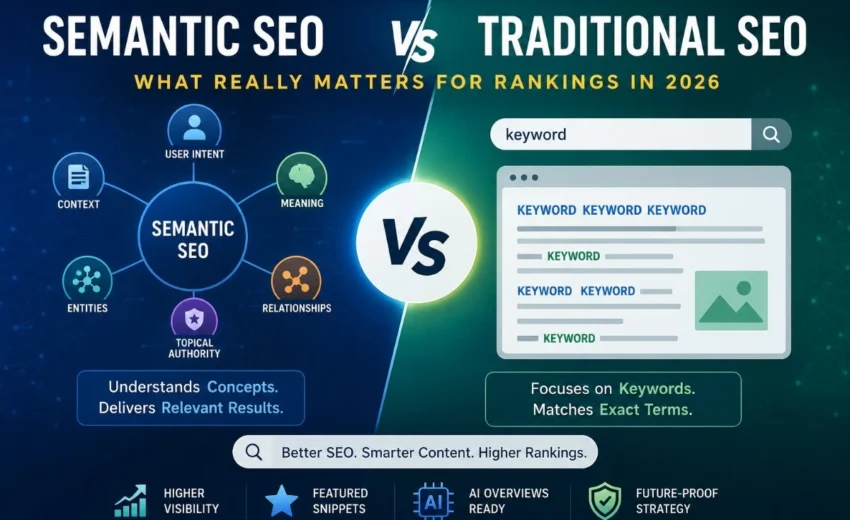
Traditional SEO is the older, keyword‑first approach. Its main goal: match the user’s query as closely as possible.
Common practices included:
Using the exact keyword in the title, headings, URL, and alt text
Building separate landing pages for near‑identical keywords (e.g., “cheap shoes NYC” vs “affordable shoes New York”)
Over‑optimizing anchor text with exact‑match phrases
Focusing on search engines rather than readers
These strategies worked when algorithms were less advanced (roughly 2005–2015). Today, traditional SEO still includes important fundamentals:
Technical SEO (crawlability, Core Web Vitals)
Backlinks (authority signals)
Mobile‑friendliness
Proper title tags and meta descriptions
But modern SEO goes far beyond them.
What Is Semantic SEO?
Semantic SEO focuses on meaning and relationships, not exact keyword matching.
Instead of optimizing for one specific phrase, semantic SEO helps search engines understand:
What a page is about (the central topic)
How different concepts relate to each other (entities and connections)
Whether the content genuinely answers the user’s question
Search engines use AI, Natural Language Processing (NLP), and machine learning to interpret language naturally. For example, an article about “content marketing” may naturally include blogging, SEO, audience personas, email sequences, and conversion funnels. Search engines understand those relationships semantically.
That’s why semantic SEO focuses on:
Topical depth (covering a subject fully)
User intent (informational, navigational, transactional)
Entity relationships (people, places, things)
Comprehensive, well‑structured content
Why Google Shifted Toward Semantic Search
Google’s goal is to deliver the most relevant result. As people started searching more conversationally—voice search, long‑tail questions—pure keyword matching became insufficient.
Key updates over the years (Hummingbird, RankBrain, BERT, MUM, and the move to AI Overviews) all pushed Google toward understanding queries rather than just matching words.
For 2026, the biggest change is AI Overviews (formerly SGE). Google now generates direct answers on the results page, pulling from content that is clear, semantically relevant, and trustworthy. Keyword‑stuffed pages get ignored.
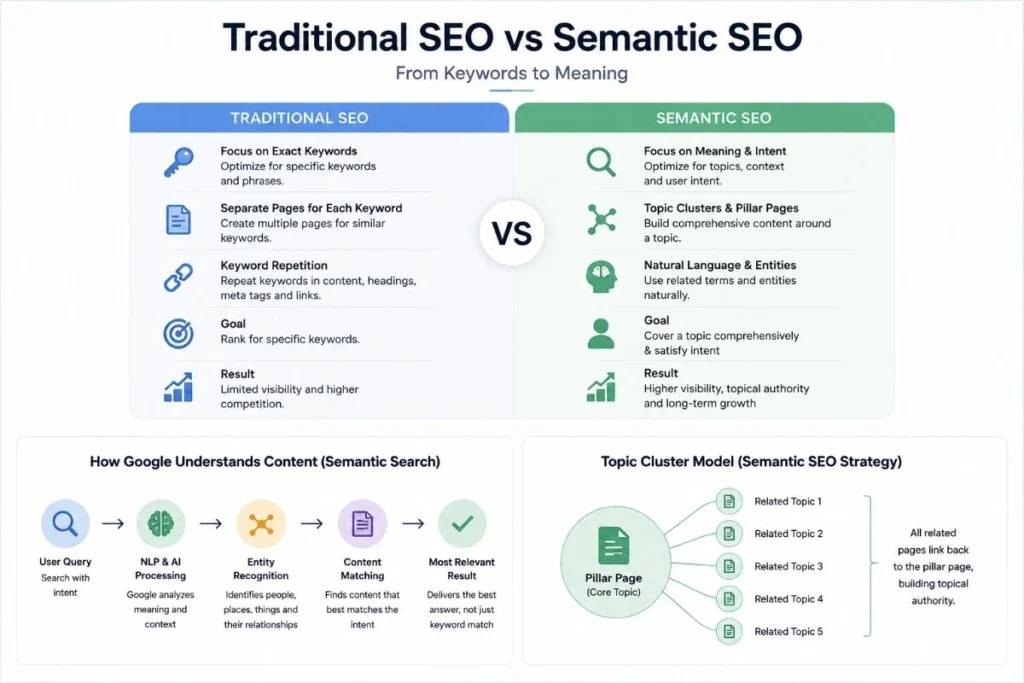
The Real Difference Between Traditional SEO and Semantic SEO
Aspect
Traditional SEO
Semantic SEO
Primary focus
Exact keywords
Meaning and intent
Content structure
Individual pages per keyword
Topic clusters + pillar pages
Optimization target
Search engine crawlers
User understanding + AI models
Key metric
Keyword ranking
Topical authority + entity coverage
Typical tactic
Repetition of the target phrase
Natural use of related entities
Risk
Keyword cannibalization, thin content
Over‑optimization (rare)
Instead of publishing multiple thin articles targeting slight variations (“best laptop 2026”, “best laptop for gaming”, “best laptop under $1000”), semantic SEO encourages one comprehensive guide that answers all related questions naturally. This improves user experience, reduces cannibalization, and helps you rank for dozens of long‑tail queries.
Why Semantic SEO Matters More in 2026
Search behavior has changed dramatically:
Voice search – “Hey Google, what’s the best laptop for video editing under $1500?”
Conversational AI – People use ChatGPT and Perplexity as entry points for search.
Zero‑click searches – AI Overviews answer directly on the SERP; your content must be the source.
Semantic SEO helps you adapt because it prioritizes:
Clarity and logical structure (headings, lists, tables)
An entity can be a person, place, product, brand, or concept. Google connects entities through its Knowledge Graph.
When your content includes relevant entities with clear relationships, Google gets stronger contextual signals.
Example: If you write about “Tesla,” does it mean the car company, Nikola Tesla, or the band? Including related entities like “Elon Musk,” “electric vehicles,” “Gigafactory,” and “autopilot” tells Google exactly which meaning you intend.
Actionable tip: Use schema markup (@type and sameAs properties) to explicitly define entities. For a blog post about SEO, add Organization schema for your brand and Person schema for the author.
What Good Semantic SEO Looks Like
Weak (traditional‑only):
“We offer SEO services. Our SEO services are affordable. Contact us for SEO services.” Too repetitive, low value.
Strong (semantic): A 2,500‑word guide titled “How to Improve Organic Traffic in 2026” that covers keyword research, entity optimization, internal linking, measuring topical authority, and a real case study. That page naturally contains entities like Semrush, Google Search Console, Core Web Vitals, NLP, and EEAT.
Quick checklist:
Define the main entity of the page
List 10–20 related entities
Write naturally, but include those entities where relevant
Use clear H2/H3 headings that answer specific questions
Add internal links to pillar pages and topic clusters
Mark up with Schema.org (Article, FAQ, HowTo, or Product)
Common Mistakes to Avoid (Even in 2026)
Publishing thin content (under 400 words) → no semantic signal
Creating separate pages for every keyword variation → cannibalization
Ignoring entities and proper nouns → Google can’t map your page to the Knowledge Graph
Writing for algorithms, not humans → high bounce rate
No schema markup → missed opportunity
Over‑optimizing exact‑match anchor text → looks unnatural
How to Improve Semantic SEO
Understand search intent first – See what’s already ranking. Guides? Product pages? Videos? Match that format.
Use natural language and related entities – Don’t repeat “best pizza NYC” 20 times. Say “Joe’s Pizza,” “thin crust,” “coal‑fired oven.”
Add structured data – Minimum: Article schema for blog posts, FAQ for question sections, Organization for brand info.
Improve internal linking – Link from general to specific. Use descriptive anchor text with entities.
Write for humans first – If a sentence sounds unnatural when reading aloud, rewrite it.
The Future of SEO (2026 and Beyond)
Traditional fundamentals (technical SEO, backlinks, mobile UX) are now table stakes. Semantic optimization is the differentiator.
In 2026, AI Overviews will change how clicks are distributed. Zero‑click searches will continue rising. Track impressions and brand mentions as much as rankings.
Websites that succeed will build topical authority, create trustworthy content, and satisfy search intent—not those with the most keyword repetitions.
Final Thoughts
Semantic SEO is not a replacement for traditional SEO. It is the evolution of it.
Technical SEO, site structure, and backlinks still matter. But modern rankings increasingly depend on how well your content helps search engines understand meaning and user intent.
The websites performing best today are not necessarily using the most keywords. They are creating useful, well‑structured, contextually rich content that genuinely answers user questions.
Ask yourself: Is your content strategy built around keywords or around topics? Your answer will determine where you rank in 2026.