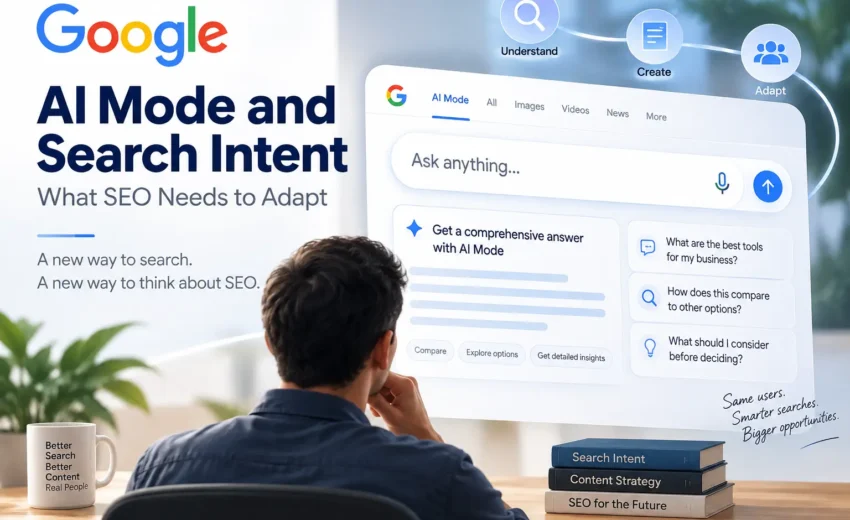
Google Search is becoming more conversational and contextual. People can now ask longer, more detailed questions, explain what they are trying to achieve, and continue exploring a topic without starting a completely new search each time.
Google AI Mode is designed for this kind of more complex search experience. Google says AI Mode can handle nuanced questions and may use query fan-out, where it searches related subtopics and sources to build a broader response.
For SEO, this does not mean traditional search optimization is disappearing. Keywords, technical SEO, indexing, internal links, useful content, and search intent still matter.
What is becoming more important is understanding the meaning and context behind a search, rather than treating a keyword as the complete definition of what the user wants.
Search Intent Is Becoming More Detailed
Search intent has always been important in SEO.
A keyword such as “SEO audit” tells you the general subject, but it does not explain why the person is searching.
They could be trying to understand what an SEO audit is, find an audit checklist, diagnose a traffic drop, or decide whether to hire someone.
AI Mode makes it easier for users to express that context in one search.
For example, a person might ask:
“My website traffic dropped after a Google update. What should I check first?”
The topic is still SEO auditing, but the intent is much clearer.
The person isn’t asking for a definition. They want to diagnose a problem and decide what to do next.
That distinction matters when creating content.
A page that only explains what an SEO audit means may match the topic, but a page that helps the reader investigate indexing, rankings, technical problems, content changes, and search intent may better match the actual need.
Longer Queries Are a Signal, Not an SEO Strategy
There is evidence that search behavior is shifting toward longer and more specific queries.
A September 2026 analysis of Google Ads data found that longer queries were gaining impression and conversion share while shorter queries were losing ground. The analysis found a notable shift toward 3–4 word searches compared with 1–2 word searches.
But this should not be interpreted as a rule that all SEO should now target long-tail keywords.
The data comes from Google Ads, not organic Search Console data, and it does not prove that AI Mode alone caused the change.
More importantly, query length does not determine intent.
A short search such as “YouTube thumbnail size” can have very specific intent. A long search such as “everything I need to know about digital marketing” can still be broad.
The better question is:
What is the person actually trying to know, compare, solve, or accomplish?
Don't Create a Page for Every Query Variation
A change in search behavior can easily lead to overproduction.
You might find several related searches and decide that each one needs its own article:
“Best SEO tools for beginners.”
“Best SEO tools for freelancers.”
“Best SEO tools for agencies.”
“Best SEO tools for small businesses.”
Sometimes these deserve separate pages. Often they are simply different versions of the same need.
Google’s guidance for AI features does not recommend creating content for every possible query variation just to appear in AI results. Google’s systems can understand related meanings without requiring a separate page for every wording.
Before creating another article, ask whether the search represents a genuinely different problem or decision.
If it does not, a stronger and more complete page may be the better choice.
Build Content Around the Problem
A useful change in SEO thinking is to move from keyword-first content toward problem-first content.
Keywords are still valuable. They help identify what people are searching for and how topics relate to one another.
But once you know the keyword, go one step further.
Ask what the reader is trying to accomplish.
Someone searching for “international SEO” may actually want to know how to target several countries, whether they need separate URLs, how hreflang works, or why the same page performs differently in different markets.
Those needs should influence the content.
This results in an article that is useful beyond the exact phrase used in the original search.
Context Matters More Than Repeating Keywords
Modern search does not require you to repeat the same keyword throughout a page.
Google’s current guidance explains that its systems can understand related terms and meanings and connect users with relevant content even when the page does not contain an exact match for every search phrase.
So instead of asking:
“How many times should I use this keyword?”
ask:
“What information naturally belongs to this topic?”
A page about Google Search Console, for example, may naturally discuss clicks, impressions, CTR, queries, pages, indexing, and URL Inspection.
Those concepts are useful because they help explain the subject. They are not there simply to increase keyword density.
Query Fan-Out Makes Topic Coverage More Important
One of the important parts of AI Mode is query fan-out.
Google describes AI Mode as grouping a user’s question into subtopics and searching for each one, allowing the system to explore different aspects of the request.
For content creators, this doesn’t mean every article needs to become extremely long.
It means a page should cover the important information needed to understand the topic or solve the underlying problem.
Think about the questions that naturally follow the main question.
If someone is learning about SEO audits, they may also need to understand indexing, content quality, internal links, technical issues, and performance data.
That kind of connected coverage is more useful than creating separate pages for every small variation.
AI Mode Doesn't Require a New SEO Rulebook
AI search has created plenty of advice about special “AI SEO” techniques.
Many of these recommendations are unnecessary.
Google says the foundational SEO requirements for AI Overviews and AI Mode are the same as for normal Search. There are no special technical requirements or special schema markup required specifically for these AI features.
Google also doesn’t require publishers to create content for every conversational query variation.
So there is no need to rewrite an entire website just to make it sound more like a conversation.
A stronger approach is to improve the content you already have and make sure it clearly satisfies the user’s need.
What SEO Should Measure Now
AI search also changes how you should interpret performance data.
The standard Search Console Performance report provides metrics such as clicks, impressions, CTR, and average position, along with dimensions such as queries, pages, countries, and devices.
Google has also introduced a separate Generative AI Performance report for AI search. It covers AI Overviews and AI Mode together and currently reports impressions, grouped by page, country, device, and date. It does not currently provide click, CTR, or query-level data in that dedicated report.
That distinction is important.
Use the standard Performance report to understand your broader organic Search traffic and queries. Use the Generative AI Performance report to understand whether your pages are gaining or losing visibility in Google’s generative AI features.
Then connect both sets of information with your analytics and business results.
A rise in AI impressions is interesting, but what matters to a business is whether that visibility contributes to useful traffic, enquiries, sales, or other meaningful outcomes.
A Practical Way to Adapt Your SEO Process
You don’t need to replace your existing SEO workflow.
Start with the main topic and identify the audience.
Then ask what problem the searcher is trying to solve.
Study the current SERP and look at the type of results Google is showing. Pay attention to the questions, formats, and information that appear repeatedly.
From there, build the content around the actual need.
Cover the important subtopics, connect related concepts naturally, and remove information that doesn’t help the reader.
Most importantly, add something valuable that isn’t just a rewritten version of what everyone else has already published.
That could be first-hand experience, original analysis, screenshots, original data, expert insight, or a practical framework.
Google’s people-first guidance emphasizes original information, useful analysis, and first-hand expertise rather than content created mainly to gain search traffic.
What Should Stay the Same
AI Mode does not make SEO fundamentals obsolete.
Technical SEO still matters.
Indexing still matters.
Internal linking still matters.
Search intent still matters.
Useful and trustworthy content still matters.
Google’s current guidance continues to treat AI features as part of Search rather than as a completely separate optimization system.
The change is in how we understand the search journey.
Instead of seeing a keyword as the entire search, think of it as the starting point.
A Better Way to Think About Search Intent
A useful SEO framework is:
Query → Intent → Context → Related needs → Content → Outcome
The query tells you what the person typed.
Intent explains what they want.
Context explains their situation.
Related needs show what information they may need next.
Content is what you create to satisfy those needs.
Outcome tells you whether the content actually helped.
This is a more useful way to approach AI-driven search than simply collecting more keyword variations.
Final Takeaway
Google AI Mode is making it easier for people to ask detailed questions and explore topics more conversationally.
For SEO, the answer isn’t to abandon keywords or create thousands of new pages.
It is to understand search intent more deeply.
Use keyword research to discover demand, but don’t stop there. Study what the searcher is trying to accomplish. Look at the current SERP. Cover the important context. Combine related questions where they belong on the same page. And add genuine value through experience, analysis, or original insight.
Also, be careful with industry trends. Longer searches may be gaining importance, but your own data should guide your strategy rather than a single study or assumption.
The goal of SEO is not to match every possible query. It is to understand the need behind the query and create the most useful content for that need.


September 15, 2026