
Ranking first for your brand name feels like a clear SEO win. But there is a bigger question that many businesses overlook:
What else do people see when they search for your brand?
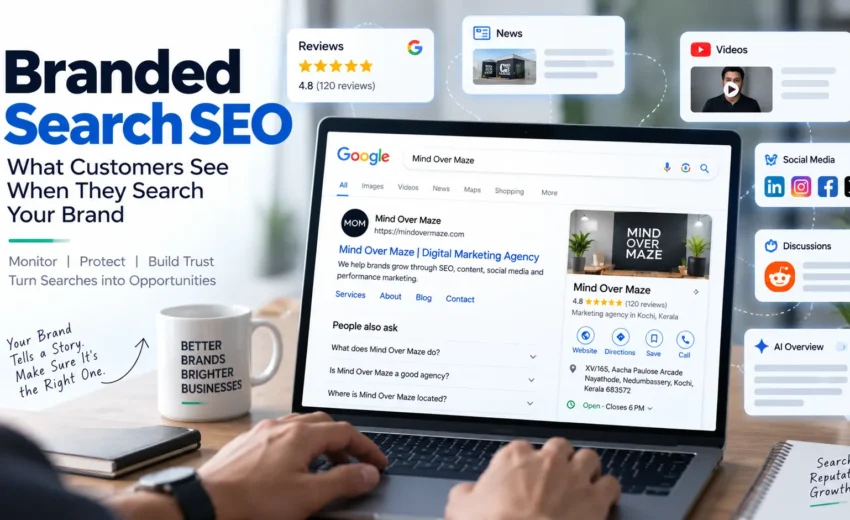
A customer may find your website, reviews, videos, social profiles, news articles, comparison pages, or other third-party information. Google can also display different search features depending on the query.
So branded SEO is not just about getting your homepage to rank first. It is about making sure the overall search experience around your brand is accurate, useful, and trustworthy.
Google Search Console also provides a branded and non-branded query filter, which can help website owners understand how their site performs for searches that specifically mention the brand. Google notes that this classification is for analysis and does not affect rankings.
What Is Branded Search?
Branded search happens when someone searches for a term specifically connected to your business or product.
For example, a person might search for:
- Your brand name
- Your brand + reviews
- Your brand + services
- Your brand + pricing
- Your brand + location
These searches are different from broad queries such as “digital marketing agency” or “best SEO company.”
A branded search often means the person already knows something about the business and wants more information. But the intent can still vary. They may be researching, comparing, looking for support, or preparing to make a decision.
That is why branded SEO should be looked at together with search intent.
Why Branded Search Matters
When someone searches a generic keyword, they are discovering businesses.
When they search your brand, they are usually researching your business specifically.
This makes branded search particularly important for reputation and customer confidence.
Imagine that your homepage ranks first, but the results underneath include outdated information, poor reviews, an old article, or a competitor’s comparison page.
Your #1 ranking is still there, but the customer is seeing a much bigger picture.
This is why branded search should be treated as part of the customer journey, not simply as a ranking report.
Look Beyond Your Homepage
One of the first things to check is whether the right page appears for the right branded query.
A customer searching for your brand’s pricing should ideally find useful pricing information. Someone searching for your location should quickly find the correct address and contact details.
Search Console can help you understand which queries bring impressions and clicks to which pages. That can reveal situations where an unexpected page is receiving visibility for an important branded search.
The goal is not to force your homepage to rank for everything.
The goal is to make sure your search results match what people are actually looking for.
Check What Others Say About Your Brand
Your own website is only one source of information about your business.
Customers may also see reviews, directories, social profiles, community discussions, videos, or articles from other websites.
That is not automatically a problem. Independent information can actually make a brand more credible.
The important part is accuracy.
Look for recurring complaints, outdated information, misleading claims, or questions that customers repeatedly struggle to answer.
A negative review is not necessarily an SEO issue. If the criticism is genuine, the better response is usually to address the underlying customer problem rather than trying to hide the review.
Watch for Competitors
Competitors can sometimes appear for searches that include your brand, especially when the query has a comparison or alternative angle.
For example, someone searching for your brand plus “alternatives” is clearly looking beyond your company.
The useful question isn’t:
“Why is my competitor ranking here?”
It is:
“What information is the customer trying to find?”
Maybe they want pricing information. Maybe they want a comparison. Maybe they want to understand what makes your service different.
Finding that gap can give you a better content opportunity than simply trying to push the competitor out of the results.
Don't Ignore Search Features
The modern Google results page contains much more than traditional organic listings.
Depending on the query, customers may see maps, images, videos, news, related questions, local information, and other search features.
That means a branded-search audit should look at the whole results page.
For a local business, Maps and reviews may matter more than a blog post.
For a product brand, images and videos may influence the search experience.
For a company with a strong news presence, recent articles may become highly visible.
Your job is to understand which features actually appear for your important branded searches and whether the information shown there is accurate.
AI Search Adds Another Layer
Branded search is also becoming relevant in AI-powered search experiences.
People may ask questions such as:
“Is this company reliable?”
or:
“What services does this company offer?”
The answer may summarize information from multiple sources rather than simply showing the company’s homepage.
This does not mean you need a completely separate technical SEO system for AI search.
Google’s current guidance says the same foundational SEO practices remain important for AI Overviews and AI Mode. Google recommends making important content accessible, useful, crawlable, and supported by clear information.
Google also says there are no special technical requirements for appearing in its AI features.
So the best starting point is still the same: create useful content and make accurate information about your business easy to find.
How to Use Google Search Console
Search Console is useful for understanding how people search for your brand.
Use the branded/non-branded query filter where available, then look at:
- Which branded queries receive impressions
- Which pages receive those impressions
- Which queries generate clicks
- Whether CTR is changing
- Whether unexpected queries are appearing
Google explains that branded query data can help businesses understand brand awareness and how users reach their site. However, the branded classification is not perfect, so it should be treated as an analytical aid rather than absolute truth.
That distinction is important when making SEO decisions.
A Simple Branded Search Audit
You can do a basic audit without a complicated tool.
Start by searching your brand name and a few important variations such as:
brand + reviews, brand + services, brand + pricing, brand + location, and brand + alternatives.
Then look at the results as if you were a new customer.
Ask:
- Is the information accurate?
- Is the right page ranking?
- Are there important questions left unanswered?
- Are competitors appearing where they matter?
- Are reviews creating concerns?
- Is outdated information still visible?
- How is the brand represented in AI-powered results?
You don’t need to fix every issue you discover.
Focus first on problems that could affect trust, leads, sales, or important customer decisions.
What You Should Not Do
Branded SEO should never become an attempt to manipulate every result you see.
Avoid creating fake reviews, artificial mentions, forum spam, or low-quality pages simply to occupy more of the search results.
These tactics may create short-term noise without solving the real problem.
Instead, improve the information customers need, keep important pages updated, respond appropriately to legitimate feedback, and build genuine authority around the brand.
That creates a much more sustainable search presence.
Branded Search Is More Than a Ranking Check
A brand can rank #1 and still have a weak search presence.
The reason is simple: customers don’t see only one result. They see the collection of information Google chooses to show around the brand.
That makes branded search useful for more than SEO reporting. It can reveal:
- What customers want to know
- What information is missing
- Where reputation issues appear
- Which competitors are entering the conversation
- Whether important brand information is outdated
- How the brand is represented across modern search experiences
Final Takeaway
Your brand ranking first is a good starting point, but it is not the complete picture.
Search your brand the way a customer would. Check your official pages, reviews, competitors, search features, and AI-generated results. Use Search Console to understand which branded searches are sending people to your website, and investigate anything that looks unusual.
Don’t just focus on where your brand ranks. Pay attention to what people learn about your brand when they search for it.
That is where branded search SEO becomes much more valuable.
AI Search Visibility: What Actually Makes a Website...