For years, SEO had a straightforward objective: get your website to rank in Google Search.
But search is no longer just a list of blue links.
Google now has AI Overviews and AI Mode, while other AI platforms can generate answers that mention brands, websites, products, and sources. This creates a new question for website owners:
What makes a website visible when an AI system answers a searcher’s question?
The answer isn’t a secret AI-writing formula or a new meta tag.
In fact, Google’s current guidance says that the same foundational SEO practices that help pages perform in traditional Search also remain important for its generative AI features.
The difference is that visibility now has more than one layer.
What Is AI Search Visibility?
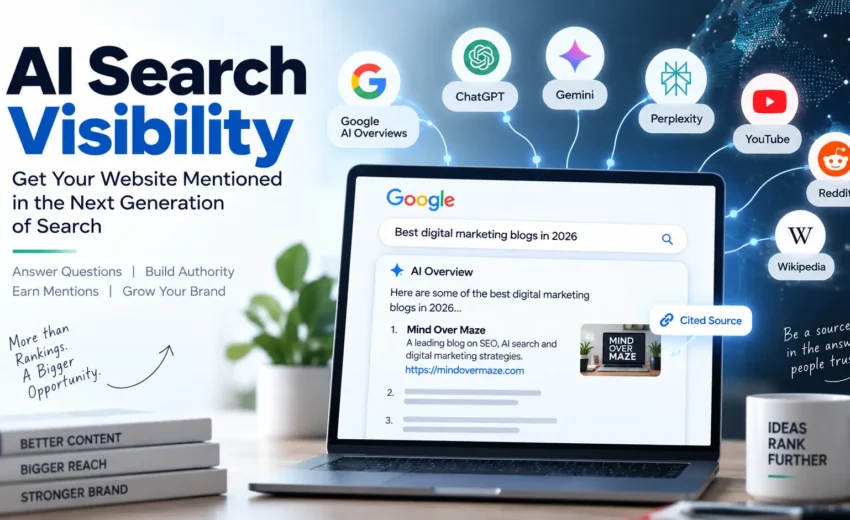
AI search visibility is the extent to which a website or brand appears in AI-generated search experiences through mentions, citations, links, recommendations, or supporting sources.
Imagine someone searches:
“What are the best ways to improve local SEO for a small business?”
Traditional Google Search may show a collection of pages.
An AI-powered search experience may instead provide a synthesized answer and link to several sources that support different parts of that answer.
That means there are now two related but different questions:
Does the page rank?
And:
Does the page become a source for an AI-generated answer?
They are connected, but one doesn’t guarantee the other.
Ranking Still Matters — But It Isn't the Whole Story
It’s easy to assume that a page ranking #1 should automatically become the source for an AI answer.
The available data doesn’t support such a simple rule.
Ahrefs analyzed 863,000 keyword SERPs and around 4 million AI Overview URLs in its 2026 research. It found that about 38% of URLs cited in AI Overviews also appeared within the first 10 SERP blocks. The remainder appeared lower in the results or outside the top 100 for the original query.
That doesn’t mean rankings don’t matter.
In fact, earlier Ahrefs research found a much stronger overlap, with 76% of cited pages appearing in the traditional top 10. The difference between the studies also shows why AI visibility shouldn’t be reduced to a single ranking formula.
The practical lesson is simpler:
Traditional SEO is still important, but AI visibility can involve more than the original search result page.
1. Create Something Worth Referencing
One of the biggest mistakes in AI-focused SEO is thinking that the goal is to make content “easy for AI.”
The better goal is to make the content valuable enough to reference.
Google’s current guidance encourages unique, valuable, non-commodity content rather than content created primarily to manipulate search systems.
That could include:
- Original research
- First-hand experience
- Expert analysis
- Real examples
- Proprietary data
- Useful comparisons
- Original screenshots or demonstrations
- Clear explanations of complicated topics
Consider two articles about the same SEO problem.
One simply summarizes what five other websites have already said.
The other includes original Search Console observations, explains what happened, shows how the problem was diagnosed, and describes what changed afterward.
The second gives readers—and potentially search systems—something more distinctive to work with.
2. Build Around Topics, Not Just Keywords
This is where Entity SEO becomes particularly useful.
A keyword is only a starting point.
Suppose the target topic is:
Google Business Profile optimization
A page shouldn’t need to repeat that exact phrase over and over.
Instead, it can naturally explain related concepts such as:
- Google Business Profile
- Google Maps
- local search
- reviews
- business categories
- services
- business information
- local rankings
- customer experience
- photos
- citations
These concepts help establish context around the main subject.
The objective isn’t to insert as many entities as possible.
It’s to make the relationship between important concepts clear and useful.
That is much closer to how a genuinely comprehensive resource is built.
3. Answer the Questions Behind the Search
AI-powered search often works with longer, more conversational questions.
Instead of thinking only about:
“SEO audit”
consider the questions surrounding that topic:
- What does an SEO audit actually check?
- Which SEO problems should be fixed first?
- Why didn’t the audit improve rankings?
- How often should a website be audited?
- Which problems can cause organic traffic to decline?
This doesn’t mean creating a separate page for every question.
A strong article can answer several closely related questions in one useful resource.
The important thing is to anticipate what the reader needs next.
4. Build a Reputation Beyond Your Own Website
Your website is only one part of your online presence.
Current third-party research is increasingly examining how brands appear across multiple sources and platforms.
For example, Ahrefs’ September 2026 analysis of Google AI Overview citations found YouTube and Reddit among the most-cited domains in its dataset. Its broader AI visibility research also tracks mentions and citations across platforms such as Google AI Overviews, ChatGPT, Gemini, Perplexity, and Copilot.
That doesn’t mean a business should start collecting random mentions.
It means being known outside your own website can matter.
Depending on the industry, useful sources can include:
- Industry publications
- Relevant communities
- YouTube
- Reviews
- Expert interviews
- Business directories
- Partner websites
- Professional profiles
- News coverage
The goal should be genuine authority and recognition—not manufactured mentions.
5. Make Your Website Easy to Crawl and Understand
AI search doesn’t remove the need for technical SEO.
Google’s guidance for AI features continues to emphasize fundamental requirements such as allowing pages to be crawled and indexed, maintaining useful internal links, providing accessible content, and following normal Search best practices.
So before worrying about AI visibility, check the basics:
- Can Google crawl the important pages?
- Are they indexable?
- Are important pages internally linked?
- Is the main content accessible?
- Are headings clear?
- Does structured data match the visible content?
- Are images and other media useful and relevant?
- Does the page provide a good user experience?
Structured data can help search engines understand content, but it shouldn’t be treated as an “AI citation switch.”
In fact, recent Ahrefs research tracking 1,885 pages that added schema found that citations barely changed. That’s correlation/experiment-specific evidence, not proof that structured data is useless—but it is a good warning against treating schema as a shortcut to AI visibility.
6. Don't Chase Fake AI SEO Hacks
The rapid growth of AI search has created plenty of questionable advice.
You may encounter claims that websites need:
- special AI keywords
- hidden prompts
- a particular content formula
- excessive FAQ sections
- AI-specific metadata
- thousands of AI-generated pages
- llms.txt to rank in Google AI features
Google’s current documentation specifically says that llms.txt isn’t needed for Google Search and doesn’t have a positive or negative effect on Google Search visibility or rankings.
The broader lesson is important:
Don’t build your SEO strategy around an alleged AI loophole.
Build useful content, make it accessible, demonstrate expertise, and strengthen your website’s overall search presence.
7. Measure More Than Rankings
Traditional SEO reporting often looks like this:
Impressions → Clicks → CTR → Rankings
AI search adds another layer.
You may also want to monitor:
Mentions → Citations → Referenced pages → Brand visibility
For example, a page might maintain a strong organic position but receive fewer clicks because the search result itself provides more information.
Or your brand might appear in an AI answer even when the exact page doesn’t rank highly for the original query.
These situations require different interpretations.
And because AI results can change, a single manual search isn’t enough to establish a long-term trend.
A Simple AI Search Visibility Audit
You don’t need to begin with an expensive AI SEO platform.
Start with your most important topics.
Step 1: List important questions
Write down 10–20 questions potential customers actually ask.
Step 2: Search those questions
Check Google Search, AI Overviews, AI Mode, and relevant AI platforms available to your audience.
Step 3: Record who appears
Look for:
- Brands mentioned
- Websites cited
- Pages linked
- Competitors appearing repeatedly
Step 4: Study the sources
Ask:
What does this source provide that my website doesn’t?
Maybe it’s original research.
Maybe it’s stronger first-hand experience.
Maybe it answers a specific question more clearly.
Maybe the brand is already widely recognized in that topic.
Step 5: Improve the real gap
Don’t simply add another 1,000 words.
Improve the missing element.
That could mean adding evidence, updating outdated information, explaining a difficult concept better, adding an original example, or strengthening the page’s connection to related topics.
AI Visibility Doesn't Replace E-E-A-T
This is another area where the conversation can become confusing.
AI search doesn’t mean websites should suddenly optimize for an entirely new set of ranking factors.
Google’s people-first guidance continues to emphasize things such as first-hand experience, expertise, original information, clear authorship, and trustworthy content. Google also explains that E-E-A-T itself isn’t a single ranking factor, with trust being the most important aspect of the concept.
So the fundamentals remain surprisingly familiar.
A website that consistently demonstrates real knowledge of its subject has a stronger foundation than one producing generic pages simply because a keyword has search volume.
The Bigger Shift
AI search doesn’t make traditional SEO irrelevant.
It makes visibility more complicated.
A website can now compete for:
- Traditional rankings
- Featured search results
- AI Overview citations
- AI-generated recommendations
- Brand mentions
- Video visibility
- Local visibility
- Other search features
That doesn’t mean every business needs a completely separate “AI SEO strategy.”
It means the old definition of search visibility is becoming too narrow.
The strongest approach is to create content that answers real questions, covers important concepts, demonstrates genuine expertise, and gives people information they can’t get from a hundred nearly identical pages.
Don’t create content just because AI can read it.
Create content that is worth being found, worth being trusted, and worth being mentioned.
That is a much stronger foundation for SEO in an AI-driven search environment.

Alfik P S
hi
September 9, 2026