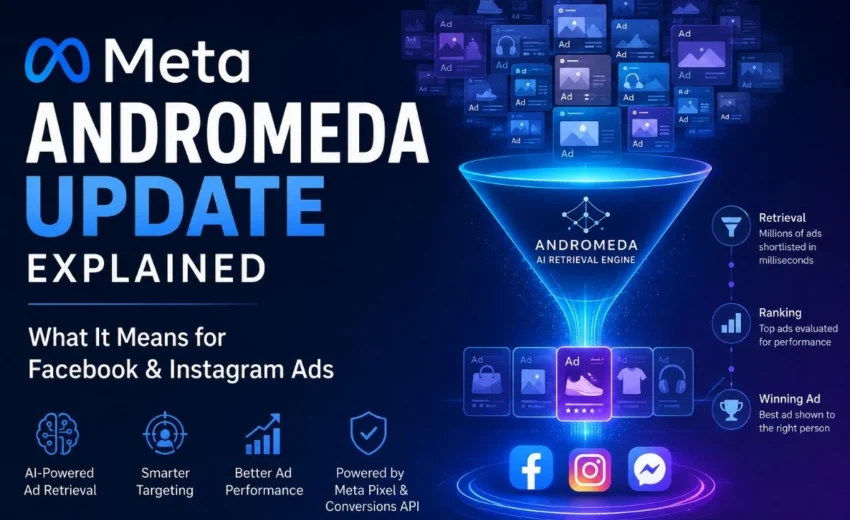
Meta Andromeda is the AI-powered ad retrieval engine that now decides which ads are even eligible to compete for a spot on Facebook and Instagram. It isn’t a new campaign setting advertisers switch on — it runs invisibly inside Meta’s ad infrastructure, narrowing millions of eligible ads down to a shortlist before the auction and ranking stage ever begins.
Andromeda isn’t a pending update anymore, either. Meta announced it on its engineering blog in December 2024, rolled it out across Facebook, Instagram, and Messenger through 2025, and by early 2026 it had become the default behavior behind essentially every campaign. If you’ve run Meta ads at any point in the last year, Andromeda has already been shaping your delivery — whether or not you’ve heard the name.
This guide covers what Andromeda is, how it works, what’s changed since its rollout, and what advertisers should actually do differently because of it.
Key Takeaways
Meta Andromeda is Meta’s AI-powered ad retrieval engine for Facebook, Instagram, and Messenger — live and fully rolled out as of early 2026.
It operates at the retrieval stage, narrowing tens of millions of ad candidates down to a shortlist before ranking and auction take over.
Creative diversity now carries more weight in ad delivery than granular manual audience targeting.
Broad audiences paired with Advantage+ automation generally outperform narrowly segmented campaigns under this system.
Meta Pixel and Conversions API (CAPI) data quality directly affects how well Andromeda can match ads to users.
Advertisers should test conceptually distinct creative variations rather than many small tweaks of the same ad.
What Is Meta Andromeda?
Meta Andromeda is a personalized ad retrieval engine built to solve a scale problem: every time someone opens Facebook or Instagram, millions of ads could theoretically be shown, but only a handful of slots to fill. Before any auction or ranking can happen, Meta first has to cut that pool down to a manageable set of realistic candidates. That first step is retrieval, and it’s the stage Andromeda was purpose-built for.
Meta has said retrieval under Andromeda narrows the field from tens of millions of ad candidates to a few thousand relevant ones before those ads move on to ranking. To do that at speed, Meta paired the system with specialized hardware — the NVIDIA Grace Hopper Superchip — which lets a much larger, more complex neural network evaluate user–ad interactions in real time rather than relying on simpler, hand-engineered rules the way earlier retrieval systems did.
Advertisers never configure Andromeda directly. There’s no toggle in Ads Manager — it’s already part of how every campaign is delivered.
Why Did Meta Build Andromeda?
The trigger was volume. Between Advantage+ automation, AI-generated creative, and the sheer number of advertisers on the platform, the number of ad variations Meta’s systems had to sort through kept climbing, and older retrieval infrastructure wasn’t built to keep pace without slowing things down.
Meta’s engineering team reported that the new hardware-and-model combination behind Andromeda delivered a measurable jump in performance: a 6% improvement in retrieval recall and an 8% improvement in ad quality on selected segments, along with more than a 3x increase in end-to-end inference throughput compared to the prior CPU-based system. In practical terms, that means Andromeda can consider far more ad candidates per request without adding delay — which is what makes it possible to keep up with today’s much larger creative libraries.
For advertisers, the practical effects are:
Better ad-to-user personalization
Support for much larger creative libraries, including AI-generated variations
Less reliance on manually built audience segments
Faster processing without a drop in ad relevance
How Meta Andromeda Works
Stage 1: Ad Retrieval
When someone opens Facebook or Instagram, Meta first pulls together every ad that could plausibly be shown to them — a pool that can run into the tens of millions. Andromeda’s job is to narrow that pool down to a few thousand strong candidates, using signals like:
Past browsing and engagement behavior
Purchase history
Campaign objective and creative content
Historical conversion performance
Advertiser and creative quality signals
This narrowing happens in milliseconds, using a neural network trained to recognize which ads are contextually relevant to a given person at that moment — not just which audience they technically fall into.
Stage 2: Ad Ranking
Once Andromeda hands off its shortlist, Meta’s ranking system takes over and evaluates each candidate more closely, factoring in:
Estimated action rate
Expected bid value
Ad quality score
Predicted conversion probability
The ad with the highest predicted value wins the auction and is shown.
Retrieval vs. Ranking
Ad Retrieval
Ad Ranking
Role
Filters tens of millions of eligible ads down to a shortlist
Selects the single winning ad from that shortlist
Powered by
Meta Andromeda
Meta’s ranking and auction algorithms
Goal
Find plausible candidates quickly
Predict which candidate will perform best
Method
Neural-network-based relevance matching
Auction signals: bid, quality, predicted value
A simple way to picture it: Andromeda is the librarian who pulls a short stack of relevant books off a library of millions based on your interests. Ranking is the process that reads that short stack and decides which single book you actually get handed. Without an efficient retrieval stage, ranking would have to evaluate every ad individually — a workload that doesn’t scale to today’s ad volumes.
Before vs. After Andromeda
Before Andromeda
After Andromeda
Targeting approach
Heavy manual audience building
AI-driven audience discovery at retrieval
Audience structure
Detailed interest stacking, multiple Lookalikes
Broader audiences via Advantage+ Audience
Optimization
Manual, ad-set-level adjustments
AI-driven delivery optimization
Role of creative
Supports targeting decisions
Actively drives who an ad is shown to
Creative libraries
Smaller, fewer variants
Larger libraries with conceptually distinct variants encouraged
Manual audience targeting hasn’t disappeared, but Meta’s retrieval layer has become good enough at identifying likely customers on its own that the highest-leverage work has shifted from audience-building toward creative development and clean data signals.
What's Actually Changed for Advertisers
1. Creative Quality Is Now a Retrieval-Stage Signal
Because Andromeda groups similar-looking ads together when it evaluates relevance, running many small variations of the same core creative doesn’t give the system much new information to work with. What moves the needle is genuine creative diversity — different formats, hooks, and personas — not just different headlines on the same image.
Strong creative inputs tend to include:
A clear hook in the first few seconds of video, or the first line of copy
A specific value proposition rather than a generic one
Short-form video and user-generated content (UGC)
Testimonials and before/after formats
A clear, single call-to-action
Rather than chasing one “perfect” ad, it’s more effective to build several genuinely different creative concepts and let delivery data show which resonates with which audience segment.
2. Broad Targeting Performs Better Than It Used To
Because retrieval is already doing sophisticated matching before ranking, campaigns built around broad audiences — paired with Advantage+ Audience and Campaign Budget Optimization — often outperform tightly segmented ones. Broad targeting gives the retrieval system more room to surface people likely to convert, even if they don’t fit a traditional audience definition.
3. Automation Has Taken Over More of Campaign Management
Advantage+ Audience, Advantage+ Shopping Campaigns, and Automatic Placements are built to work in tandem with Andromeda. Leaning on these tools rather than manually adjusting every variable tends to produce better results, since they’re designed around how the retrieval and ranking stages actually behave.
Why Meta Pixel and Conversions API Matter More Under Andromeda
Andromeda’s matching quality depends entirely on the conversion data it’s fed. Weak or incomplete signals mean the retrieval model has less to work with, regardless of how good the creative is.
Meta Pixel is browser-based tracking that records events like page views, add-to-cart actions, checkout initiation, purchases, and lead form completions.
Conversions API (CAPI) sends the same kind of conversion events server-side, directly from a website or CRM to Meta. This matters because browser-based tracking alone increasingly misses events due to cookie restrictions, ad blockers, and browser privacy changes.
Running Pixel and CAPI together, with deduplication configured correctly, improves Event Match Quality (EMQ) and gives Andromeda more reliable signals to optimize against.
Best Practices for Advertising Under Andromeda
Build genuinely distinct creative concepts, not minor variations of the same asset — different formats, hooks, and personas give the retrieval system more to work with.
Refresh creative before performance drops, not after — creative fatigue shows up as declining CTR and rising costs.
Optimize for meaningful conversion events (purchases, qualified leads, completed registrations) rather than clicks or engagement alone.
Use Advantage+ tools where appropriate instead of manually managing every targeting variable.
Treat every campaign as a test — vary hooks, formats, and offers, and let performance data (not assumptions) guide decisions.
Common Mistakes to Avoid
Building overly narrow, heavily stacked audiences
Relying on a single hero creative instead of a diverse set
Ignoring creative fatigue until performance has already dropped
Resetting campaigns repeatedly during the learning phase
Skipping or misconfiguring Meta Pixel and CAPI
Optimizing for clicks instead of down-funnel outcomes
Making major changes before enough data has accumulated to judge performance
Final Thoughts
Andromeda isn’t an update on the horizon — it’s the infrastructure your ads have been running through for over a year now. The advertisers seeing the best results under it aren’t the ones with the most granular targeting; they’re the ones feeding the system genuinely diverse creative and clean conversion data. That’s the real shift: less time refining audience segments, more time on creative variety and tracking accuracy.