

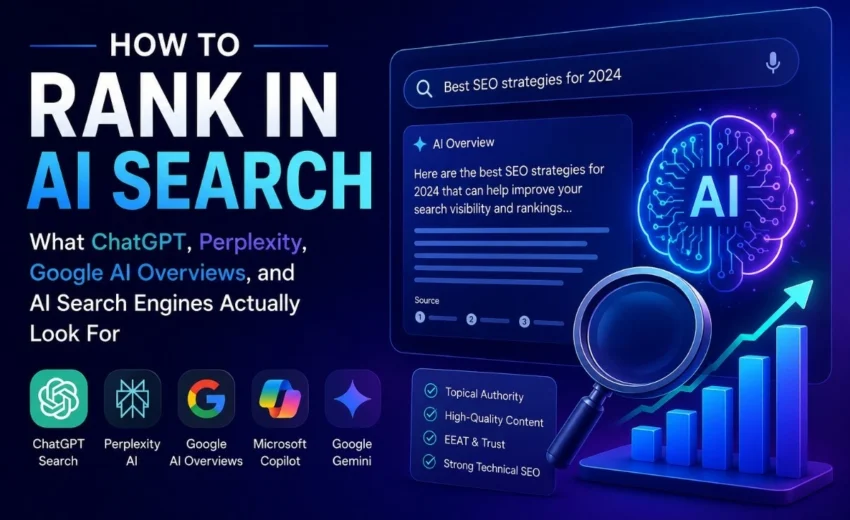
Search is evolving faster than ever. Instead of scrolling through pages of blue links, people are increasingly turning to AI-powered search platforms like ChatGPT Search, Google AI Overviews, Perplexity AI, Microsoft Copilot, and Google Gemini for direct answers.
This shift has changed how websites gain visibility. Ranking #1 on Google is still valuable, but it’s no longer the only goal. Today, businesses also want their content to appear in AI-generated answers, summaries, and citations.
So, how do you rank in AI search?
The answer isn’t about replacing traditional SEO—it’s about building on it. AI search engines still rely on many of the same signals that have powered search for years, including high-quality content, technical SEO, and website authority. However, they place greater emphasis on topical expertise, content quality, and the ability to answer users’ questions clearly.
In this guide, you’ll learn how AI search engines rank content, how to rank in ChatGPT Search, Google AI Overviews, Perplexity AI, and other AI platforms, along with practical strategies to improve your visibility in AI search results.
What Is AI Search?
AI search refers to search experiences where artificial intelligence generates answers instead of simply displaying a list of websites.
Rather than asking users to open multiple pages, AI systems analyze trusted sources, combine relevant information, and provide a summarized response. Many platforms also cite the websites they used, allowing authoritative content to gain visibility even without a traditional click.
Popular AI search platforms include:
- ChatGPT Search
- Google AI Overviews
- Perplexity AI
- Microsoft Copilot
- Google Gemini
- You.com
This evolution means websites are no longer competing only for search rankings—they’re competing to become trusted sources that AI systems choose to reference.
How Do AI Search Engines Rank Content?
One of the most common questions today is, “How do AI search engines rank content?”
Although companies like OpenAI, Google, and Perplexity don’t publicly disclose their complete ranking systems, consistent patterns have emerged.
Most AI search engines follow a process similar to this:
1. Discover Content
AI systems rely on search engine indexes and web crawlers to discover pages. If your website isn’t crawlable or indexed properly, it has little chance of appearing in AI-generated answers.
2. Understand the Topic
Modern AI doesn’t simply count keywords. Instead, it analyzes the overall topic of a page and determines how well it answers a user’s question.
3. Evaluate Trust
AI search engines look for signals that indicate credibility, including:
- Author expertise
- Website authority
- High-quality backlinks
- Brand reputation
- Content accuracy
- Consistent publishing
4. Compare Multiple Sources
Rather than relying on a single article, AI systems compare information from numerous trusted websites before generating an answer.
5. Generate and Cite Responses
The final response combines information from authoritative sources. Websites with comprehensive, trustworthy content are more likely to be cited.
This is why ranking in AI search isn’t just about keywords—it’s about becoming one of the most reliable sources on a topic.
How to Rank in AI Search
If you’re wondering how to rank in AI search, the strategy is surprisingly similar to creating genuinely helpful content for people.
Instead of trying to manipulate algorithms, focus on becoming the best resource for a specific topic.
Here are the key principles that consistently improve AI search visibility.
Build Topical Authority
AI search engines prefer websites that demonstrate deep expertise across an entire subject.
For example, if your website publishes only one article about SEO, AI systems may consider it a limited resource. However, if you publish comprehensive content covering technical SEO, keyword research, schema markup, internal linking, Core Web Vitals, local SEO, and AI SEO, your website demonstrates topical authority.
Rather than targeting isolated keywords, build topic clusters that cover related subjects in depth.
Publish Comprehensive Content
Thin articles rarely perform well in AI search.
A high-quality article should answer a topic completely by including:
- Definitions
- Explanations
- Examples
- Benefits
- Challenges
- Best practices
- Common mistakes
- Frequently asked questions
The goal is to eliminate the need for users to perform another search.
Answer Questions Directly
AI platforms often extract concise answers from webpages.
Instead of writing:
“Technical SEO is something every website should think about.”
Write:
“Technical SEO is the process of optimizing a website’s infrastructure so search engines can crawl, index, and understand its content more effectively.”
Clear, direct definitions increase the likelihood of being referenced in AI-generated responses.
Strengthen Internal Linking
Internal links help AI systems understand how your content connects.
For example, an article about AI search optimization should naturally link to related content such as:
- Technical SEO
- Schema markup
- Keyword research
- Internal linking
- Content marketing
- Google Search Console
- Core Web Vitals
A well-connected content hub demonstrates expertise far better than isolated blog posts.
Focus on User Intent
Every article should answer the question behind the search.
Instead of asking:
“Which keyword should I target?”
Ask:
“What information is the user actually looking for?”
AI systems reward content that thoroughly and naturally satisfies user intent.
How to Rank in AI Search Results
Many people search for how to rank in AI search results, expecting a secret ranking formula.
The reality is simpler.
There is no official AI search algorithm available to publishers. However, websites that consistently appear in AI-generated answers tend to share the same characteristics:
Ranking Factor | Why It Matters |
Demonstrates expertise across an entire subject | |
Helpful content | Provides complete and accurate answers |
EEAT | Builds trust and credibility |
Technical SEO | Ensures content can be discovered |
Internal linking | Strengthens topical relationships |
Content freshness | Keeps information accurate |
Brand authority | Increases trust across the web |
Rather than chasing individual ranking factors, focus on building an authoritative website that consistently publishes valuable content.
How to Rank in ChatGPT Search
One of the fastest-growing questions in Search Console is “How to rank in ChatGPT Search.”
While OpenAI hasn’t published an official ranking algorithm, several best practices consistently improve your chances of appearing in ChatGPT-generated answers.
Create Original Content
Don’t simply rewrite existing articles.
Offer original insights, real-world experience, case studies, research, or expert opinions that add genuine value.
Demonstrate Expertise
Content written by knowledgeable professionals is more likely to be trusted than generic AI-generated text with little human oversight.
Build Authority Across Your Niche
Publishing dozens of high-quality articles on related topics signals expertise far more effectively than publishing isolated content.
Keep Information Updated
ChatGPT Search is more likely to reference accurate and current information, especially for rapidly evolving topics such as AI, digital marketing, cybersecurity, finance, and technology.
Earn Brand Recognition
Brand mentions, backlinks, positive reputation, and industry recognition all contribute to your website’s overall authority.
The stronger your brand becomes, the greater your likelihood of being referenced by AI systems.
How to Rank Higher on ChatGPT Searches
If your goal is to rank higher on ChatGPT searches, focus on making your content easier for both humans and AI to understand.
Some practical improvements include:
- Write clear introductions that answer the topic immediately.
- Use descriptive H2 and H3 headings.
- Break up long paragraphs.
- Include bullet points and numbered lists.
- Add comparison tables where appropriate.
- Include FAQs that answer common questions.
- Update important articles regularly.
These improvements enhance readability while increasing the chances that AI systems can accurately interpret and cite your content.
How to Rank on SearchGPT and Other AI Platforms
Whether users search for SearchGPT, Google AI Overviews, Perplexity AI, Microsoft Copilot, or Google Gemini, the underlying goal is the same: to provide the most accurate and trustworthy answer.
Although each platform may prioritize signals differently, they generally reward websites that:
- Publish comprehensive content.
- Demonstrate real expertise.
- Cover topics in depth.
- Maintain strong technical SEO.
- Earn quality backlinks.
- Build recognizable brands.
- Update content consistently.
Instead of optimizing separately for each AI platform, create content that fully satisfies users. High-quality, authoritative content has the greatest chance of performing well across multiple AI search engines.
How to Rank on Perplexity AI Searches
Perplexity AI has become one of the fastest-growing AI search platforms because it cites sources for nearly every answer. Unlike traditional search engines that primarily rank webpages, Perplexity focuses on finding the most trustworthy and up-to-date information before generating a response.
If you want to rank on Perplexity AI searches, focus on these best practices:
Publish Well-Researched Content
Back up your claims with reliable sources, original insights, industry experience, and factual accuracy. Content that provides genuine value is more likely to be cited.
Keep Content Fresh
Perplexity often favors updated information for fast-changing topics such as AI, SEO, marketing, finance, and technology. Review your important articles regularly and update statistics, examples, and recommendations.
Structure Content Clearly
Use descriptive headings, bullet points, comparison tables, and concise paragraphs. Clear formatting helps both readers and AI systems understand your content more effectively.
Build Website Authority
High-quality backlinks, positive brand mentions, expert author profiles, and consistent publishing all contribute to your website’s credibility across AI search platforms.
Understanding AI Search Rankings
Many people assume AI search rankings work exactly like Google’s traditional search rankings. In reality, they are different.
Traditional SEO asks:
Which webpage should rank highest for this keyword?
AI search asks:
Which sources provide the most trustworthy and complete answer?
This means your website doesn’t necessarily need to hold the #1 organic position to be cited by AI systems. Instead, AI platforms evaluate factors such as:
- Topical expertise
- Content completeness
- Trustworthiness
- Readability
- User intent
- Brand authority
- Technical SEO
Rather than optimizing individual pages in isolation, build an authoritative website that consistently demonstrates expertise across your niche.
AI Search Ranking Factors
Although no AI company has publicly revealed its complete ranking algorithm, several ranking signals consistently appear across ChatGPT Search, Google AI Overviews, Perplexity AI, Microsoft Copilot, and Google Gemini.
1. Topical Authority
Publishing multiple high-quality articles covering every aspect of a subject helps AI systems recognize your website as an expert resource.
2. EEAT
Experience, Expertise, Authoritativeness, and Trustworthiness remain essential. Showcase real-world experience, qualified authors, and accurate information to build credibility.
3. Helpful Content
Create content that answers users’ questions thoroughly instead of writing solely for search engines.
4. Strong Technical SEO
Ensure your website has:
- Fast loading speed
- Mobile-friendly design
- Secure HTTPS
- XML sitemap
- Proper indexing
- Structured data where appropriate
Without these foundations, even excellent content may struggle to be discovered.
5. Internal Linking
Connect related articles naturally to build topic clusters and help search engines understand relationships between your content.
6. Original Insights
Avoid publishing generic content that simply repeats information already available online. Share practical experience, unique perspectives, case studies, and real examples.
7. Brand Authority
Brands with strong online reputations, quality backlinks, industry mentions, and consistent publishing are more likely to be referenced by AI systems.
How to Rank in AI Answers
Many users ask how to rank AI answers rather than traditional search results.
AI platforms typically extract information that is:
- Clear and concise
- Factually accurate
- Well-structured
- Easy to understand
- Comprehensive enough to answer the user’s question
To improve your chances of appearing in AI-generated answers:
- Answer the main question within the first few paragraphs.
- Use descriptive headings that reflect common search queries.
- Include definitions, examples, and practical advice.
- Add FAQ sections to address related questions.
- Keep paragraphs short and readable.
The easier your content is to understand, the easier it is for AI systems to reference it.
How to Rank on AI Search Engines
Whether you’re targeting ChatGPT Search, Google AI Overviews, Perplexity AI, Microsoft Copilot, or Google Gemini, the core strategy remains the same.
Focus on creating content that:
- Solves real user problems.
- Covers topics comprehensively.
- Demonstrates genuine expertise.
- Is technically optimized for search engines.
- Builds trust through accuracy and transparency.
Avoid chasing platform-specific tricks. High-quality content performs well across multiple AI search engines because it satisfies the needs of both users and AI systems.
Common Mistakes That Prevent Ranking in AI Search
Many websites still struggle to appear in AI search results because they repeat outdated SEO habits.
Avoid these common mistakes:
Publishing Thin Content
Short articles that barely answer a question rarely provide enough value for AI systems to reference.
Targeting Only Keywords
Instead of creating dozens of articles around similar keywords, build comprehensive topic clusters that demonstrate expertise.
Ignoring User Intent
If your content doesn’t answer what users actually want to know, AI systems will likely choose another source.
Overusing AI Without Human Editing
AI-generated drafts should always be reviewed, expanded, and enhanced with human expertise. Original insights and real-world experience make your content more trustworthy.
Neglecting Technical SEO
Slow websites, poor mobile experiences, broken internal links, and indexing issues reduce your visibility across both traditional and AI search.
Failing to Update Content
Outdated information becomes less useful over time. Refresh your key articles regularly to maintain accuracy and relevance.
AI Search Optimization Checklist
Before publishing a new article, ask yourself:
✅ Does it answer the user’s question clearly?
✅ Does it demonstrate expertise and real experience?
✅ Is the content more helpful than competing articles?
✅ Have I covered the topic comprehensively?
✅ Have I added useful internal links?
✅ Is the page easy to read with clear headings?
✅ Is the information accurate and up to date?
✅ Is the website technically optimized?
If you can answer “yes” to all of these questions, your content is well positioned for both traditional SEO and AI search.
Frequently Asked Questions
Can you rank in ChatGPT Search?
Yes. Although OpenAI has not published an official ranking algorithm, websites with strong topical authority, comprehensive content, and high trust signals are more likely to be referenced in ChatGPT Search.
How do AI search engines rank content?
AI search engines evaluate content based on relevance, expertise, topical authority, content quality, technical SEO, brand reputation, and how effectively a page satisfies user intent.
Does traditional SEO still matter?
Absolutely. Technical SEO, internal linking, page speed, crawlability, and content quality remain essential because AI search systems rely on search engine infrastructure to discover and evaluate webpages.
How often should I update my content?
For rapidly changing topics such as AI, SEO, and digital marketing, review important articles every few months. Evergreen content should also be refreshed periodically to ensure accuracy.
Is ranking in AI search different from ranking on Google?
Yes. Traditional Google Search focuses on ranking webpages, while AI search aims to generate the best possible answer by combining information from multiple trusted sources. Strong SEO remains important, but topical authority, helpful content, and trust play an even greater role in AI-generated responses.
Final Thoughts
AI search is transforming how people discover information, but the principles of creating valuable content remain unchanged.
Instead of focusing only on keyword rankings, focus on becoming the most trusted resource in your niche. Build topical authority, publish original insights, maintain strong technical SEO, and create content that genuinely answers users’ questions.
As AI search platforms continue to evolve, websites that consistently demonstrate expertise, trustworthiness, and user-first content will have the greatest opportunity to appear in ChatGPT Search, Google AI Overviews, Perplexity AI, Microsoft Copilot, Google Gemini, and future AI-powered search engines.
The goal is no longer just to rank on search engines—it’s to become a trusted source that both people and AI choose to reference.

Alfik P S
hi

June 25, 2026
Mobile Optimization for SEO: Complete Guide for 2026
June 25, 2026




SEO Competitor Analysis: What to Check Beyond Keywords August 31, 2026
[…] Search visibility now extends past traditional rankings. Depending on your audience, it’s worth checking how competitors appear in AI-powered experiences like Google AI Overviews, Google AI Mode, ChatGPT, Perplexity, and Gemini. […]
Google AI Mode and Search Intent: What SEO Needs to Adapt September 15, 2026
[…] has also introduced a separate Generative AI Performance report for AI search. It covers AI Overviews and AI Mode together and currently reports impressions, grouped by page, country, device, and date. […]