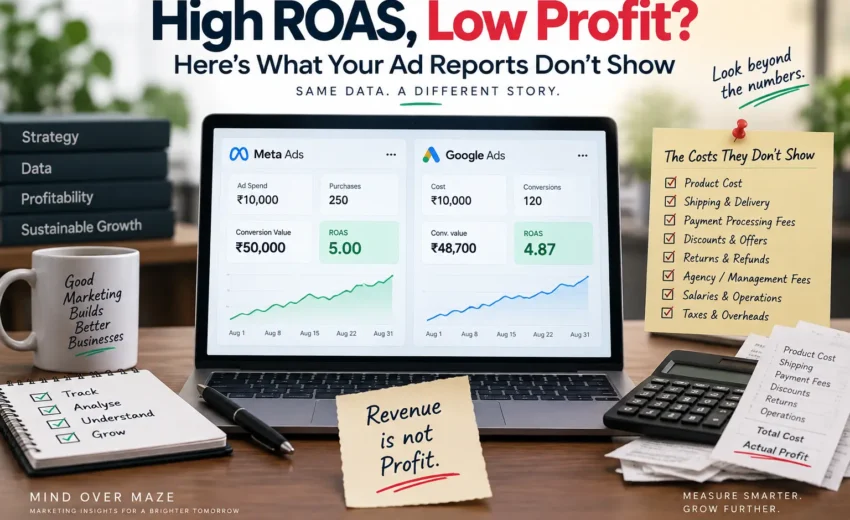
A campaign can show a 5× ROAS and still leave a business with less profit than expected.
That sounds strange at first. If you spend ₹10,000 on advertising and generate ₹50,000 in revenue, the campaign appears to be performing well. But advertising revenue is not the same thing as profit.
The money generated from a campaign may still need to cover product costs, discounts, shipping, payment fees, refunds, salaries, software, and other business expenses.
That is why ROAS is useful, but it should never be the only number you use to judge advertising performance.
What Does ROAS Actually Measure?
ROAS stands for Return on Ad Spend.
It measures how much revenue is generated for every unit of money spent on advertising.
For example:
Ad spend: ₹10,000
Attributed revenue: ₹50,000
ROAS: 5×
This means the campaign generated ₹5 in attributed revenue for every ₹1 spent on advertising.
But notice the wording: revenue, not profit.
That’s where the problem begins.
A 5× ROAS Doesn't Mean You Made 5× Profit
Suppose an e-commerce business spends ₹10,000 on Meta Ads and generates ₹50,000 in sales.
The dashboard reports:
ROAS = 5×
It might look like this:
Item
Amount
Revenue
₹50,000
Ad spend
₹10,000
Product cost
₹25,000
Shipping & payment costs
₹5,000
Discounts/other costs
₹3,000
Remaining amount
₹7,000
The campaign generated ₹50,000 in revenue, but the business doesn’t get to keep ₹50,000.
After several costs, only ₹7,000 remains before considering other overheads.
So the question shouldn’t simply be:
“What is my ROAS?”
It should also be:
“How much money does this advertising actually leave in the business?”
Why Ad Reports Don't Show the Full Picture
Platforms such as Google Ads and Meta Ads Manager are designed primarily to report advertising performance.
They can show you metrics such as:
Ad spend
Impressions
Clicks
Conversions
Conversion value
Cost per conversion
ROAS
These metrics are valuable for understanding what happened inside the advertising system.
But your advertising platform generally doesn’t know every cost involved in delivering your product or service.
It may not know your:
Product manufacturing cost
Employee salaries
Warehouse expenses
Shipping losses
Refunds
Payment processing fees
Agency fees
Software subscriptions
Rent
Taxes and other operating expenses
So a campaign can look excellent inside an ad account while producing a very different result at the business level.
ROAS vs ROI: The Difference Matters
ROAS and ROI are often used interchangeably, but they answer different questions.
ROAS asks:
How much revenue did I generate from my advertising spend?
ROI asks:
How much return did I generate after considering the relevant costs?
For example, if you spend ₹20,000 on advertising and generate ₹100,000 in attributed revenue, your ROAS is 5×.
That tells you about the relationship between advertising spend and attributed revenue.
It doesn’t tell you whether the overall business transaction was profitable.
This distinction becomes particularly important when profit margins are low.
Your Break-Even ROAS Depends on Your Margin
There isn’t one universal ROAS number that means “good.”
A business selling products with high margins can potentially operate with a different break-even ROAS than a business with very low margins.
For example, imagine two products:
Product A
Selling price: ₹1,000
Gross margin before advertising: 60%
Product B
Selling price: ₹1,000
Gross margin before advertising: 20%
Both businesses could generate the same ROAS, but their economics are completely different.
This is why simply saying “We need a 4× ROAS” without understanding margins can lead to poor decisions.
Your target should come from your business economics, not from a random industry benchmark.
ROAS Can Also Depend on Attribution
Another important issue is attribution.
Advertising platforms use attribution systems to connect conversions and revenue back to ads. The reported number therefore depends partly on how conversions are attributed.
A customer might:
See an Instagram ad.
Visit the website.
Leave.
Search for the brand later.
Return through another channel.
Complete the purchase.
Different measurement systems can give different views of that journey.
That doesn’t automatically mean the ad platform’s number is wrong. It means you need to understand what the reported ROAS actually represents.
ROAS is a measurement of attributed advertising performance, not a perfect measurement of every factor that influenced a purchase.
Lead Generation Has a Different ROAS Problem
ROAS becomes even more complicated when you’re running lead-generation campaigns.
Imagine a Meta campaign spends ₹20,000 and generates 100 leads.
Your cost per lead is:
₹200
But the campaign hasn’t necessarily generated ₹20,000 worth of revenue yet.
Suppose:
100 leads
20 become qualified prospects
5 become customers
Average customer value = ₹10,000
Now the business has generated ₹50,000 in customer revenue.
The advertising platform may not automatically understand the complete offline sales process unless you feed the relevant conversion information back into your measurement system.
For lead-generation businesses, metrics such as qualified leads, customer acquisition cost (CAC), close rate, and customer value can therefore be more meaningful than looking at platform ROAS alone.
What Should You Measure Alongside ROAS?
ROAS becomes much more useful when you combine it with other metrics.
Customer Acquisition Cost (CAC)
CAC tells you how much it costs to acquire a customer.
A campaign can have attractive ROAS but an acquisition cost that doesn’t work for your business model.
Conversion Rate
A high number of clicks doesn’t necessarily mean a successful campaign.
Conversion rate helps you understand how effectively traffic becomes leads or customers.
Average Order Value
If your average order value increases, you may be able to acquire customers profitably at a higher advertising cost.
Gross Margin
This is one of the most important numbers for understanding whether your ROAS is sustainable.
Customer Lifetime Value
A first purchase isn’t always the entire value of a customer.
If customers regularly return and purchase again, the business may be able to justify a higher initial acquisition cost.
Don't Optimize Your Campaign for ROAS Blindly
There is another side to the problem.
Trying to maximize ROAS at all costs can sometimes encourage you to focus only on the easiest conversions.
For example, a campaign could generate excellent ROAS from existing customers or people who already know your brand.
That might look efficient in the advertising dashboard.
But if your business goal is customer growth, you may also need to evaluate new-customer acquisition, reach, qualified traffic, and long-term customer value.
The best metric depends on the actual business objective.
A Better Way to Read Your Ad Reports
Instead of opening Google Ads or Meta Ads Manager and immediately asking “What’s the ROAS?”, use a wider process.
Start with the advertising numbers
Look at:
Spend
Revenue or conversion value
ROAS
CPA/CPL
Conversion rate
Then connect them to business numbers
Check:
Revenue actually received
Product or service costs
Gross margin
Refunds
Discounts
Customer acquisition cost
New vs returning customers
Customer lifetime value
Finally, ask the business question
“If we continue spending at this level, does the business make enough money to justify scaling?”
That’s a much more useful question than simply chasing a higher ROAS.
High ROAS Can Sometimes Hide a Growth Problem
Imagine two campaigns.
Campaign A
Spend: ₹10,000
Revenue: ₹60,000
ROAS: 6×
Campaign B
Spend: ₹100,000
Revenue: ₹400,000
ROAS: 4×
Campaign A has the higher ROAS.
But Campaign B is generating substantially more revenue and may be bringing significantly more customers into the business.
The right decision cannot be made from ROAS alone.
You need to understand profitability, scale, customer quality, and the business objective.
Final Takeaway
A 5× ROAS can look impressive, but it doesn’t automatically mean a campaign is profitable.
Before increasing your advertising budget, look beyond the number in the dashboard.
Consider your margins, product costs, customer acquisition cost, refunds, discounts, customer lifetime value, and the actual business objective.
Don’t ask only, “How much revenue did my ads generate?”
Ask:
“After everything is accounted for, what did those ads actually contribute to the business?”
That’s where ROAS becomes more than a dashboard metric — it becomes part of a real marketing decision.