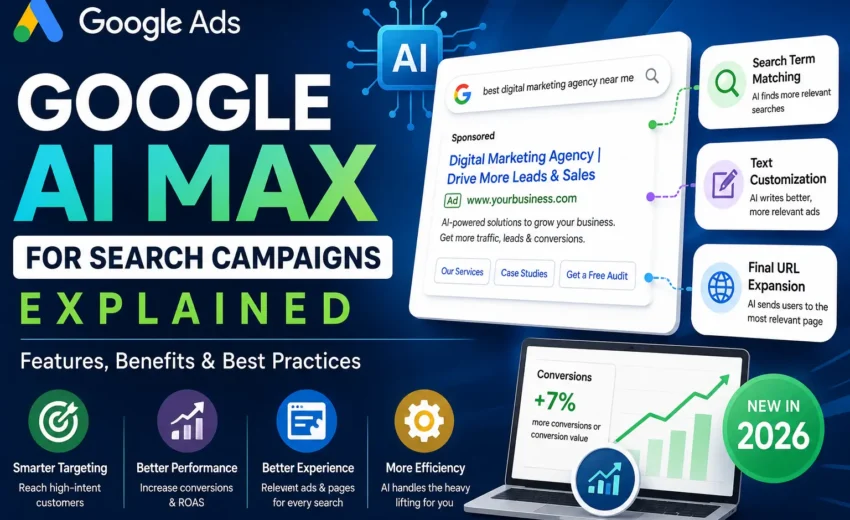
Google AI Max is reshaping how Search advertisers reach relevant customers, combining AI-powered search term matching, text customization, and intelligent landing page selection. It’s no longer a niche beta feature — as of 2026, it’s moved to general availability, gained new controls, and in some cases will be applied to campaigns automatically whether advertisers opt in or not. This guide covers what Google AI Max is, how it works, what’s changed in 2026, and how to use it effectively.
Key Takeaways
- Google AI Max is an optional-turned-semi-mandatory AI enhancement for existing Google Search campaigns — not a new campaign type like Performance Max or Demand Gen.
- AI Max moved out of beta in April 2026, with improved targeting and creative quality and enhanced controls.
- Starting September 2026, campaigns using Dynamic Search Ads, Automatically Created Assets, or campaign-level Broad Match will be auto-upgraded to AI Max — advertisers who want control should migrate proactively rather than wait.
- AI Max combines Search Term Matching, Text Customization, and Final URL Expansion to improve ad relevance.
- New in 2026: AI Brief (Gemini-powered campaign steering) and text disclaimers for regulated industries.
- AI Max now extends beyond Search to Shopping and Travel formats.
- Advertisers using the full feature suite see an average of 7% more conversions or conversion value at a similar CPA/ROAS compared to search term matching alone.
- Ads containing AI-generated elements must now carry a disclosure label.
- Businesses with well-structured landing pages, accurate conversion tracking, and quality Responsive Search Ads benefit the most.
What Is Google AI Max?
Google AI Max is an AI-powered optimization layer built into existing Google Search campaigns. Rather than creating a new campaign type, advertisers enable AI Max within their current Search campaigns to improve targeting, ad relevance, and landing page selection using machine learning.
Unlike Performance Max, which distributes ads across Search, YouTube, Display, Gmail, Discover, Maps, and Shopping, AI Max was originally built exclusively for the Google Search Network. As of 2026, Google has extended the AI Max approach to two additional formats: AI Max for Shopping (for retailers, using Merchant Center feeds) and Search campaigns for Travel (unifying travel ad formats like Travel Promotion Ads and Booking Links). This guide focuses on AI Max for standard Search campaigns.
AI Max analyzes user intent, campaign settings, landing pages, and historical performance to identify additional opportunities where your ads may be relevant — even for searches that don’t exactly match your keyword list.
For example, if your campaign targets “SEO services in Kochi,” AI Max may also surface searches such as:
- Best digital marketing agency near me
- Improve Google rankings for my business
- SEO consultant for ecommerce website
- Local SEO expert in Kerala
Even though these searches don’t exactly match your keyword list, Google’s AI recognizes similar commercial intent and may choose to display your ad.
Why Did Google Introduce AI Max?
Search behavior has changed. Thanks to voice search, AI Overviews, Gemini, and conversational search, users increasingly ask detailed questions instead of typing short keyword phrases.
Traditional Search | Modern Search |
Hotel in Kochi | Which business hotel near Infopark Kochi offers free breakfast and airport pickup? |
Both searches express similar intent, but the second carries far more context. Manually predicting every long-tail variation isn’t realistic, so AI Max combines keyword signals with semantic understanding to identify contextually relevant searches — reflecting Google’s broader shift from keyword matching to intent matching.
2026 Update: The Auto-Migration You Need to Know About
This is the part most guides on this topic still miss.
AI Max exited beta in April 2026 with improved targeting and creative quality. But the bigger operational change is this: starting September 2026, Google is automatically upgrading eligible campaigns to AI Max — specifically those using:
- Dynamic Search Ads (DSA)
- Automatically Created Assets (ACA)
- Campaign-level Broad Match settings
Google expects these upgrades to conclude by the end of September 2026, and the exact feature configuration a campaign inherits depends on its original campaign type — DSA campaigns, for instance, inherit the most aggressive configuration, with all three AI Max features (search term matching, text customization, and Final URL Expansion) active simultaneously.
What this means for advertisers:
- If you’re running DSA, ACA, or broad match campaigns and haven’t touched AI Max settings, don’t assume you’re unaffected — plan the migration on your terms rather than Google’s default configuration.
- Set brand exclusions before the migration takes effect, not after. Unconfigured accounts have seen a meaningful share of AI Max impressions land on competitor brand terms.
- Review which AI Max features are enabled post-migration — you can turn features on or off individually rather than accepting the full suite.
How Google AI Max Works
AI Max is built around three core technologies.
1. Search Term Matching
Traditional Search campaigns rely on Exact, Phrase, or Broad Match keywords. AI Max goes further, using Google’s AI to understand the meaning behind a search rather than just matching words — weighing signals like search intent, query context, landing page relevance, existing keywords, Responsive Search Ads, historical conversion data, device and location signals, and campaign objectives.
For example, a Kerala tour operator targeting “Kerala tour packages,” “Kerala holiday packages,” and “Kerala vacation packages” might see AI Max also surface:
- 5-day Kerala itinerary for couples
- Family trip to Munnar and Alleppey
- Best Kerala backwater holiday
- Kerala honeymoon package with houseboat
- Custom Kerala travel package
This doesn’t replace keywords — it complements them by surfacing search opportunities manual keyword research may have missed.
2. Text Customization
AI Max generates and optimizes headlines and descriptions using your existing Responsive Search Ads, landing page content, business information, search queries, keywords, and user intent — reducing the need to manually write ad variations for every possible query.
2026 update: Ads containing AI-generated elements must now display a disclosure label. Early data suggests minimal impact on click-through rates, but brand-sensitive advertisers should be aware of it.
Also new: AI Brief. Rolling out through 2026, AI Brief is a Gemini-powered tool that lets advertisers guide AI Max’s messaging and audience targeting in their own words. Existing text guidelines automatically migrate into AI Brief’s messaging guidelines when it’s enabled.
AI performs best with strong underlying Responsive Search Ads — it enhances good copywriting, it doesn’t replace it.
3. Final URL Expansion
Final URL Expansion lets Google’s AI automatically select the page on your website that best matches a user’s search intent, rather than sending every visitor to one fixed landing page or the homepage.
For example, a hotel website with separate pages for Deluxe Rooms, Family Suites, Restaurant, Conference Hall, and Wedding Venue might route “hotel conference hall in Kochi” straight to the Conference Hall page.
2026 update: Text disclaimers now work alongside Final URL Expansion. Previously, regulated-industry advertisers requiring mandatory legal text in their ads had to choose between Text Customization and Final URL Expansion. Now both can run together with guaranteed disclaimer text.
Final URL Expansion works best on sites with a clear content structure and strong internal linking, and it should be monitored via the Landing Page Report to confirm that Google is routing users appropriately.
AI Max vs. Performance Max
Feature | AI Max | Performance Max |
Campaign Type | Enhancement for existing Search campaigns | Standalone campaign type |
Advertising Channels | Search (plus Shopping and Travel formats as of 2026) | Search, Display, YouTube, Gmail, Discover, Maps & Shopping |
Keyword Usage | Works alongside existing keywords with AI-powered matching | Doesn’t rely on traditional keywords |
Ad Assets | Optimizes existing Responsive Search Ads | Uses Asset Groups with images, video, headlines, logos, descriptions |
Best For | Improving Search campaign performance | Running cross-channel campaigns from a single campaign |
If your business depends heavily on Search advertising, AI Max is the natural upgrade path. If you want Google’s AI managing ads across multiple properties with minimal manual input, Performance Max remains the better fit.
Key Features Summary
- Search Term Matching — expands reach beyond exact keyword matching by evaluating intent and context
- Text Customization — dynamically generates headlines and descriptions matched to individual queries, now with AI Brief for steering and mandatory AI-content disclosure labels
- Final URL Expansion — automatically routes users to the most relevant landing page, now compatible with text disclaimers
- Smart Bidding Integration — works with Maximize Conversions, Maximize Conversion Value, Target CPA, and Target ROAS
- Improved Reporting — Search Terms Report, Landing Page Report, Asset Performance, and Conversion Performance remain fully visible
Benefits of Google AI Max
- Discover new search opportunities. Keyword research can’t predict every search a customer might use — AI Max identifies relevant searches manual targeting would miss.
- Improve ad relevance. Combining search intent, landing page content, and AI-generated assets can improve Click-Through Rate, Quality Score, Ad Rank, and Conversion Rate.
- Measurable performance lift. Advertisers using the full feature suite — search term matching, text customization, and Final URL Expansion together — see an average of 7% more conversions or conversion value at a similar CPA/ROAS compared to search term matching alone.
- Better user experience. Routing visitors directly to the most relevant page — product, service, category, or location — reduces friction.
- Save time and improve scalability. Automating query expansion, ad copy variation, and landing page selection frees up time for strategy, creative testing, and CRO, and helps campaigns scale without constant manual keyword and ad expansion.
Best Practices for AI Max
Implement accurate conversion tracking first. Confirm Google Ads Conversion Tracking, Google Tag Manager, GA4, and Enhanced Conversions are all in place — AI Max performs significantly better with clean conversion data.
Set brand exclusions before migration, not after. This matters most for advertisers with competitive brand sensitivities, given how much AI Max traffic can land on competitor brand terms if left unconfigured.
Build high-quality landing pages. Each key product or service should have a dedicated page with clear headings, helpful content, fast load speed, mobile responsiveness, and strong calls-to-action.
Write strong Responsive Search Ads. AI Max customizes copy, but still depends on the quality of your existing headlines and descriptions covering benefits, features, pricing, trust signals, and unique selling points.
Monitor Search Terms Reports frequently. Review regularly to catch new keyword opportunities, add negative keywords, and prevent irrelevant traffic.
Use Google Ads Experiments before broad rollout. Compare a standard Search campaign against an AI Max-enabled version under similar conditions before enabling it account-wide.
Review AI-generated assets regularly. You can review and reject AI-generated assets in the asset report — but this requires ongoing attention, not a one-time check.
Common Mistakes to Avoid
- Enabling AI Max (or letting it auto-migrate) without conversion tracking in place
- Using poor-quality landing pages
- Ignoring Search Terms Reports
- Failing to set brand exclusions and negative keywords
- Writing weak Responsive Search Ads
- Expecting AI to fix a poorly structured campaign
- Never reviewing AI-generated assets or the disclosure labels attached to them
- Missing the September 2026 auto-migration and losing control of feature configuration by default
Real-World Example
A Kerala travel company running a Search campaign targeting “Kerala package tours,” “Kerala holiday packages,” and “Kerala honeymoon packages” enables AI Max. Google’s AI may surface additional relevant searches such as “7-day Kerala itinerary,” “romantic trip to Munnar and Alleppey,” “Kerala backwater vacation with houseboat,” “family tour packages in Kerala,” and “Kerala taxi and sightseeing package.”
Because Google’s AI understands intent rather than relying solely on keywords, the campaign gains access to relevant traffic manual keyword research may have overlooked. Regular monitoring remains essential — some expanded searches may not align with business goals, making negative keywords an ongoing part of optimization.
Should You Enable AI Max?
Good fit if you:
- Run mature Search campaigns with historical conversion data
- Use Smart Bidding strategies
- Have well-structured landing pages
- Track conversions accurately
- Want to discover new search opportunities
Consider delaying if:
- Your campaign is brand new
- Conversion tracking is incomplete
- Landing pages need improvement
- You have limited campaign data
Note that “delaying” is no longer entirely within your control if you’re running DSA, ACA, or broad match — plan for the September 2026 migration regardless.
AI Max amplifies good campaigns; it doesn’t fix poor foundations.
Final Thoughts
Google AI Max represents a real shift in Search advertising — not just as an optional automation layer, but increasingly as the default state of Search campaigns given the September 2026 auto-migration. It combines AI with existing Search campaigns to understand user intent, optimize messaging, and route users to relevant landing pages.
It’s still not a substitute for good fundamentals. Success depends on well-structured campaigns, quality content, accurate conversion tracking, strong Responsive Search Ads, and continuous review of what the AI is doing on your behalf — especially now that features can be applied without an explicit opt-in. Advertisers who plan their AI Max configuration proactively, rather than accepting Google’s migration defaults, will be better positioned as Search continues its shift toward AI-driven, intent-based matching.

Alfik P S
hi
July 31, 2026
Meta Andromeda Update Explained: What It Means for...
July 31, 2026