
Every day, thousands of blog posts, videos, and social media updates are published online. AI tools have made content creation faster than ever. Yet many website owners still struggle with one basic question: how do you create content that actually stands out?
The answer is originality.
Google’s job is not just to index more content. According to Google’s Helpful Content guidance, content should be created primarily for people rather than search engines. That is why original content plays a central role in modern SEO.
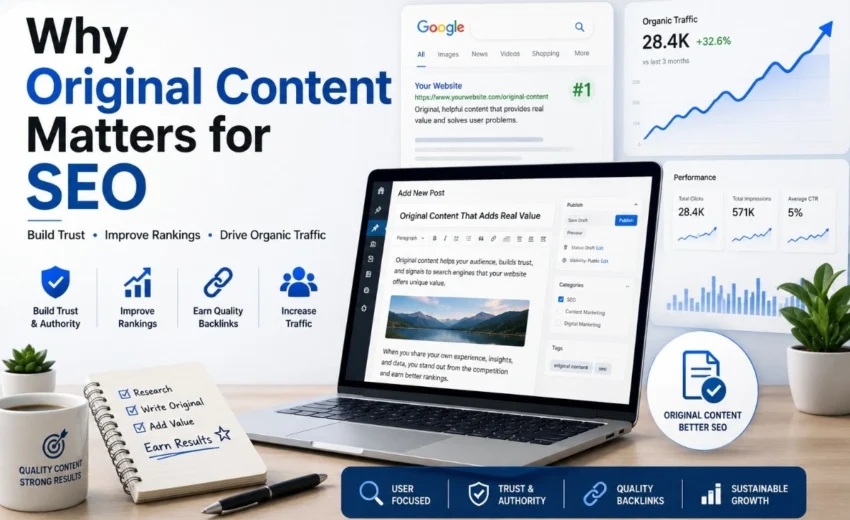
Whether you run a business website, a blog, or an online store, publishing original content helps you rank higher, build trust, attract backlinks, and become an authority in your field.
This guide explains why original content matters, how duplicate content and plagiarism can hurt your SEO, and practical ways to create content that offers real value.
What Is Original Content, Really?
Many people think original content means inventing a completely new idea that no one has ever talked about. That is almost impossible today. Most topics have already been covered online.
Instead, original content means offering something unique. This can include:
- Sharing your own experience
- Giving updated information or fresh statistics
- Using real examples from your work
- Offering your personal analysis
- Answering a question more clearly than others
For example, hundreds of websites have written about on‑page SEO. But a blog post that includes your real campaign results, lessons learned, and specific mistakes you made provides far more value than a generic article that repeats common knowledge.
Why Original Content Helps Your SEO
Google wants to rank content that meets users’ needs and helps them solve problems. Original content helps Google achieve that goal.
When your content provides unique value, you can expect:
- Better search visibility
- More organic traffic
- Natural backlinks from other sites
- Higher user engagement (people stay longer on your pages)
- Stronger trust in your brand
To understand what users are actually searching for, you can use tools like Google Search Console. This helps you align your original content with real search behaviour.
Over time, websites that consistently publish original and useful content become trusted resources in their industry. That is when rankings become stable and grow.
How Duplicate Content Affects Your Rankings
Duplicate content happens when identical or very similar content appears on more than one web page. This can occur on your own site (for example, printer‑friendly versions or similar category pages) or across different websites.
A common myth is that Google will penalize you for duplicate content. That is usually not true. Google does not penalize for most duplicate content. Instead, it applies a filter.
Here is what actually happens: Google has to choose which version of the content to show in search results. It may ignore the other versions. As a result, your rankings and traffic can suffer, not because of a punishment, but because Google is confused about which page is the best one to display.
Duplicate content can also split your backlinks. If ten different URLs have the same content, incoming links may be spread across all of them, giving none of them enough strength to rank well. Learning about Keyword Cannibalization in SEO can help you avoid similar issues on your own site.
Plagiarism vs. Duplicate Content
People often confuse plagiarism with duplicate content. They are related but different.
Duplicate content is usually accidental. It happens when the same content appears in multiple places, often on your own website.
Plagiarism is when you take someone else’s work, ideas, or writing and present them as your own without giving credit. This is intentional and unethical.
Plagiarism can lead to serious consequences. Beyond damaging your reputation, the original author can file a DMCA takedown request. Google will then remove your page from search results entirely. That is much worse than any algorithm issue.
Even if you avoid legal trouble, plagiarism destroys trust. Readers and other website owners will not link to or recommend a site that steals content.
Why AI Content Makes Originality More Important
AI writing tools have changed how content is created. They can help you generate ideas, create outlines, and write first drafts faster. That is fine.
However, AI‑generated content often has clear limits. Many AI articles repeat the same information found on dozens of other sites. They lack personal experience, miss important context, and sound generic.
Google has made it clear that it values people‑first content. AI can help you work faster, but human expertise and real‑world experience should guide the final content. The strongest articles combine AI‑assisted research with your own examples, insights, and fact‑checking.
What Google Looks For: Experience, Expertise, Trust
Google uses a framework called EEAT. It stands for Experience, Expertise, Authoritativeness, and Trustworthiness. These are not direct ranking factors, but they represent the qualities that Google’s algorithms try to recognize.
- Experience means the author has actually done or tested what they write about.
- Expertise means the content shows deep knowledge of the subject.
- Authoritativeness means other trusted sites see you as a reliable source.
- Trustworthiness means your information is accurate and transparent.
The easiest way to improve these signals is to write from your own experience. Instead of saying “backlinks help SEO,” say “after getting backlinks from three industry sites, our traffic increased by 40% in two months.” That small change makes your content more original and more valuable.
How to Create Original Content That Performs Well
You do not need to reinvent the wheel. You just need to add real value. Here are practical steps.
1. Research multiple sources
Do not rely on one article. Read several trusted sources and look for gaps. What questions are still unanswered? What practical advice is missing? Fill those gaps.
2. Add your personal experience
This is your strongest advantage. Share what you have learned, what worked, and what failed. Real observations cannot be copied by AI or by competitors.
3. Use your own examples
Many articles recycle the same examples over and over. Create your own, even if they are small. An example from your own blog, client work, or daily life is automatically original.
4. Update old content
You do not always need to create something new. Refreshing an old post with updated facts, new insights, and better examples can improve your rankings faster than starting from scratch. A good practice is to Refresh Old Blog Posts for SEO regularly.
5. Focus on solving real problems
Before you publish, ask yourself: Does this content genuinely help someone solve a problem? If yes, you are on the right track. If the content exists only to target a keyword, it will struggle to rank.
A Simple Checklist Before You Publish
Before you hit the publish button, run through these questions:
- Does this article add something new that is not already on the first page of Google?
- Have I included my own experience or original examples?
- Are my facts and statistics accurate and up to date?
- Have I properly credited any sources I quoted?
- Does this content fully answer what the user is looking for?
If you answer yes to most of these, your content is likely original enough to perform well.
How to Avoid Plagiarism
Avoiding plagiarism is simple if you follow a few rules.
- Always write in your own words. Do not copy and paste from another source.
- If you want to quote someone, use quotation marks and clearly state where the quote came from.
- When you mention statistics or research, link back to the source.
- Before publishing, run your content through a plagiarism checker. Free tools like Duplichecker or small paid tools like Grammarly can catch accidental matches.
Taking five minutes to check your work can save you from reputation damage and search removals.
Common Mistakes to Avoid
Copying competitors – It is fine to research what they are doing. It is not fine to copy their sentences or structure.
Publishing raw AI content – Always edit, fact‑check, and add your own experience to any AI draft.
Ignoring what users actually want – Make sure your content matches the search intent. An article that is well written but does not answer the user’s question will not rank.
Focusing on word count – Longer is not better. Useful is better.
Forgetting to update old posts – Even great content becomes outdated. Schedule a review every six months.
Final Thoughts
Original content is one of the smartest long‑term investments you can make for SEO. Technical fixes and backlinks are important, but they cannot rescue content that offers nothing new or simply repeats what already exists.
The websites that consistently rank well, earn backlinks, and build trust are usually the ones that contribute something unique. That could be your experience, your research, your examples, or your honest insights.
Stop asking, “How can I publish more content?”
Start asking, “How can I create more valuable content?”
That small shift in thinking is what separates average websites from true industry leaders.