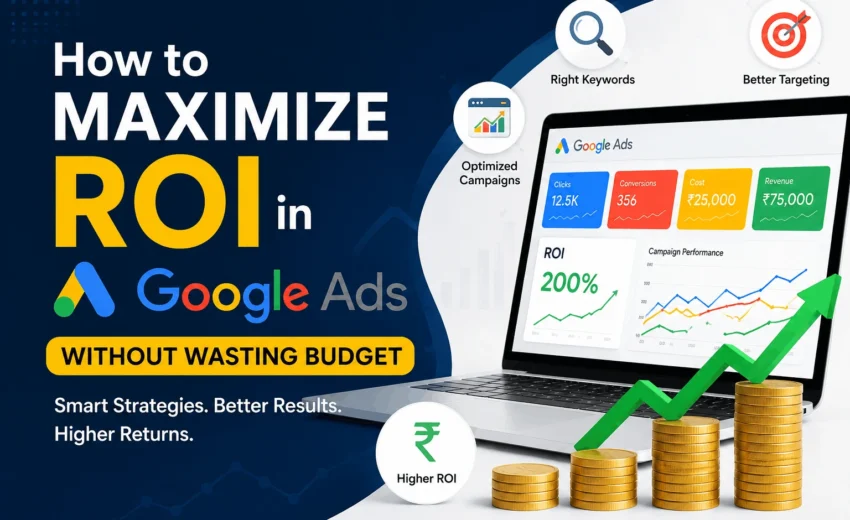
Running a Google Ads campaign isn’t just about how much you spend. Throwing more money at ads doesn’t automatically bring better results. The real goal is to get stronger returns from every rupee you invest.
Many campaigns fail not because the budget is too small, but because of poor targeting, weak optimization, or inefficient spending. Maximizing ROI requires a clear strategy and regular optimization.
This guide explains practical, straightforward ways to improve ROI in Google Ads and get better long‑term performance.
What Is ROI in Google Ads?
ROI stands for Return on Investment. It measures how much profit you earn compared to what you spent.
The formula is:
ROI = (Revenue – Cost) ÷ Cost × 100
For example, if you spend ₹10,000 on Google Ads and generate ₹30,000 in revenue, your ROI is 200%. That means you earned back double your investment.
A positive ROI means your campaigns are creating real business value, not just clicks or traffic.
ROI and ROAS: What’s the Difference?
ROAS (Return on Ad Spend) is often confused with ROI, but they’re different.
- ROAS focuses only on ad spend. It tells you how much revenue each rupee of ad money brings.
- ROI looks at the full picture. It includes other costs like product costs, shipping, software tools, and even your time managing the campaigns.
A campaign can look great on ROAS but still have a weak ROI if your other costs are high. Always track both, but make decisions based on ROI.
Why Google Ads Campaigns Often Have Low ROI
Low ROI doesn’t always mean you need a bigger budget. In most cases, the real issues are in the setup and daily management.
Common reasons include:
- Targeting that’s too broad
- Broken or missing conversion tracking
- Attracting irrelevant traffic
- Poor landing pages that don’t convert
- Getting low‑quality leads
- Not using negative keywords
- Unclear campaign goals
Find these problems early, and you’ll stop wasting money fast.
Practical Ways to Maximize ROI
1. Set Clear, Specific Goals
Before you touch any settings, decide what success looks like. Examples:
- Generate 50 sales per week
- Get 20 phone calls a day
- Collect 100 form submissions a month
Clear goals help you measure what matters. Don’t run a campaign to “get more traffic.”
2. Focus on Search Intent, Not Just Keywords
Not every keyword is equal. Someone searching “buy leather boots online” is ready to buy. Someone searching “best boots for winter” is still looking around.
Choose keywords that match what your business actually sells. Use these free tools:
- Google Keyword Planner
- Google Trends
They help you find high‑intent searches. You’ll get better traffic and spend less money.
3. Use Negative Keywords Every Week
Negative keywords stop your ads from showing on searches that aren’t relevant. For example, if you sell new laptops, add “used”, “broken”, “repair”, and “free” as negative keywords.
Check your search terms report weekly. Add anything that clearly doesn’t fit. This is one of the fastest ways to cut wasted spending.
4. Improve Ad Relevance
Your ad copy needs to match what people are looking for. If someone searches “emergency plumber near me,” don’t write an ad that says “plumbing services.” Write “24/7 emergency plumber – call now.”
Strong ads usually have:
- A headline that matches the search
- Clear benefits (not just features)
- A direct call‑to‑action
- A landing page that says the same thing
Greater relevance means higher-quality clicks and more conversions.
5. Optimize Your Landing Pages
You can write the perfect ad, but if your landing page is slow or confusing, people will leave. A strong landing page experience plays an important role in improving conversions and overall campaign ROI. You can also read our guide on how to improve landing page conversion rates to learn practical ways to turn more visitors into customers.
Check these areas:
- Loading speed – under 3 seconds is ideal
- Mobile usability – most clicks come from phones
- Content relevance – the page headline should match the ad headline
- Form design – ask only for what you really need
- Call‑to‑action placement – make it obvious and easy
Your landing page is where the sale happens. Don’t send traffic to your homepage unless it’s directly related.
6. Use Google Ads Assets (Formerly Extensions)
Assets add extra information to your ads at no additional cost. They make your ad bigger and give people more reasons to click. If you’re new to Assets, read our Google Ads Assets guide to understand the different types and how they improve campaign performance.
Useful assets include:
- Sitelinks (links to specific pages)
- Call assets (click to call)
- Lead form assets (fill out a form without leaving Google)
- Callout assets (free shipping, 24/7 support)
- Image assets (show your product)
Assets don’t cost extra, but they improve click‑through rates and often lower your cost per click.
7. Monitor Conversion Tracking Closely
You can’t improve what you don’t measure. Make sure Google Ads is tracking the actions that matter: purchases, phone calls, form submissions, chat starts, etc.
Test your tracking regularly. One broken tag can make you think a campaign is failing when it’s actually working – or worse, make you think it’s working when it’s losing money.
Common Mistakes That Hurt ROI
Many advertisers make the same mistakes without realizing it.
Mistake | Why It’s a Problem |
Increasing the budget without checking performance | You just waste more money faster |
Ignoring search term reports | You keep paying for useless clicks |
Sending traffic to a weak landing page | Good ads can’t save a bad page |
Never reviewing campaign performance | Small issues grow into big losses |
Relying entirely on automation | Automated bidding needs good data – without it, you overpay |
Avoid these, and you’ll protect your ROI from gradual erosion
Frequently Asked Questions
What is a good Google Ads ROI?
There’s no universal number. It depends on your industry, profit margins, and business goals. A 200% ROI (earning ₹2 profit for every ₹1 invested) is often a solid benchmark, but some businesses need 400% to stay profitable.
How long does it take to improve ROI?
Usually, 4–6 weeks of consistent data collection. Google’s algorithms need enough conversions to optimize properly. Avoid making big changes every few days.
Can a campaign have high ROAS but low ROI?
Yes. ROAS only looks at ad spend. If your product costs, shipping, or other expenses are high, you can still lose money despite a strong ROAS. Always track ROI for the full picture.
Should I use automated bidding to improve ROI?
Automated bidding can help, but it usually performs better when campaigns have enough conversion data. Without sufficient data, manual bidding often works better.
Final Thoughts
Maximizing ROI in Google Ads isn’t about spending more. It’s about spending smarter. Strong returns come from better targeting, cleaner campaign structure, improved landing pages, and regular optimization.
Don’t obsess over clicks. Focus on attracting the right users and measuring real outcomes. Over time, small, consistent improvements will create much stronger returns.
Alfik P S
hi