When running Facebook and Instagram advertising campaigns, reaching the right audience is important. But reaching the same people repeatedly also affects how your ads perform.
Some people may need to see an ad several times before taking action. Others may lose interest if they see the same creative too frequently. Finding the right balance can help businesses manage their advertising budget and maintain campaign performance.
This is where Meta Ads frequency becomes an important metric.
In this guide, we will explain what frequency means, how to understand it in Meta Ads Manager, how often people should see your ads, and when you may need to make changes.
What Is Frequency in Meta Ads?
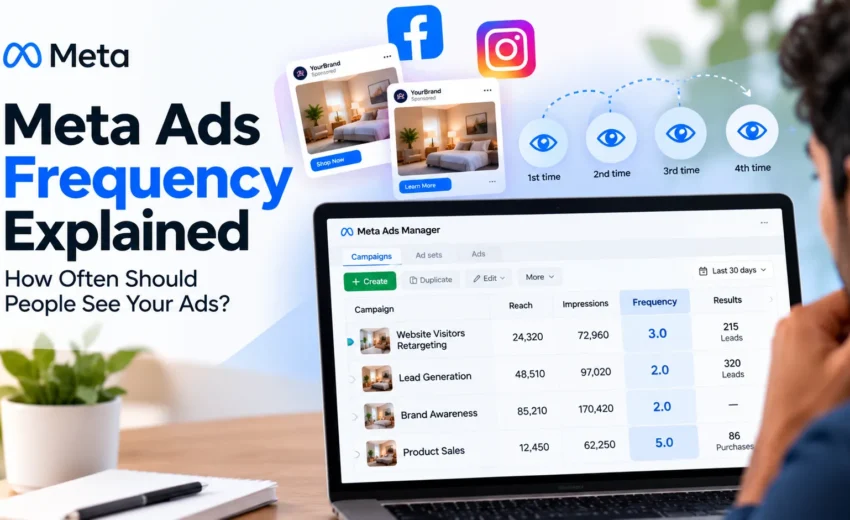
Frequency is the average number of times each person reached by your campaign has seen your ad during a selected reporting period.
For example, if your ad reaches 1,000 people and generates 3,000 impressions, the average frequency is 3.
This means each person reached saw the ad an average of three times. It does not mean every person saw it exactly three times.
Frequency is useful because it helps advertisers understand how often their ads are being delivered to the same audience.
How Is Meta Ads Frequency Calculated?
Frequency is calculated by dividing total impressions by total reach.
Formula:
Frequency = Impressions ÷ Reach
- Reach: The number of unique people who saw your ad.
- Impressions: The total number of times your ad was displayed.
For example, suppose a campaign records 12,000 impressions and reaches 4,000 people.
Frequency = 12,000 ÷ 4,000 = 3
The average frequency is 3, meaning the ad was displayed three times per person reached on average.
You can check this metric in Meta Ads Manager by viewing the relevant campaign, ad set, or ad and selecting the appropriate reporting period.
How Often Should People See Your Meta Ads?
There is no single frequency that works for every campaign. The right level depends on your campaign objective, audience size, budget, creative quality, and how long your campaign runs.
1. Awareness Campaigns
Awareness campaigns aim to introduce your business, product, or service to an audience.
Showing an ad more than once can help people become familiar with your brand. However, repeatedly showing the same creative without adding value may lead to diminishing returns.
Focus on reach, frequency, brand awareness indicators, and the overall cost of reaching your target audience.
2. Lead Generation Campaigns
Lead generation campaigns aim to encourage people to submit enquiries or contact your business.
Some potential customers may need multiple exposures before they are ready to enquire. However, increasing frequency does not automatically improve lead quality or generate more conversions.
Monitor cost per lead, lead quality, conversion rate, and frequency together to understand whether repeated exposure is helping.
3. Retargeting Campaigns
Retargeting campaigns target people who have previously interacted with your business, such as website visitors or social media engagers.
These audiences are often smaller than broad prospecting audiences, so frequency can increase more quickly.
Repeated exposure may help remind people about your offer, but excessive repetition can create ad fatigue. Review frequency alongside conversions, cost per result, and audience size.
4. Sales Campaigns
Sales campaigns focus on generating purchases or other valuable conversion actions.
The number of times people need to see an ad depends on the product, buying process, price, and audience behaviour.
Rather than aiming for a particular frequency, evaluate whether the campaign is generating profitable sales and whether performance changes as frequency increases.
What Is a Good Frequency for Meta Ads?
A frequency of 2 or 3 is not automatically good or bad. It simply describes how often your ad was shown on average to people reached.
For one campaign, a frequency of 4 may be reasonable if conversions remain strong. For another, a frequency of 2 may already be accompanied by declining engagement and rising costs.
Instead of following a fixed benchmark, compare frequency with your campaign’s objective and historical performance.
Pay attention to these questions:
- Is the cost per result increasing?
- Are click-through rates declining?
- Are conversions remaining stable?
- Is the audience relatively small?
- Has the same creative been running for a long time?
The answers help you decide whether the current frequency is appropriate.
Signs That Your Meta Ads Frequency May Be Too High
A high frequency does not automatically mean your campaign is underperforming. However, certain changes can indicate that your audience is seeing the same ad too often.
Declining Click-Through Rate
If fewer people click your ad over time, the creative may be becoming less interesting to the audience. Other factors, such as changes in audience quality or competition, can also affect click-through rate.
Increasing Cost Per Result
If your cost per lead or purchase continues to rise while frequency increases, investigate whether repeated exposure is contributing to weaker performance.
Do not assume frequency is the only cause. Review the campaign’s audience, creative, offer, and conversion experience as well.
Falling Engagement
A decline in meaningful engagement can suggest that the audience is becoming less responsive to your message.
Compare results over consistent periods before deciding whether the change is significant.
Ad Fatigue
Ad fatigue occurs when an audience becomes less responsive to an ad after repeated exposure.
It can appear through declining engagement, lower click-through rates, or increasing costs. Refreshing your creative or adjusting your audience strategy may help when the data supports that decision.
How to Reduce High Frequency in Meta Ads
If your frequency is increasing and campaign performance is weakening, consider the following adjustments.
1. Refresh Your Ad Creatives
Introduce new images, videos, headlines, or messaging. Keep the offer relevant while presenting it differently.
Creative changes can help renew interest without requiring you to rebuild the entire campaign.
2. Review Your Audience Size
A small audience combined with a large budget can lead to repeated delivery to the same people.
Check whether your targeting is unnecessarily restrictive. Expanding the audience may help when a larger audience is relevant to your business goals.
3. Review Your Budget
If the audience is limited, spending too quickly can increase repeated exposure without generating additional valuable results.
Consider adjusting the budget based on performance and audience size rather than reducing it automatically whenever frequency rises.
4. Exclude People Who Have Already Converted
For campaigns designed to acquire new customers, consider excluding recent leads or purchasers when appropriate.
This can reduce unnecessary exposure to people who have already completed your desired action. For retention or repeat-purchase campaigns, those people may still be valuable audiences.
5. Test Different Messages
Different people respond to different benefits and messages. Testing creative variations can help you discover which approaches continue to attract attention and drive results.
Make changes based on performance data rather than changing multiple elements without a clear reason.
How to Monitor Frequency in Meta Ads Manager
Regular monitoring helps you understand whether your campaigns are maintaining performance.
- Open Meta Ads Manager.
- Select the campaign, ad set, or ad you want to review.
- Choose the reporting period you want to analyse.
- Customise the columns if necessary and include Reach, Impressions, Frequency, CTR, and Cost per Result.
- Compare frequency with performance over time.
Reviewing these metrics together is more useful than looking at frequency alone.
For example, if frequency increases but conversions remain strong and cost per result stays acceptable, there may be no reason to make immediate changes.
If frequency increases while engagement declines and costs rise, investigate the creative, audience, and campaign setup.
Common Mistakes When Analysing Meta Ads Frequency
Advertisers can misinterpret frequency when they treat it as a standalone measure of campaign success.
Avoid these common mistakes:
- Assuming a high frequency always means poor performance.
- Treating a low frequency as proof that an ad is performing well.
- Comparing campaigns with different objectives without considering their differences.
- Changing campaigns based on short reporting periods or limited data.
- Ignoring conversion quality and focusing only on impressions or clicks.
Frequency should be used alongside other performance metrics to support better decisions.
Final Thoughts
Meta Ads frequency helps advertisers understand how often their ads are shown to the people they reach. It can provide useful signals about audience exposure, creative fatigue, and the need to review campaign performance.
However, there is no universal frequency target that guarantees better results. The appropriate level depends on your audience, campaign objective, budget, and offer.
Monitor frequency alongside cost per result, click-through rate, conversions, and lead quality. If performance remains strong, repeated exposure may be useful. If results begin to decline, review your creatives, audience, and budget before making changes.
The goal is not to show your ads fewer or more times. It is to reach the right people with the right message while maintaining effective campaign performance.

October 21, 2026