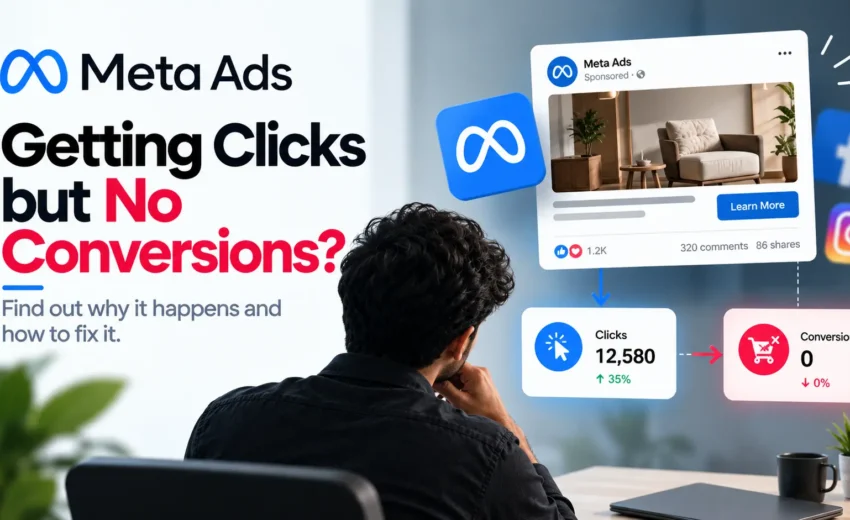
Getting clicks on your Meta ad can feel like a good sign.
People see your ad, are interested enough to click, and traffic comes to your website or landing page.
But then you check your results and notice something is missing: conversions.
This is a common problem with Meta Ads. A campaign can generate plenty of clicks without producing enough leads, purchases, bookings, or enquiries.
Don’t assume the ad itself is always the problem. A conversion depends on the entire journey from the moment someone sees the ad to the moment they take action.
Clicks and Conversions Are Not the Same
A click simply means someone interacted with your advertisement.
A conversion happens when that person completes the action you actually want, such as submitting a form, making a purchase, sending a WhatsApp enquiry, booking a service, or signing up.
Someone can click an ad out of curiosity without having any real intention to buy.
This is why a campaign with a high number of clicks can still produce disappointing business results.
Your Ad May Be Reaching the Wrong People
One possible reason for low conversions is that your ad is reaching people who are interested in the topic but are not your actual customers.
For example, an advertisement may attract people who are curious about a product but have no intention of purchasing it.
Audience selection matters, but Meta Ads targeting is not simply about choosing as many interests as possible. Your audience, creative, message, offer, and campaign objective all work together.
If the people clicking your ad don’t match your business, you may get cheap traffic without meaningful results.
Your Ad and Landing Page May Not Match
Imagine an advertisement promising a specific service or offer.
A person clicks the ad and arrives on a page that talks about something completely different.
The visitor now has to figure out what to do next.
This creates friction.
Your ad should set a clear expectation, and the landing page should continue that same message. The offer, headline, visuals, and call to action should feel connected rather than like separate experiences.
When there is a strong match between the ad and the destination page, visitors are more likely to understand what they are being offered.
Your Landing Page Could Be the Problem
Sometimes the ad is doing its job, but the website is not converting the traffic.
A landing page may have a weak call to action, too much unnecessary information, a confusing layout, or a form that asks for too many details.
Mobile experience is particularly important because a large amount of social media traffic comes from mobile devices.
If the page loads slowly or is difficult to use on a phone, some visitors may leave before taking action.
Before changing your Meta campaign, check what happens after the click.
Your Offer May Not Be Strong Enough
Even a well-targeted audience may not convert if the offer does not give them a clear reason to take action.
People need to understand what they are getting and why it is worth their time or money.
Your offer could involve a product, service, discount, consultation, booking, free trial, or another type of value.
The important part is clarity.
If someone has to work too hard to understand the benefit, they may simply leave the page.
Your Campaign Objective Matters
Meta provides different campaign objectives designed around different business outcomes.
A campaign designed to generate traffic is not necessarily optimized in the same way as a campaign designed to generate leads or sales.
This is important because you should choose the campaign objective based on the action you actually want people to take.
If your goal is to generate enquiries, focusing only on getting the cheapest clicks may not give you the best business result.
The campaign should be built around the outcome that matters to your business.
Your Conversion Tracking May Not Be Working Properly
Another possibility is that people are converting, but your tracking is not recording those conversions correctly.
Meta Ads relies on event data and other measurement systems to understand what happens after someone interacts with an ad.
Depending on your setup, this can involve the Meta Pixel, Conversions API, or other conversion tracking methods.
If an important event is missing, incorrectly configured, or not firing as expected, your reports may not accurately represent what is happening.
Before making major campaign changes, make sure your conversion tracking is working correctly.
Not Everyone Converts on the First Visit
A person who clicks your ad today may not be ready to take action immediately.
They may compare prices, visit other websites, think about the offer, or simply leave and return later.
This is where retargeting can become useful.
Instead of treating every visitor as a lost customer, businesses can create campaigns for people who have already interacted with their website, content, or previous advertisements, depending on the available audience and tracking setup.
The goal is to reconnect with people who have already shown some level of interest.
Don't Judge the Campaign by CTR Alone
Click-through rate, or CTR, can tell you how often people click after seeing your ad.
But CTR does not tell you whether those people became customers.
When analyzing a Meta Ads campaign, look at the complete journey.
Important metrics can include:
Impressions
Reach
CTR
CPC
Landing page views
Leads
Purchases
Conversion rate
Cost per lead
Cost per conversion
A campaign with a lower CTR can sometimes produce more valuable customers than a campaign with a very high CTR.
The final business outcome matters more than one individual metric.
How to Find Where the Problem Is
Instead of immediately changing everything, look at each stage of the customer journey.
If your ad receives very few clicks, review the creative, message, audience, and offer.
If people click but do not properly engage with the landing page, examine the page speed, mobile experience, messaging, and page structure.
If people reach the page and show interest but rarely convert, look closely at the offer, trust signals, call to action, and conversion process.
And if conversions are happening but Meta is not reporting them correctly, investigate your tracking setup.
This approach makes it easier to identify the actual problem.
What Should You Change First?
Avoid changing five things at the same time.
Start with the biggest weakness you can identify from your data.
If the problem is the creative, test a different message or visual.
If the audience appears unsuitable, review your targeting and campaign structure.
If the landing page is weak, improve the page before increasing your advertising budget.
If tracking is inaccurate, fix the measurement system first.
Small, controlled changes make it easier to understand what is actually improving performance.
The Bigger Picture
Meta Ads are not simply about getting people to click.
A successful campaign needs to connect several parts of the customer journey:
Ad → Click → Landing Page → Offer → Action
If one part of that journey is weak, the campaign may generate traffic without generating enough conversions.
So when your Meta Ads are getting clicks but not conversions, don’t immediately conclude that the advertising campaign has failed.
Look at what happens before and after the click.
The real question is not:
“Why aren’t people clicking?”
It is:
“What is stopping interested people from taking the next step?”
Once you identify that point, you can make more informed changes to your Meta Ads strategy and focus your budget on generating results that matter to the business.