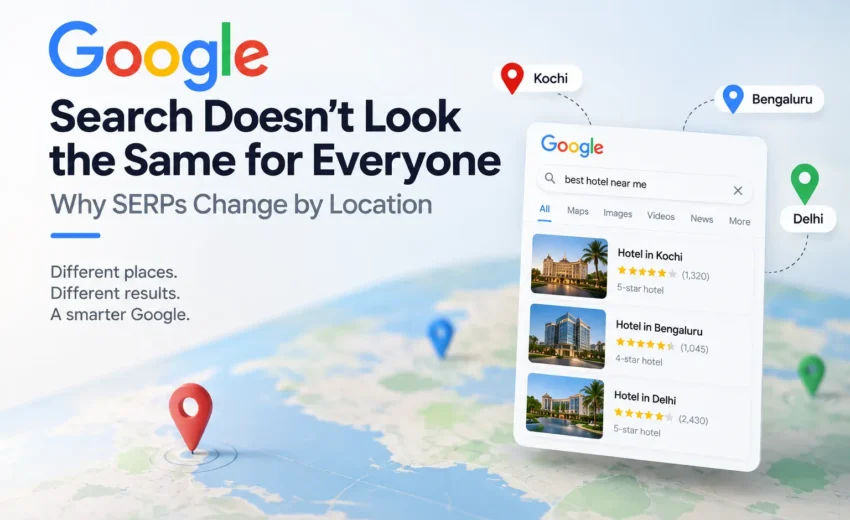
Have you ever searched for something on Google and noticed that your friend gets different results for the same search?
You might search for “best hotel near me” and see one set of websites, while someone in another city sees completely different businesses and pages. Even two people sitting in the same city can sometimes see slightly different search results.
This is because Google does not always show the same Search Engine Results Page (SERP) to everyone. The results can change based on several factors, and location is one of the most important ones.
For businesses that depend on Google search traffic, understanding this difference is important. A website may rank well for a keyword in one location but appear much lower in another.
What Is a SERP?
SERP stands for Search Engine Results Page. It is the page Google displays after you enter a search query.
A SERP can include traditional organic results, Google Maps or local business listings, featured snippets, images, videos, shopping results, and other search features.
What appears on that page depends on what Google believes will be most useful for the particular searcher.
That means there isn’t always one fixed ranking position for every keyword.
Why Does Location Change Google Search Results?
Google tries to understand where a search is coming from so it can provide results that are relevant to that area.
Imagine someone searches for “laundry service”.
A person searching from Kochi is likely looking for laundry businesses that serve Kochi. Showing a laundry company several hundred kilometres away would not be very useful.
So Google can use the searcher’s location to adjust the results.
This is especially noticeable for searches related to businesses, services, restaurants, hotels, shops, healthcare, travel, and other location-dependent queries.
Google Can Use More Than Just Your City
Location-based search is not always as simple as Google knowing which city you are in.
Depending on the situation, Google may have signals that indicate a more specific area, such as your approximate location, the location associated with your device, or location information included in the search itself.
For these searches, Google may show businesses that are geographically relevant to the searcher rather than simply showing the websites with the highest overall authority.
This is one reason why local businesses need to think beyond traditional organic rankings.
Organic Rankings Can Also Vary
Location doesn’t only affect Google Maps and local business listings.
Organic search results can also vary depending on where the search is performed.
A website targeting customers in Kerala, for example, may have stronger visibility for certain searches when the search is performed from Kerala than when the same search is performed from another region.
This does not necessarily mean that the website has changed its ranking.
Instead, Google may be adjusting the results it displays based on the context of the search.
Why You May See a Different Ranking From Your Client
This creates a common situation for SEO professionals.
You check a keyword and see that a client’s website is ranking on the first page. Then the client searches for the same keyword and says:
“I can’t find my website.”
Both people may be telling the truth.
The difference could come from location, search history, device, language, personalization, or other search signals.
This is why checking rankings manually from one computer is not always enough to understand how a website performs across an entire target market.
Location and “Near Me” Searches
“Near me” searches are a particularly clear example of location-based SERPs.
When someone searches for “hotel near me”, Google doesn’t simply look for pages containing the words “hotel near me.”
It tries to understand which hotels are actually relevant to the searcher’s location.
The same search performed in Kochi and Thiruvananthapuram can therefore produce very different results.
For businesses, this means that appearing for a location-based search is not just about adding the location name to a webpage. Google considers several signals when determining which businesses and pages are relevant.
Does a Different SERP Mean Google Is Changing the Ranking?
Not necessarily.
It is important to distinguish between ranking variation and a genuine change in a website’s overall search performance.
If you see a website at position 5 and someone else sees it at position 12, that does not automatically mean the website has lost rankings.
You may simply be looking at different versions of the SERP.
This is one reason SEO reporting should focus on reliable, consistent data rather than occasional manual searches.
How SEO Professionals Check Location-Based Rankings
SEO tools can help marketers understand how a website performs in different locations.
Instead of checking a keyword only from the marketer’s own computer, SEO professionals can use tools that allow them to specify a target country, city, or other location.
This provides a more useful picture of how a website is performing for its intended audience.
For example, if a business serves customers in Kochi, checking rankings from a completely different city may not accurately represent what its potential customers are seeing.
The important question is not simply:
“What position is my website in?”
It is:
“What position is my website getting for the audience and location I actually want to reach?”
What This Means for Businesses
Businesses should understand that Google visibility is not always universal.
A business might perform strongly in its target area but have limited visibility outside that area. For a local business, this may actually be appropriate because its customers are concentrated in a specific geographic market.
Instead of trying to rank everywhere, the SEO strategy should focus on reaching the locations where the business actually operates and wants customers.
This can involve creating useful location-relevant content, maintaining accurate business information, improving the website’s overall SEO, and building authority and relevance for the target market.
Why Checking Google Manually Can Be Misleading
Searching your own keywords every day can give you a quick idea of visibility, but it should not be treated as a complete SEO measurement.
Your search results can be influenced by your location and other search signals. Your results may therefore not exactly match what a potential customer sees.
For a more reliable assessment, use consistent tracking methods and compare performance over time.
This is especially important when reporting SEO results to clients. A single manual Google search should not be used as the only evidence of ranking performance.
The Bigger Picture
Google’s goal is not simply to show the same ten blue links to everyone.
Search has become much more contextual. Google tries to understand the query, searcher’s location, intent, device, and other available signals to provide results that it believes are relevant.
That is why two people can search for exactly the same phrase and still see different SERPs.
For SEO professionals and business owners, the key lesson is simple: ranking is not always a single fixed number.
Your visibility depends partly on who is searching, where they are searching from, and what Google understands about their search intent.
So the next time someone says, “I searched the keyword, but your website isn’t ranking there,” don’t immediately assume that the SEO has failed.
First, check where the search was performed, what type of SERP was displayed, and whether you are comparing the same search conditions.
Understanding this difference can make SEO reporting more accurate and help businesses build strategies around the customers they actually want to reach.