If you run Facebook or Instagram ads, you have likely spent a lot of time building detailed audiences. Interests, behaviors, demographics, lookalikes. In the past, that was the main way to improve results.
In 2026, that approach alone is no longer enough for consistent success.
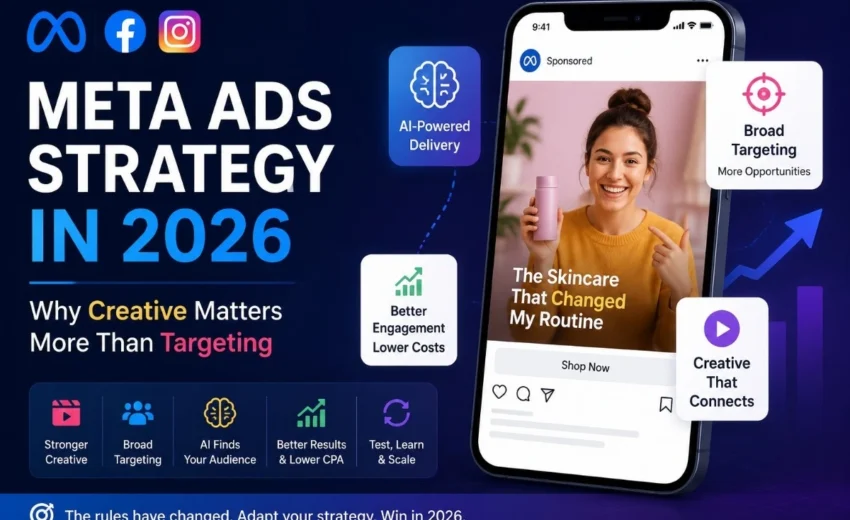
The biggest factor that determines ad performance now is your creative – the video, image, text, and hook you show to users. This article explains why and how to adjust your strategy.
What Changed in Meta Ads?
Meta now uses artificial intelligence (AI) to deliver ads. The AI does not just follow your targeting settings. It watches how people react to your ad.
The AI tracks:
Whether someone watches the first 3 seconds of your video
How much of your video do they watch
If they like, share, save, or comment
If they click through to your website
What they do after clicking (bounce, view pages, purchase)
When your creative gets positive reactions, the AI shows your ad to more people who behave like those engaged users. This often works better than manual targeting alone.
That is why many advertisers now say, “Creative is the new targeting.”
What "Creative" Means in This Context
Creative includes:
The video or image
The first few seconds (hook)
Text overlay on the video
The caption
The call-to-action button
If your creative is weak, people scroll past quickly. The AI learns this and stops showing your ad. If your creative is strong, people engage. The AI finds more customers for you automatically.
Why Hyper-Detailed Targeting Is Less Effective (But Still Useful)
A few years ago, advertisers built very narrow audiences. For example: women, age 25-40, who like yoga, organic food, and hiking.
Today, that approach can limit Meta’s ability to find good customers. The AI cannot explore outside your narrow settings. It might miss audiences that actually convert well.
Many advertisers have seen better results by switching to broad targeting (just country or age range) combined with strong creative. The AI uses engagement signals from the creative to discover which users respond best.
However, targeting still matters significantly for:
Retargeting campaigns (people who already visited your site)
Local ads (radius targeting around a physical store)
Niche B2B products (e.g., software for specific industries)
High-ticket offers (where buyer qualification is critical)
Regulated industries (healthcare, finance, etc.)
For standard prospecting campaigns, broad targeting plus good creative usually wins. But targeting is not dead. It just plays a different role.
What Meta's AI Actually Uses
Signal
Why It Matters
First 3 seconds of video
Tells the AI if your ad stops the scroll. Critical for ad delivery.
Total watch time
Longer watch time signals quality. Leads to cheaper reach.
Saves and shares
Strong positive signals. The AI prioritizes these ads.
Click-through rate
Shows immediate interest in your offer.
Post-click behavior (bounce, purchase)
Most important for conversion campaigns. Feeds the pixel.
The AI does not understand your story or emotion. It only measures responses. So your job is to create content that gets good responses.
Simple Rules for Creatives That Work
You do not need expensive production. Follow these guidelines.
1. Hook in the first 3 seconds
Start with a question, a surprising statement, or a clear problem. Example: “This saved me two hours every day.” Do not start with a logo or slow fade-in.
2. Consider UGC-style content, but know your industry
In many direct-to-consumer campaigns, UGC-style ads (smartphone video, natural lighting, real customers) often outperform overly polished corporate creatives. However, this is not universal. Luxury brands, high-end services, and certain B2B offers may perform better with professional production. Test both.
3. Video length depends on your audience
For many cold-audience campaigns, shorter videos (under 45 seconds) often perform better because attention spans are short. However, some long-form ads (2-3 minutes) work extremely well for complex products, tutorials, or storytelling. The right length depends on your offer and audience. Test different lengths.
A Realistic Testing Process
You do not need a complex system. Follow these steps.
Step 1: Create 3 to 5 different video ads. Use different hooks, different people, different opening lines.
Step 2: Set your campaign to broad targeting for prospecting. Select only a country and maybe an age range. Save detailed targeting for retargeting or niche use cases.
Step 3: Run the campaign long enough to gather meaningful data. For small budgets (
50/day),allow5−7days.Forlargerbudgets(
50/day),allow5−7days.For larger budgets (500+/day), 2-3 days may be enough. The key is to collect sufficient conversion volume (at least 50 conversions per week per ad set) before making decisions.
Step 4: Identify the best-performing ad based on cost per result. Pause the underperformers. Create more ads similar to the winner.
Repeat this process weekly. Creative fatigue happens faster than before.
Landing Pages and Other Factors Still Matter
Your creative gets the click. But several other elements determine overall success:
Creative quality has become one of the biggest performance drivers. But it works together with these other factors.
If people click your ad and leave the page immediately, the AI receives a negative signal. Your ads will become more expensive over time.
Check these three things on your landing page:
Load time under 3 seconds (test on mobile)
Headline matches the promise of your ad
Easy to complete the desired action (buy, sign up, call)
Fix these before scaling any campaign.
When to Still Use Detailed Targeting
Do not abandon targeting. It still serves specific purposes.
Use detailed targeting for:
Retargeting – Show different ads to people who visited your site or added to cart.
Local businesses – Use radius targeting around your physical location.
Niche B2B – Example: software for dental clinics or accounting firms.
High-ticket items – $5,000+ purchases often require tighter qualification.
Regulated industries – Where compliance requires audience restrictions.
For standard prospecting campaigns (e-commerce, leads, lower-priced products), broad targeting plus strong creative is a good starting point.
Common Mistakes to Avoid
Running the same creative for weeks. Performance will drop because people see it too many times.
Using overly narrow audiences for prospecting. The AI cannot explore and find hidden customer groups.
Ignoring the first 3 seconds of the video. This is where most scroll-past happens.
Assuming one creative style works for all industries. Test UGC vs. polished production.
Making changes too early. Allow enough time and budget for the algorithm to gather meaningful data.
Your 2026 Meta Ads Checklist
Before launching your next campaign, review this list:
The first 3 seconds of the video grab attention
Video style matches your industry (test UGC vs. polished)
Video length tested (short vs. long depending on offer)
Captions added (many users watch without sound)
Audience set too broad for prospecting (detailed targeting saved for retargeting/niche)
Landing page loads fast and matches the ad
You have the budget and the patience to collect meaningful data
If most boxes are checked, you have a strong chance of success.
Summary
Meta Ads in 2026 work differently from a few years ago. AI-powered delivery has reduced the importance of manual targeting for many campaigns. Creative quality has become one of the biggest performance drivers.
But targeting is not dead. It still matters for retargeting, local, B2B, high-ticket, and regulated industries. And performance still depends on offer, landing page, pricing, pixel data, and other factors.
Focus on creating ads that stop the scroll, hold attention, and feel appropriate for your audience. Test multiple versions every week. Keep your landing page experience smooth. Use broad targeting for finding new customers when appropriate.
The best targeting strategy in 2026 is not one extreme or the other. It is a balanced approach where creative leads, but targeting supports where needed.