Digital advertising has always struggled with one fundamental question:
“Did this ad actually cause the result… or would it have happened anyway?”
This concept is called incrementality, and while advanced experiments like Conversion Lift exist, most advertisers still rely on everyday tools like Ads Manager and analytics dashboards to make decisions.
Now, Meta is rolling out a major update to attribution that aims to bring more clarity, reduce confusion, and help advertisers make smarter decisions.
Let’s break down what’s changing—and why it matters.
The Problem: Confusing and Misaligned Data
For years, there has been a disconnect between Meta Ads Manager and third-party analytics tools like Google Analytics.
Here’s why:
Meta historically counted all types of interactions as “clicks,” including:
- Link clicks (visiting your website)
- Likes
- Shares
- Saves
Meanwhile, tools like Google Analytics only track:
- Actual website visits (link clicks)
The Result?
- Meta shows higher conversions
- Google Analytics shows lower numbers
- Advertisers are left confused about what’s real
The Big Shift: Cleaner Click-Through Attribution
Meta is now simplifying its measurement system.
What’s Changing?
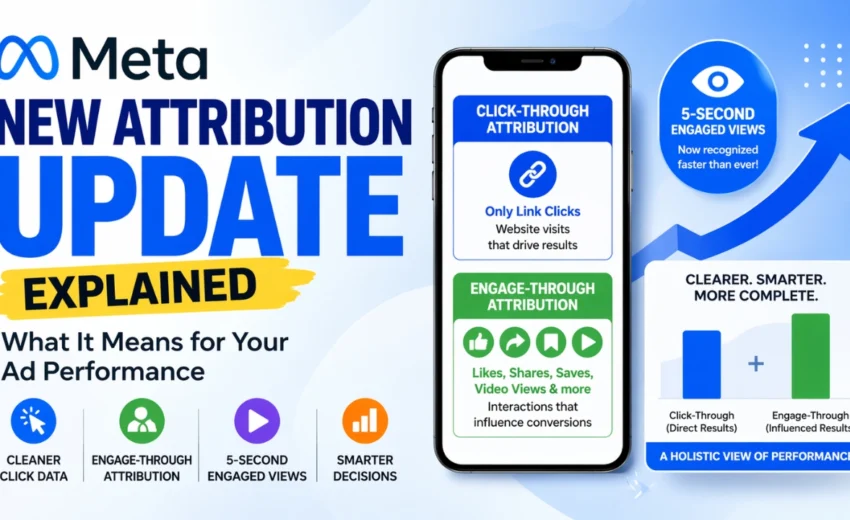
👉 Click-through attribution will now ONLY include link clicks
This means:
- Only users who click and visit your website will be counted under click-based conversions
- Likes, shares, and saves are no longer included in this category
Why This Matters
- Better alignment with third-party tools
- More accurate understanding of website performance
- Increased confidence in your ad spend decisions
This is a big step toward making Meta’s reporting more transparent and easier to trust.
Introducing “Engage-Through Attribution”
So what happens to all the other interactions?
Meta isn’t ignoring them—it’s just categorizing them differently.
New Category: Engage-Through Attribution
This includes conversions influenced by:
- Likes
- Shares
- Saves
- Video views
These are high-intent social signals that don’t always result in immediate clicks—but still influence buying decisions.
Why This Is Important
Social media doesn’t work like search.
People often:
- Discover your brand
- Engage with your content
- Come back later to convert
This new category helps you measure that delayed impact.
A Major Update for Video Ads
Consumer behavior is changing—fast.
Meta reports that a large portion of conversions from Reels happen within the first few seconds of viewing.
What’s Changed?
- “Engaged view” threshold reduced from 10 seconds → 5 seconds
What This Means for Advertisers
- Faster engagement is now recognized
- Short-form content becomes even more powerful
- Early attention matters more than ever
If you’re running video ads, especially Reels, this is a strong signal to:
- Hook attention in the first 3–5 seconds
- Optimize creatives for quick impact
The Bigger Picture: A More Holistic View of Performance
Meta’s goal is simple:
👉 Give advertisers both clarity and completeness
You now get:
- Click-through attribution → Clear, comparable, website-driven results
- Engage-through attribution → The hidden influence of social interactions
Instead of mixing everything together, Meta is separating:
- Direct actions
- Indirect influence
This helps you understand not just what converted, but what influenced the conversion.
What This Means for You as an Advertiser
If you’re running Meta ads, here’s how to adapt:
1. Don’t panic if conversions drop
You might see lower click-based conversions—but that’s because reporting is now stricter and cleaner.
2. Start paying attention to engage-through data
This is where a lot of social media value actually lives.
3. Align your reporting systems
Meta and Google Analytics should now match more closely for click-based results.
4. Rethink creative strategy
Engagement (especially in the first few seconds) is now more important than ever.
Final Thoughts
This update is not just a technical change—it’s a shift in how we understand advertising impact. For a long time, advertisers relied too heavily on clicks alone. But the reality is that social media influences decisions long before the click happens.
With this update, Meta is finally acknowledging that reality—while also giving advertisers cleaner, more reliable data to support data-driven digital marketing strategies and make better campaign decisions.
And that’s a win.
If you’re a business owner or marketer trying to scale your ads, understanding this shift will give you a serious edge in making smarter, more confident decisions.
Welcome to the next phase of digital ad measurement.
Alfik P S
hi